Department of Electrocardiogram Diagnosis, Zhejiang Hospital, Hangzhou, Zhejiang 310013, P.R. China.
Department of Cardiovasology, Zhejiang Hospital, Hangzhou, Zhejiang 310013, P.R. China.
Mol Med Rep. 2018 Aug;18(2):1560-1570. doi: 10.3892/mmr.2018.9115. Epub 2018 May 31.
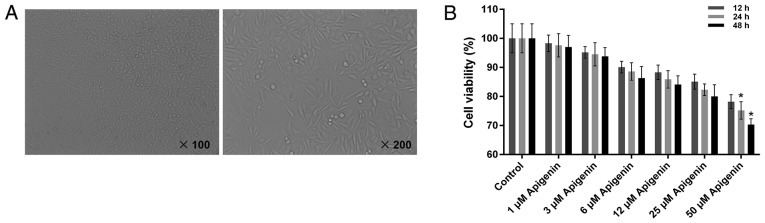
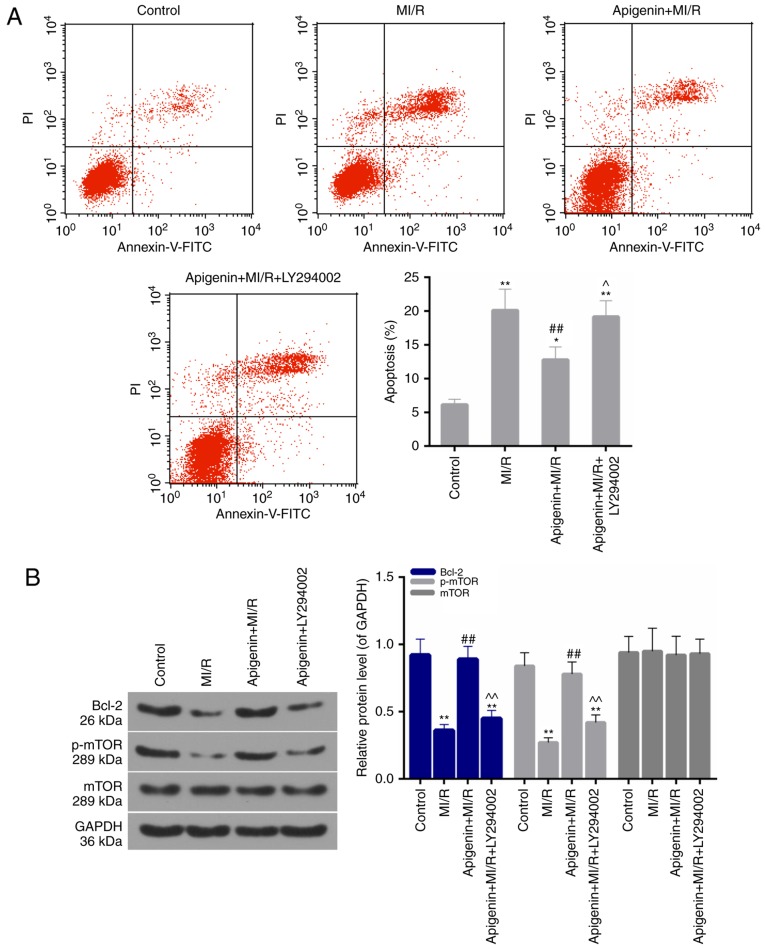
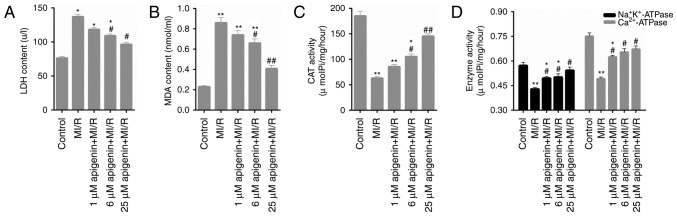
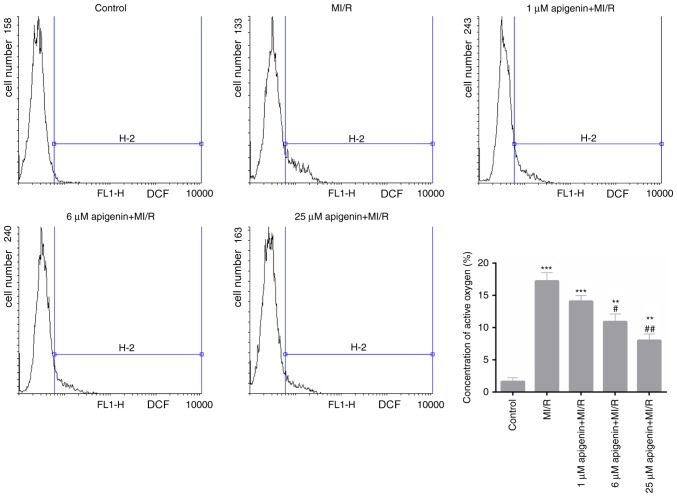
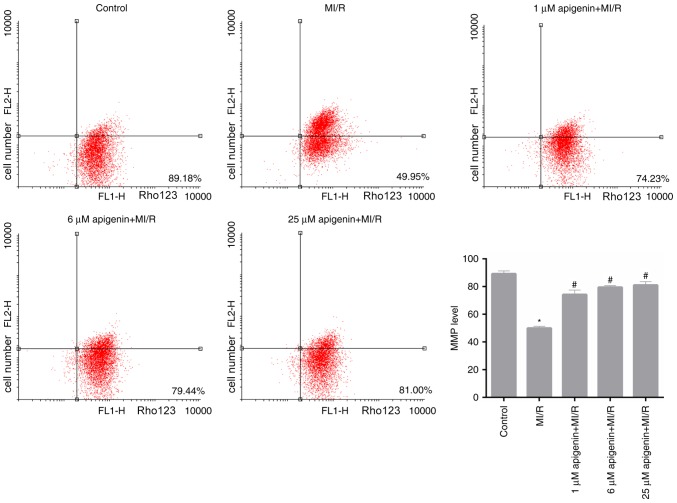
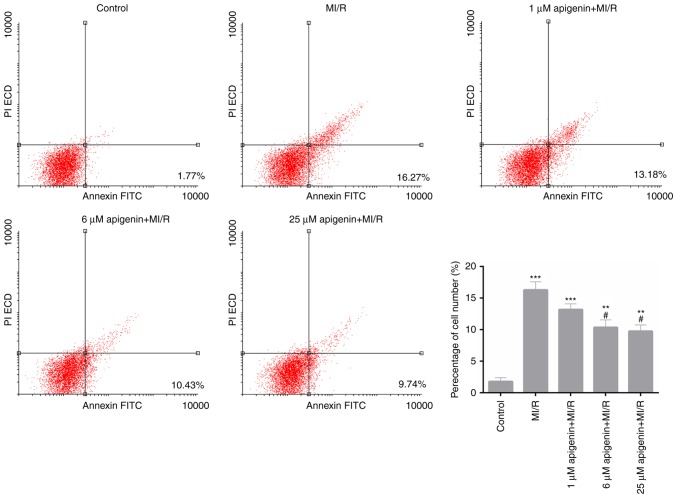
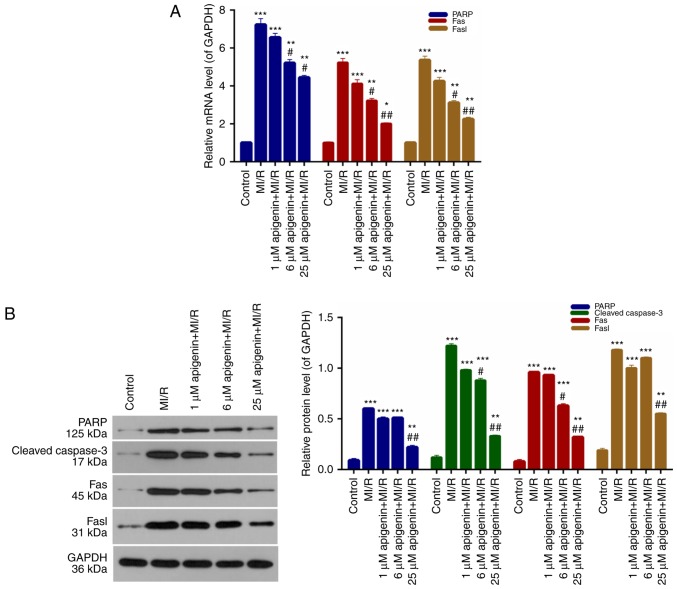
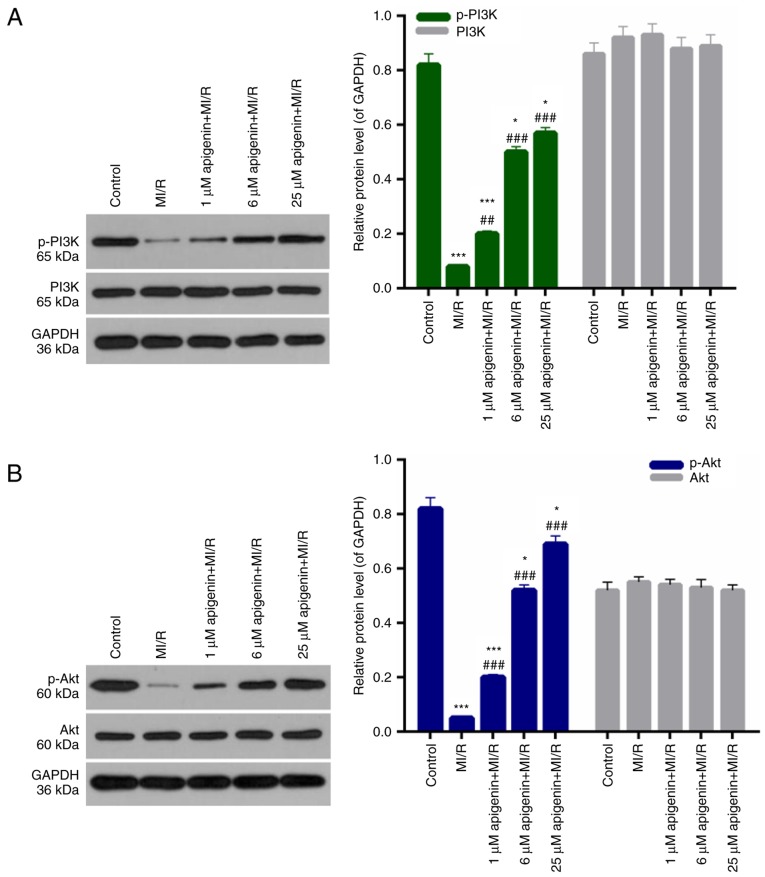
Apigenin, a flavonoid with multiple physiological and pharmacological activities, is associated with the prevention of cardiovascular diseases. The present study aimed to examine the roles and mechanisms of apigenin in the apoptosis of H9C2 rat cardiomyocytes, which were subjected to myocardial ischemia‑reperfusion (MI/R) injury. Cell viability, reactive oxygen species (ROS), mitochondrial membrane potential (MMP) and cellular apoptosis were evaluated using cell counting kit‑8 assays and flow cytometry. The content/activity of oxidative stress markers was determined using commercial kits. Western blot analysis and reverse transcription‑quantitative polymerase chain reaction assays were used to measure protein and mRNA expression, respectively. The results demonstrated that apigenin had limited cytotoxicity on the viability of H9C2 rat cardiomyocytes. Apigenin reduced the oxidative stress, ROS production and cellular apoptotic capacity of MI/R‑induced H9C2 cells. Apigenin additionally increased the MMP level of MI/R‑induced H9C2 cells. Furthermore, apigenin modulated apoptosis‑associated protein expression and phosphatidylinositol 3'-kinase (PI3K)/RAC‑α serine/threonine‑protein kinase (Akt) signaling in MI/R‑induced H9C2 cells. Treatment with LY294002 reversed the anti‑apoptotic effect of apigenin. In conclusion, apigenin suppressed the apoptosis of H9C2 cells that were subjected to MI/R injury by activating the PI3K/Akt pathway. It was suggested that apigenin may be effective as an MI/R therapy.
芹菜素是一种具有多种生理和药理活性的类黄酮,与预防心血管疾病有关。本研究旨在探讨芹菜素在心肌缺血再灌注(MI/R)损伤的 H9C2 大鼠心肌细胞凋亡中的作用和机制。使用细胞计数试剂盒-8 测定和流式细胞术评估细胞活力、活性氧(ROS)、线粒体膜电位(MMP)和细胞凋亡。使用商业试剂盒测定氧化应激标志物的含量/活性。Western blot 分析和逆转录-定量聚合酶链反应测定分别用于测量蛋白和 mRNA 表达。结果表明,芹菜素对 H9C2 大鼠心肌细胞活力的细胞毒性有限。芹菜素降低了 MI/R 诱导的 H9C2 细胞的氧化应激、ROS 产生和细胞凋亡能力。芹菜素还增加了 MI/R 诱导的 H9C2 细胞的 MMP 水平。此外,芹菜素调节了 MI/R 诱导的 H9C2 细胞中与细胞凋亡相关的蛋白表达和磷脂酰肌醇 3'-激酶(PI3K)/RAC-α 丝氨酸/苏氨酸-蛋白激酶(Akt)信号通路。用 LY294002 处理可逆转芹菜素的抗凋亡作用。结论:芹菜素通过激活 PI3K/Akt 通路抑制 MI/R 损伤的 H9C2 细胞凋亡,提示芹菜素可能是一种有效的 MI/R 治疗药物。