Department of Endocrinology, The First Affiliated Hospital of Sun Yat‑sen University, Guangzhou, Guangdong 510080, P.R. China.
Department of Breast and Thyroid Surgery, The First Affiliated Hospital of Sun Yat‑sen University, Guangzhou, Guangdong 510080, P.R. China.
Oncol Rep. 2018 Aug;40(2):659-668. doi: 10.3892/or.2018.6493. Epub 2018 Jun 14.
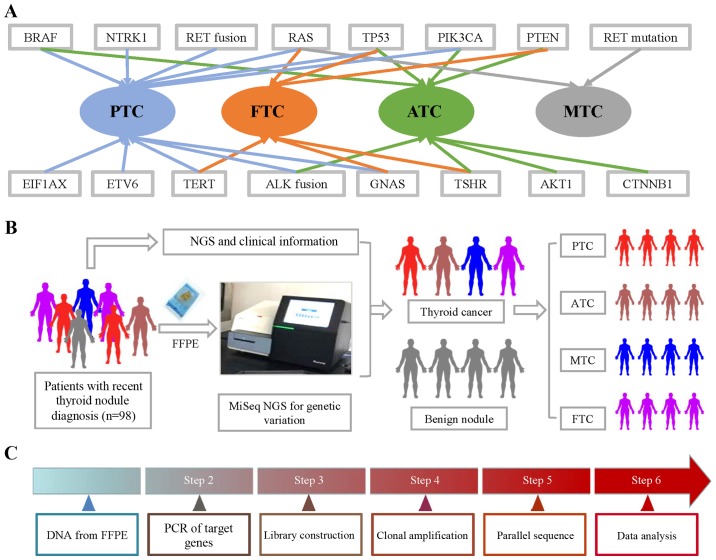
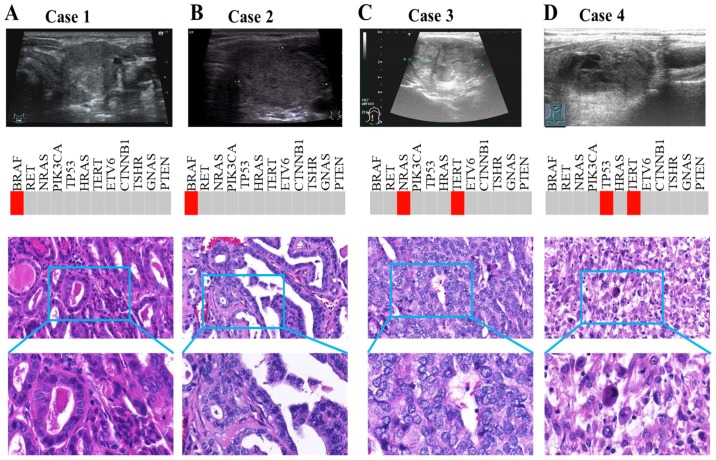
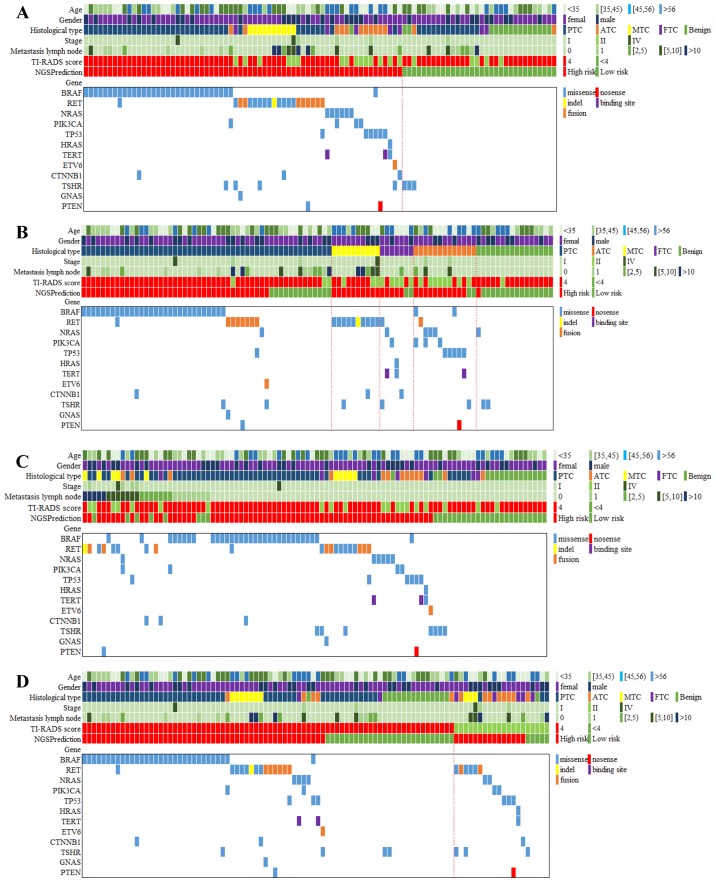
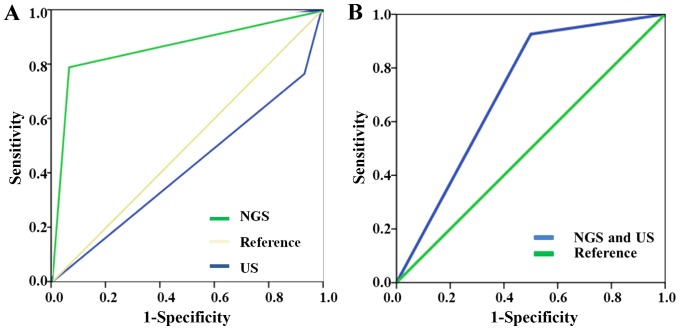
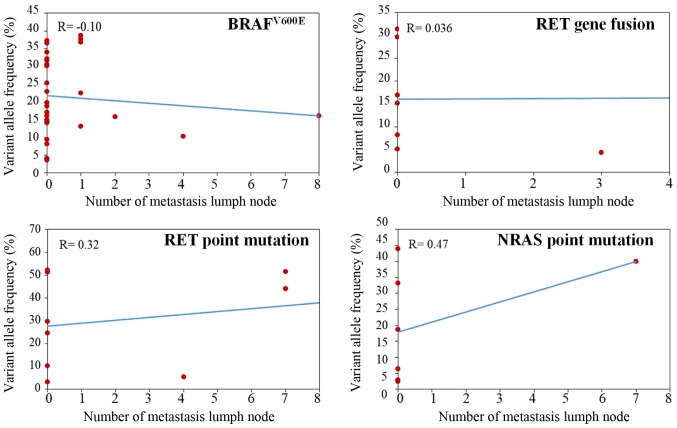
Differentiation of benign and malignant thyroid nodules is crucial for clinical management. Here, we explored the efficacy of next‑generation sequencing (NGS) in predicting the classification of benign and malignant thyroid nodules and lymph node metastasis status, and simultaneously compared the results with ultrasound (US). Thyroline was designed to detect 15 target gene mutations and 2 fusions in 98 formalin‑fixed, paraffin‑embedded (FFPE) tissues, including those from 82 thyroid cancer (TC) patients and 16 patients with benign nodules. BRAF mutations were found in 57.69% of the papillary thyroid cancer (PTC) cases, while RET mutations were detected among all the medullary thyroid cancer (MTC) cases. Multiple mutations were positive but none showed dominance in anaplastic thyroid cancer (ATC) and follicular thyroid cancer (FTC). The sensitivity and specificity of NGS prediction in differentiation of benign and malignant thyroid nodules were 79.27 and 93.75%, respectively, and the positive predictive value (PPV) and negative predictive value (NPV) were 98.48 and 46.88%, respectively. The sens-itivity and specificity of US were 76.83 and 6.25%, respectively, and the PPV and NPV were 80.77 and 5.00%, respectively. The area under curve (AUC) of NGS and US were 0.865 and 0.415, respectively. A total of 27 patients had ≥1 metastases to lymph nodes, 19 of which carried mutations, including BRAF, RET, NRAS, PIK3CA, TP53, CTNNB1 and PTEN. However, there was no correlation between the variant allele frequency of specific gene mutations and the number of metastatic lymph nodes. In conclusion, the prediction value of NGS was higher than the US‑based Thyroid Imaging Reporting and Data System (TI‑RADS). NGS is valuable for the accurate differentiation of benign and malignant thyroid nodules, and pathological subtypes in FFPE samples. The findings of the present study may pave the way for the application of NGS in analyzing fine‑needle aspiration (FNA) biopsy samples.
良性和恶性甲状腺结节的鉴别对于临床管理至关重要。在这里,我们探讨了下一代测序(NGS)在预测良性和恶性甲状腺结节以及淋巴结转移状态分类方面的疗效,并与超声(US)结果进行了比较。Thyroline 旨在检测 98 个福尔马林固定、石蜡包埋(FFPE)组织中的 15 个靶基因突变和 2 个融合,包括 82 例甲状腺癌(TC)患者和 16 例良性结节患者的组织。在甲状腺乳头状癌(PTC)病例中,发现 57.69%存在 BRAF 突变,而所有甲状腺髓样癌(MTC)病例均存在 RET 突变。在间变性甲状腺癌(ATC)和滤泡状甲状腺癌(FTC)中,多个突变呈阳性,但没有一个呈优势。NGS 在鉴别良性和恶性甲状腺结节中的灵敏度和特异性分别为 79.27%和 93.75%,阳性预测值(PPV)和阴性预测值(NPV)分别为 98.48%和 46.88%。US 的灵敏度和特异性分别为 76.83%和 6.25%,PPV 和 NPV 分别为 80.77%和 5.00%。NGS 和 US 的曲线下面积(AUC)分别为 0.865 和 0.415。共有 27 例患者有≥1 个淋巴结转移,其中 19 例携带突变,包括 BRAF、RET、NRAS、PIK3CA、TP53、CTNNB1 和 PTEN。然而,特定基因突变的变异等位基因频率与转移性淋巴结的数量之间没有相关性。总之,NGS 的预测价值高于基于超声的甲状腺成像报告和数据系统(TI-RADS)。NGS 对于准确鉴别 FFPE 样本中的良性和恶性甲状腺结节以及病理亚型具有重要价值。本研究的结果可能为 NGS 在分析细针抽吸(FNA)活检样本中的应用铺平道路。