Department of Animal Science, Universidade Federal de Viçosa, Viçosa, Minas Gerais, Brazil.
Department of Animal Science, Universidade do Estado de Santa Catarina, Chapecó, Santa Catarina, Brazil.
PLoS One. 2018 Jun 14;13(6):e0198963. doi: 10.1371/journal.pone.0198963. eCollection 2018.
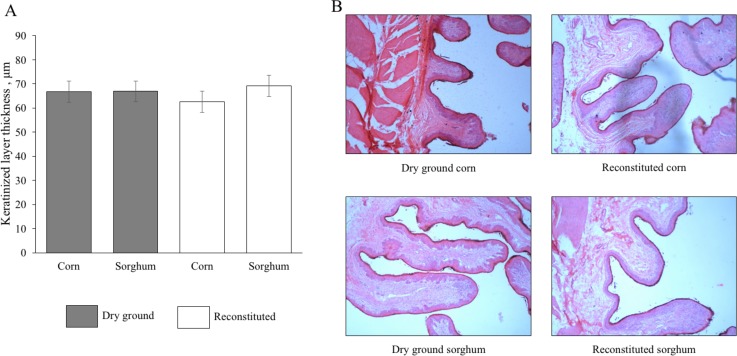
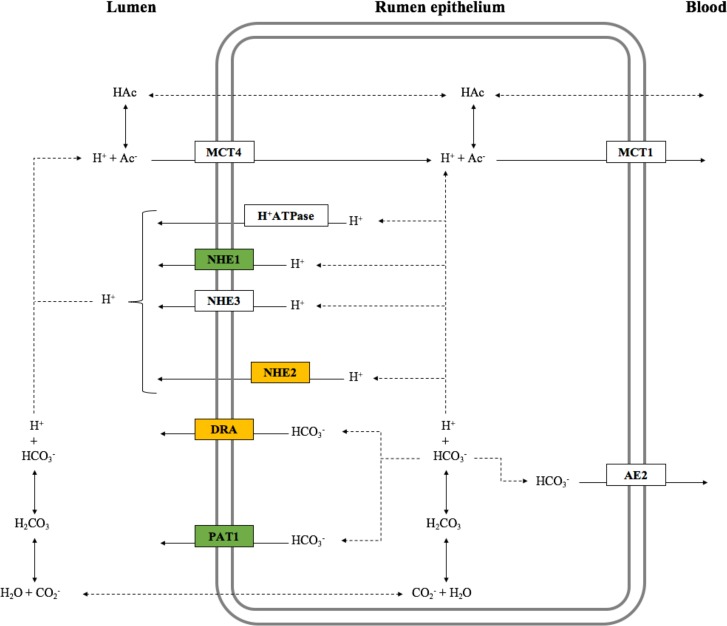
Two experiments were carried out to evaluate the effects of corn and sorghum with different processing methods on the expression of genes involved in volatile fatty acids transport and pH regulation, and ruminal keratinization in rumen epithelium of finishing bulls. For Exp. 1, five rumen cannulated Nellore bulls were used in a 5x5 Latin square arrangement, with 14 d for adaptation and 9 d for sample collection. Treatments were: dry ground corn, dry ground sorghum, reconstituted corn, reconstituted sorghum, and control (forage-based diet). Samples of rumen epithelium from ventral sac were excised, rinsed, snap-frozen and stored at -80°C until total RNA isolation and quantitative real-time PCR analysis. In the Exp. 2, 24 Nellore bulls were assigned to a completely randomized design lasting 168 d. Experimental treatments were similar to those at Exp. 1, but without the control treatment. After the experimental period, bulls were slaughtered and rumen epithelium samples were rapidly excised for further histological analysis. Rumen epithelial tissue from animals fed reconstituted corn had lower expression of downregulated-in-adenoma (P = 0.03) and Na+/H+ exchanger 2 (trend; P = 0.09). The expression of Na+/ H+ exchanger 1 (P = 0.10) and putative anion transporter (P = 0.06) tended to be lower in rumen epithelium of bulls fed reconstituted grains. Ruminal concentration of valerate was greater for animals fed reconstituted grain (P = 0.01). Likewise, animals fed reconstituted corn tended to have greater butyrate ruminal concentration (P = 0.08). Keratinized layer thickness did not differ among treatments (P > 0.10). Therefore, reconstituted grains (especially corn) decrease the mRNA expression of genes involved in volatile fatty acids transport and pH control in the rumen epithelium.
进行了两项实验,以评估不同加工方法的玉米和高粱对育肥公牛瘤胃上皮中与挥发性脂肪酸转运和 pH 调节相关的基因表达以及瘤胃角化的影响。实验 1 中,使用 5 头瘤胃有套管的内罗尔公牛进行 5x5 拉丁方排列,适应期为 14 天,采样期为 9 天。处理方法为:干磨玉米、干磨高粱、重组玉米、重组高粱和对照(基于饲料的饮食)。从腹囊切除瘤胃上皮样品,冲洗,冷冻并储存在-80°C,直到提取总 RNA 并进行定量实时 PCR 分析。在实验 2 中,24 头内罗尔公牛被分配到完全随机设计,持续 168 天。实验处理与实验 1 相似,但没有对照处理。实验期结束后,公牛被屠宰,迅速切除瘤胃上皮样品进行进一步的组织学分析。与喂食重组玉米的动物相比,重组玉米组动物的腺瘤下调(P = 0.03)和 Na+/H+交换器 2(趋势;P = 0.09)表达降低。Na+/H+交换器 1(P = 0.10)和假定阴离子转运蛋白(P = 0.06)的表达在喂食重组谷物的公牛瘤胃上皮中也较低。与喂食重组谷物的动物相比,瘤胃戊酸盐浓度较高(P = 0.01)。同样,喂食重组玉米的动物的瘤胃丁酸浓度也较高(P = 0.08)。角化层厚度在处理之间没有差异(P > 0.10)。因此,重组谷物(尤其是玉米)降低了瘤胃上皮中与挥发性脂肪酸转运和 pH 控制相关的基因的 mRNA 表达。