Mt. Sinai St. Luke's Roosevelt Hospital Center, New York, NY.
RWJ Barnabas Health/Jersey City Medical Center, Jersey City, NJ.
J Am Heart Assoc. 2018 Jun 15;7(12):e009294. doi: 10.1161/JAHA.118.009294.
Reducing readmission after catheter ablation (CA) in atrial fibrillation (AF) is important.
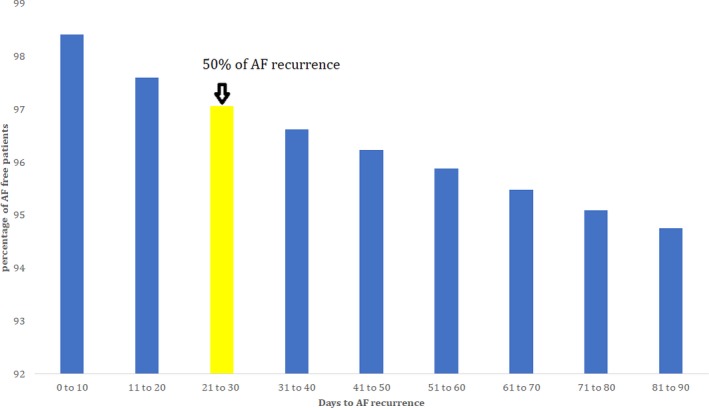
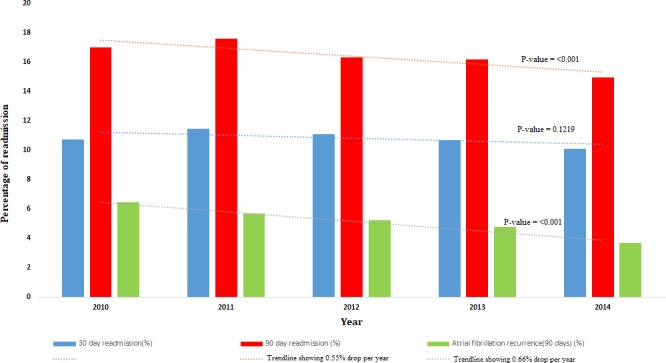
We utilized National Readmission Data (NRD) 2010-2014. AF was identified by diagnostic code 427.31 in the primary field, while first CA of AF was identified via -procedure code 37.34. Any admission within 30 or 90 days of index admission was considered a readmission. Cox proportional hazard regression was used to adjust for confounders. The primary outcomes were 30- and 90-day readmissions and the secondary outcome was AF recurrence. In total, 1 128 372 patients with AF were identified from January 1, 2010 to September 30, 2014. Of which 37 360 (3.3%) underwent CA. Patients aged ≥65 years and female sex were less likely to receive CA for AF. Overall, 10.9% and 16.5% of CA patients were readmitted within 30 and 90 days post-CA, respectively. Most common causes of readmissions were arrhythmia (AF, atrial flutter), heart failure, pulmonary causes (pneumonia, chronic obstructive pulmonary disease) and bleeding complications (gastrointestinal bleed, intracranial hemorrhage). Patients with diabetes mellitus, heart failure, coronary artery disease (CAD), chronic pulmonary and kidney disease, prior stroke/transient ischemic attack (TIA), female sex, length of stay ≥2 and disposition to the facility were prone to higher 30- and 90-day readmissions post-CA. Predictors of increase in AF recurrence post-CA were female sex, diabetes mellitus, chronic pulmonary disease, and length of stay ≥2. Trends of 90-day readmission and AF recurrence were found to improve over the study period.
We identified several demographic and clinical factors associated with the use of CA in AF, and short-term outcomes of the same, which could potentially help in the patient selection and improve outcomes.
降低房颤(AF)导管消融(CA)后的再入院率很重要。
我们利用了 2010-2014 年国家再入院数据库(NRD)。AF 通过主要字段的诊断代码 427.31 识别,而 AF 的首次 CA 通过程序代码 37.34 识别。索引入院后 30 或 90 天内的任何入院均被视为再入院。Cox 比例风险回归用于调整混杂因素。主要结局是 30 天和 90 天的再入院率,次要结局是 AF 复发。从 2010 年 1 月 1 日至 2014 年 9 月 30 日,共从 NRD 中确定了 1128372 例 AF 患者。其中 37360 例(3.3%)接受了 CA。年龄≥65 岁和女性患者接受 CA 治疗 AF 的可能性较低。总体而言,CA 患者中有 10.9%和 16.5%分别在 CA 后 30 天和 90 天内再入院。再入院的最常见原因是心律失常(AF、房性扑动)、心力衰竭、肺部原因(肺炎、慢性阻塞性肺疾病)和出血并发症(胃肠道出血、颅内出血)。患有糖尿病、心力衰竭、冠心病(CAD)、慢性肺部和肾脏疾病、既往中风/短暂性脑缺血发作(TIA)、女性、住院时间≥2 天和在机构中的处置方式的患者,CA 后 30 天和 90 天内再入院的风险更高。CA 后 AF 复发的预测因素包括女性、糖尿病、慢性肺部疾病和住院时间≥2 天。研究期间发现 90 天再入院率和 AF 复发率呈上升趋势。
我们确定了与 AF 中 CA 使用相关的一些人口统计学和临床因素,以及 CA 的短期结局,这可能有助于患者选择并改善结局。