Institute for Bioscience and Biotechnology Research, University of Maryland, Rockville, MD, USA.
Department of Horticulture and Crop Science, Ohio Agricultural Research and Development Center, The Ohio State University, Wooster, OH, USA.
J Exp Bot. 2018 Jun 27;69(15):3675-3688. doi: 10.1093/jxb/ery146.
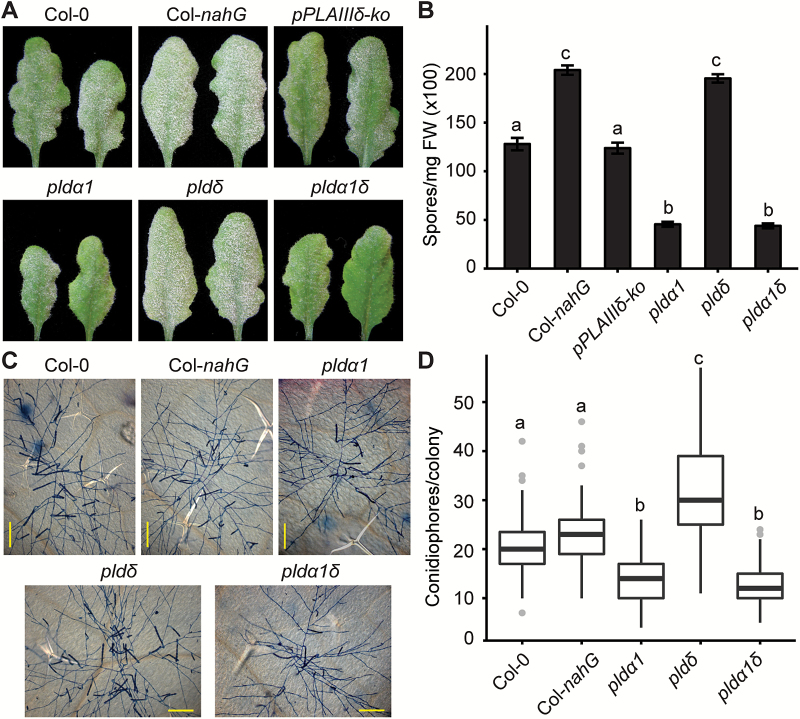
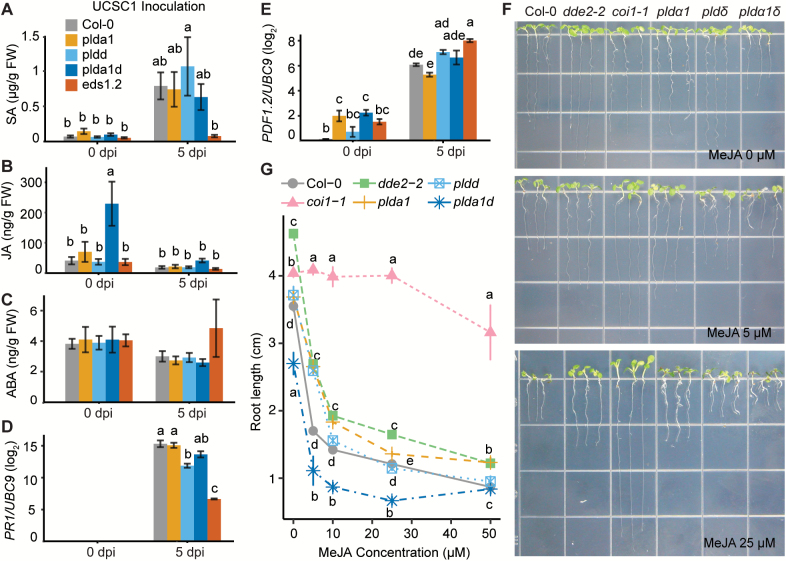
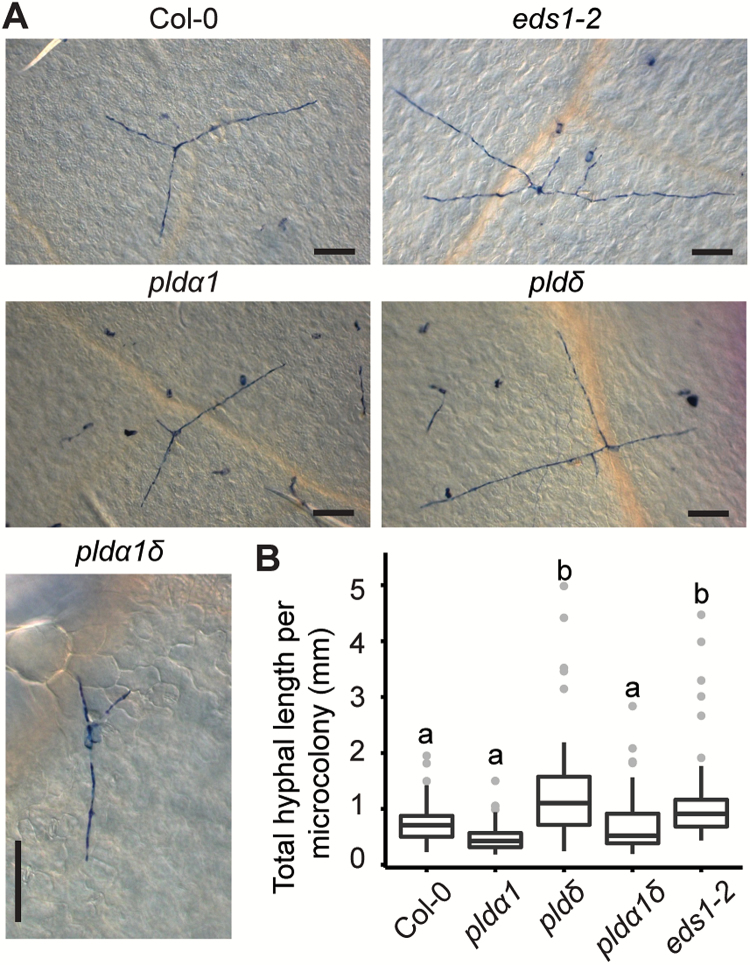
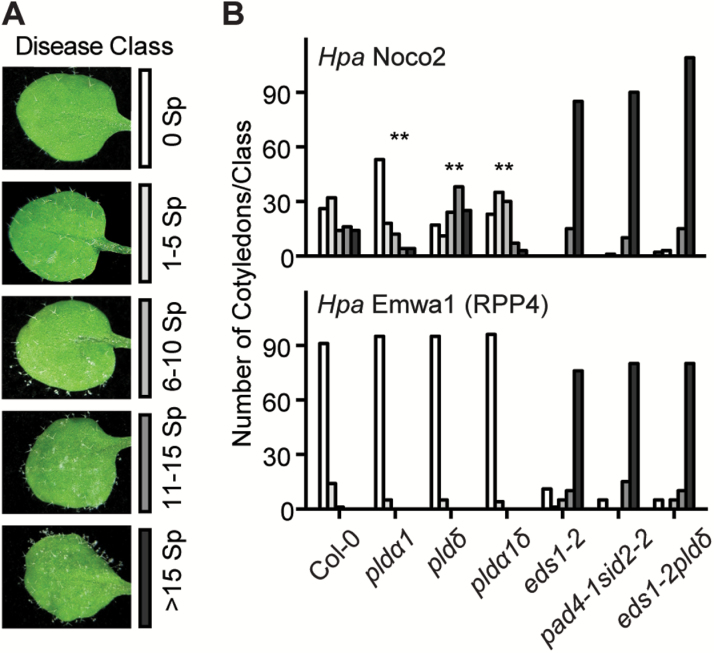
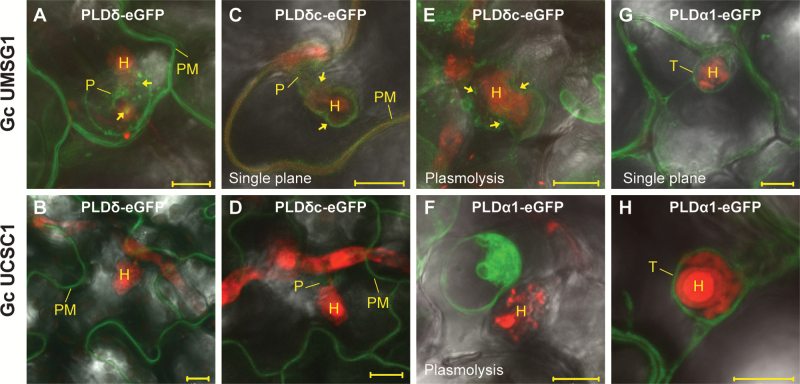
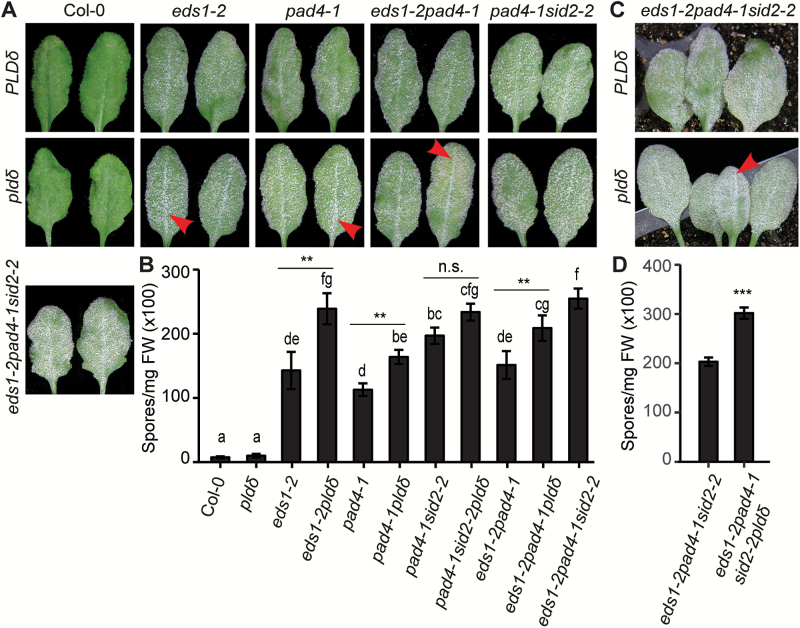
Plants use a tightly regulated immune system to fight off various pathogens. Phospholipase D (PLD) and its product, phosphatidic acid, have been shown to influence plant immunity; however, the underlying mechanisms remain unclear. Here, we show that the Arabidopsis mutants pldα1 and pldδ, respectively, exhibited enhanced resistance and enhanced susceptibility to both well-adapted and poorly adapted powdery mildew pathogens, and a virulent oomycete pathogen, indicating that PLDα1 negatively while PLDδ positively modulates post-penetration resistance. The pldα1δ double mutant showed a similar infection phenotype to pldα1, genetically placing PLDα1 downstream of PLDδ. Detailed genetic analyses of pldδ with mutations in genes for salicylic acid (SA) synthesis (SID2) and/or signaling (EDS1 and PAD4), measurement of SA and jasmonic acid (JA) levels, and expression of their respective reporter genes indicate that PLDδ contributes to basal resistance independent of EDS1/PAD4, SA, and JAsignaling. Interestingly, while PLDα1-enhanced green fluorescent protein (eGFP) was mainly found in the tonoplast before and after haustorium invasion, PLDδ-eGFP's focal accumulation to the plasma membrane around the fungal penetration site appeared to be suppressed by adapted powdery mildew. Together, our results demonstrate that PLDα1 and PLDδ oppositely modulate basal, post-penetration resistance against powdery mildew through a non-canonical mechanism that is independent of EDS1/PAD4, SA, and JA.
植物利用一套严密调控的免疫系统来抵御各种病原体。已证实磷脂酶 D(PLD)及其产物磷脂酸会影响植物的免疫;然而,其潜在机制尚不清楚。在这里,我们发现拟南芥突变体 pldα1 和 pldδ 分别对适应性强和适应性弱的白粉病病原体以及一种毒性卵菌病原体表现出增强的抗性和易感性,表明 PLDα1 负调控,而 PLDδ 正调控穿透后抗性。pldα1δ 双突变体表现出与 pldα1 相似的感染表型,在遗传上 PLDα1 位于 PLDδ 的下游。对 pldδ 进行基因敲除突变分析,突变的基因包括水杨酸(SA)合成(SID2)和/或信号转导(EDS1 和 PAD4),测量 SA 和茉莉酸(JA)的水平,并检测它们各自的报告基因的表达,结果表明 PLDδ 独立于 EDS1/PAD4、SA 和 JA 信号通路对基础抗性有贡献。有趣的是,虽然 PLDα1-增强型绿色荧光蛋白(eGFP)主要在吸器侵入前后位于液泡膜上,但 PLDδ-eGFP 在真菌穿透部位周围质膜的焦点积累似乎被适应性白粉病所抑制。总之,我们的研究结果表明,PLDα1 和 PLDδ 通过一种非经典机制,对适应性强和弱的白粉病病原体的基础抗性和穿透后抗性进行相反的调控,该机制独立于 EDS1/PAD4、SA 和 JA。