Department of Otolaryngology-Head and Neck Surgery, Medical University of South Carolina, Charleston, South Carolina.
Entellus Medical, Inc., Plymouth, Minnesota.
Otol Neurotol. 2018 Aug;39(7):894-902. doi: 10.1097/MAO.0000000000001853.
Compare Eustachian tube balloon dilation versus continued medical therapy (control) for treating persistent Eustachian tube dysfunction (ETD).
Prospective, multicenter, randomized controlled trial.
Tertiary care academic center and private practice.
Diagnosed with medically refractory persistent ETD.
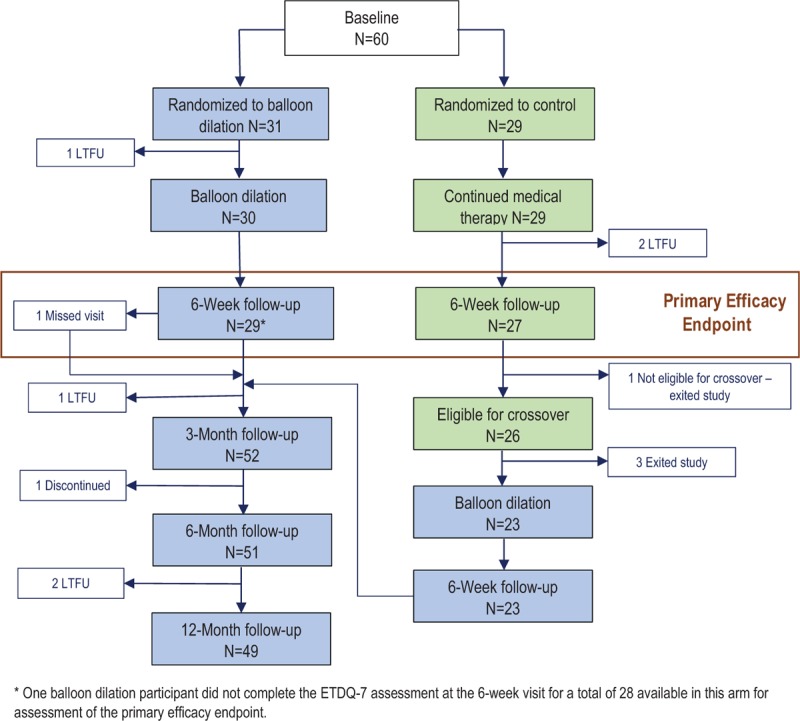
1:1 Randomization to balloon dilation or control. After 6 weeks, control participants had the option to undergo balloon dilation if symptoms persisted.
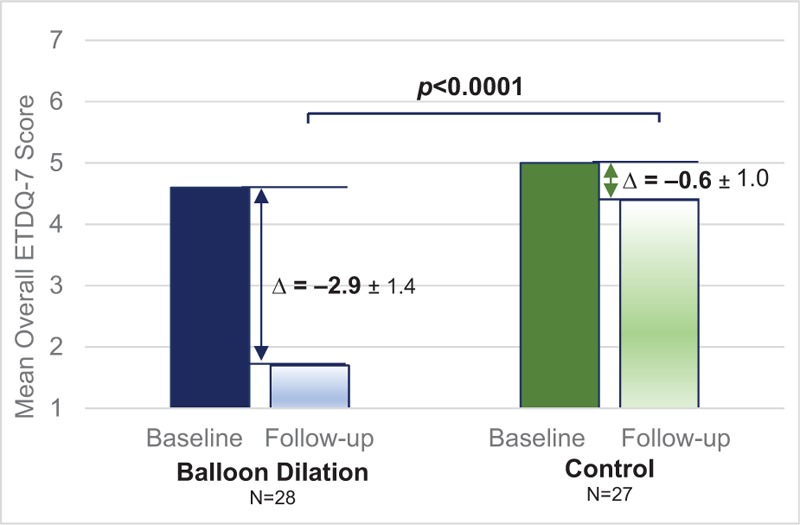
Primary efficacy endpoint was the comparison between treatment arms in the mean change from baseline in the 7-item Eustachian Tube Dysfunction Questionnaire (ETDQ-7) score. Primary safety endpoint was complication rate.
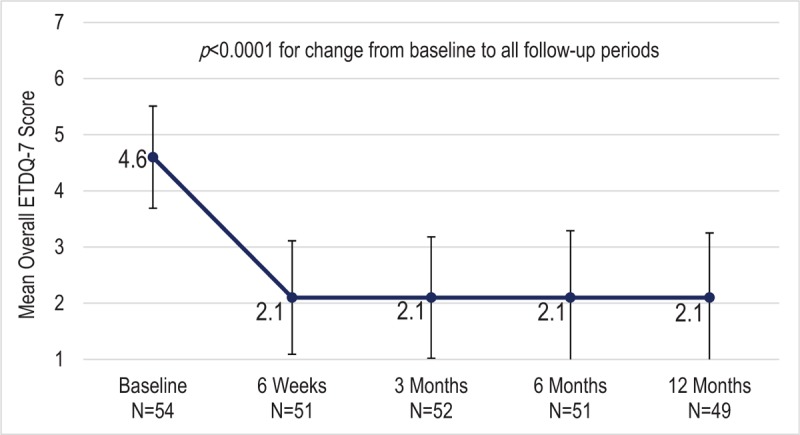
Sixty participants were randomized (31 balloon dilation, 29 control). Mean (SD) change in overall ETDQ-7 score at 6 weeks was -2.9 (1.4) for balloon dilation compared with -0.6 (1.0) for control: balloon dilation was superior to control (p < 0.0001). No complications were reported in either study arm. Among participants with abnormal baseline assessments, improvements in tympanogram type (p < 0.006) and tympanic membrane position (p < 0.001) were significantly better for balloon dilation than control. Technical success was 100% (91 successful dilations/91 attempts) and most procedures (72%) were completed in the office under local anesthesia. Improvements in the ETDQ-7 scores were maintained through 12 months after balloon dilation.
Balloon dilation is a safe and effective treatment for persistent ETD. Based on improved ETDQ-7 scores, balloon dilation is superior to continued medical management for persistent ETD. Symptom improvement is durable through a minimum of 12 months. Procedures are well tolerated in the office setting under local anesthesia.
比较咽鼓管球囊扩张与继续药物治疗(对照)治疗持续性咽鼓管功能障碍(ETD)。
前瞻性、多中心、随机对照试验。
三级保健学术中心和私人诊所。
诊断为医学上难治性持续性 ETD。
1:1 随机分为球囊扩张或对照。6 周后,如果症状持续存在,对照组患者可选择行球囊扩张。
主要疗效终点为治疗组间从基线开始的 7 项咽鼓管功能障碍问卷(ETDQ-7)评分的平均变化。主要安全性终点为并发症发生率。
60 名患者被随机分配(31 名球囊扩张,29 名对照)。球囊扩张组 6 周时 ETDQ-7 总分的平均(SD)变化为-2.9(1.4),而对照组为-0.6(1.0):球囊扩张优于对照组(p<0.0001)。在两个研究组中均未报告任何并发症。在基线评估异常的患者中,球囊扩张组的鼓室图类型(p<0.006)和鼓膜位置(p<0.001)改善明显优于对照组。技术成功率为 100%(91 次成功扩张/91 次尝试),大多数手术(72%)在局麻下于办公室完成。球囊扩张后 12 个月 ETDQ-7 评分的改善得以维持。
球囊扩张是治疗持续性 ETD 的一种安全有效的方法。基于 ETDQ-7 评分的改善,球囊扩张优于持续性 ETD 的持续药物治疗。症状改善至少可维持 12 个月。在局麻下于办公室进行的手术耐受性良好。