Racine Holly L, Meadows Chad A, Ion Gabriela, Serrat Maria A
Department of Biomedical Sciences, Joan C. Edwards School of Medicine, Marshall University, Huntington, WV, United States.
Front Endocrinol (Lausanne). 2018 Jun 4;9:289. doi: 10.3389/fendo.2018.00289. eCollection 2018.
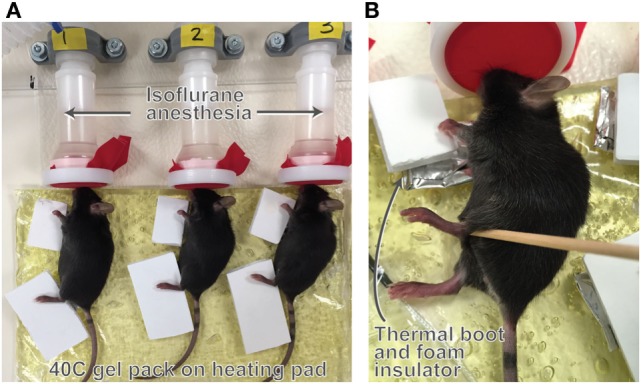
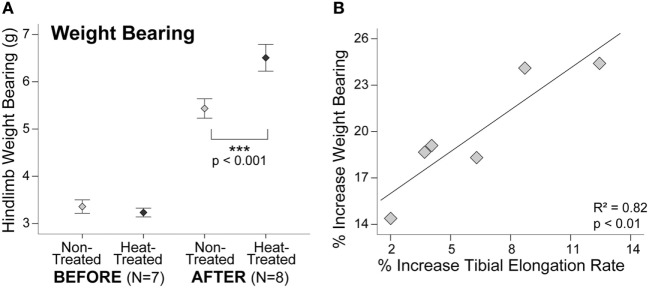
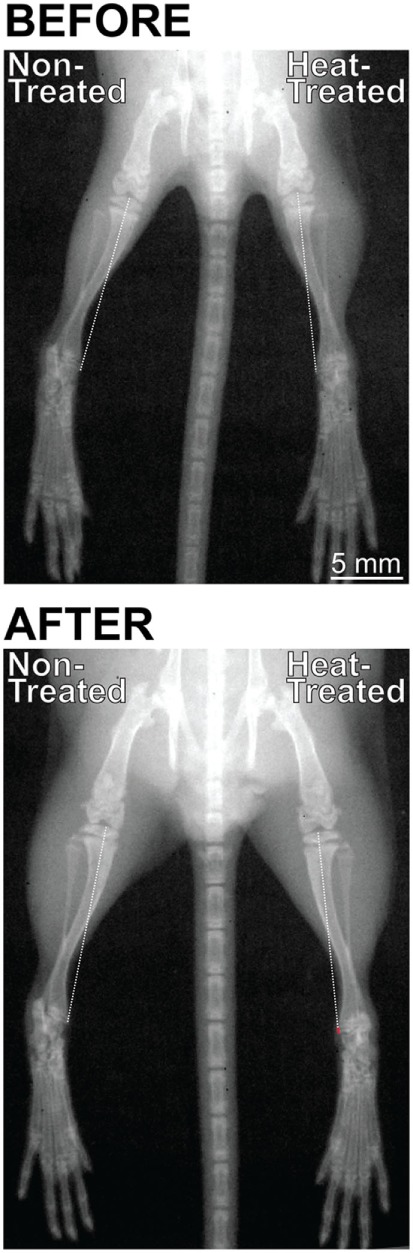
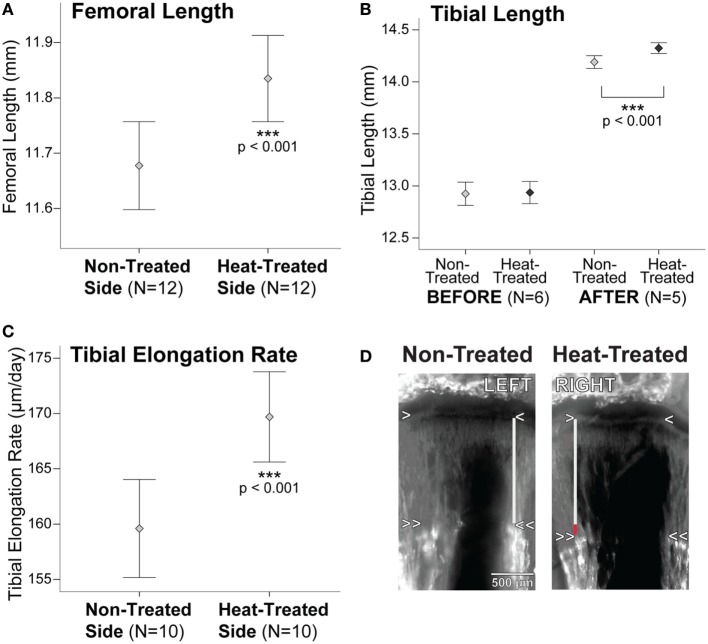
Limb length inequality results from many types of musculoskeletal disorders. Asymmetric weight bearing from a limb length discrepancy of less than 2% can have debilitating consequences such as back problems and early-onset osteoarthritis. Existing treatments include invasive surgeries and/or drug regimens that are often only partially effective. As a noninvasive alternative, we previously developed a once daily limb-heating model using targeted heat on one side of the body for 2 weeks to unilaterally increase bone length by up to 1.5% in growing mice. In this study, we applied heat for 1 week to determine whether these small differences in limb length are functionally significant, assessed by changes in hindlimb weight bearing. We tested the hypothesis that heat-induced limb length asymmetry has a functional impact on weight bearing in mouse hindlimbs. Female 3-week-old C57BL/6 mice ( = 12 total) were treated with targeted intermittent heat for 7 days (40 C for 40 min/day). High-resolution x-ray ( = 6) and hindlimb weight bearing data ( = 8) were acquired at the start and end of the experiments. There were no significant left-right differences in starting tibial length or hindlimb weight bearing. After 1-week heat exposure, tibiae ( = 7.7, < 0.001) and femora ( = 11.5, < 0.001) were ~1 and 1.4% longer, respectively, on the heat-treated sides (40 C) compared to the non-treated contralateral sides (30 C). Tibial elongation rate was over 6% greater ( = 5.19, < 0.001). Hindlimb weight bearing was nearly 20% greater ( = 11.9, < 0.001) and significantly correlated with the increase in tibial elongation rate on the heat-treated side ( = 0.82, < 0.01). These results support the hypothesis that even a small limb length discrepancy can cause imbalanced weight distribution in healthy mice. The increase in bone elongation rate generated by localized heat could be a way to equalize limb length and weight bearing asymmetry caused by disease or trauma, leading to new approaches with better outcomes by using heat to lengthen limbs and reduce costly side effects of more invasive interventions.
肢体长度不等可由多种肌肉骨骼疾病引起。肢体长度差异小于2%导致的不对称负重可能会产生诸如背部问题和早发性骨关节炎等使人衰弱的后果。现有的治疗方法包括侵入性手术和/或药物治疗方案,这些方法往往只能部分有效。作为一种非侵入性替代方法,我们之前开发了一种每日一次的肢体加热模型,对身体一侧进行靶向加热,持续2周,以使生长中的小鼠单侧骨长度增加高达1.5%。在本研究中,我们进行了1周的加热,以确定这些肢体长度的微小差异在功能上是否显著,通过后肢负重的变化来评估。我们检验了这样一个假设:热诱导的肢体长度不对称对小鼠后肢的负重有功能影响。对12只3周龄雌性C57BL/6小鼠进行靶向间歇性加热7天(40℃,每天40分钟)。在实验开始和结束时获取高分辨率x光数据(n = 6)和后肢负重数据(n = 8)。起始胫骨长度或后肢负重方面不存在显著的左右差异。热暴露1周后,与未处理的对侧(30℃)相比,处理侧(40℃)的胫骨(n = 7.7,P < 0.001)和股骨(n = !1.5,P < 0.001)分别长约1%和1.4%。胫骨伸长率高出6%以上(n = 5.19,P < 0.001)。后肢负重增加近20%(n = 11.9,P < 0.001),并且与处理侧胫骨伸长率的增加显著相关(r = 0.82,P < 0.01)。这些结果支持了这样一个假设,即即使是微小的肢体长度差异也会导致健康小鼠体重分布失衡。局部加热产生的骨伸长率增加可能是一种平衡由疾病或创伤引起的肢体长度和负重不对称的方法,从而通过利用热来延长肢体并减少更具侵入性干预的昂贵副作用,带来具有更好结果的新方法。