• 文献检索
  • 文档翻译
  • 深度研究
  • 学术资讯
  • Suppr Zotero 插件Zotero 插件
  • 邀请有礼
  • 套餐&价格
  • 历史记录
应用&插件
Suppr Zotero 插件Zotero 插件浏览器插件Mac 客户端Windows 客户端微信小程序
定价
高级版会员购买积分包购买API积分包
服务
文献检索文档翻译深度研究API 文档MCP 服务
关于我们
关于 Suppr公司介绍联系我们用户协议隐私条款
关注我们

Suppr 超能文献

核心技术专利:CN118964589B侵权必究
粤ICP备2023148730 号-1Suppr @ 2026

文献检索

告别复杂PubMed语法,用中文像聊天一样搜索,搜遍4000万医学文献。AI智能推荐,让科研检索更轻松。

立即免费搜索

文件翻译

保留排版,准确专业,支持PDF/Word/PPT等文件格式,支持 12+语言互译。

免费翻译文档

深度研究

AI帮你快速写综述,25分钟生成高质量综述,智能提取关键信息,辅助科研写作。

立即免费体验

手术补片的调控祖网络。

The regulatory ancestral network of surgical meshes.

机构信息

Nuffield Department of Orthopaedics, Rheumatology and Musculoskeletal Sciences (NDORMS), Botnar Research Centre, University of Oxford, Headington, Oxford, United Kingdom.

出版信息

PLoS One. 2018 Jun 19;13(6):e0197883. doi: 10.1371/journal.pone.0197883. eCollection 2018.

DOI:10.1371/journal.pone.0197883
PMID:29920525
原文链接:https://pmc.ncbi.nlm.nih.gov/articles/PMC6007828/
Abstract

BACKGROUND

All surgical meshes entering the U.S. market have been cleared for clinical use by the 510(k) process of the Food and Drug Administration (FDA), in which devices simply require proof of "substantial equivalence" to predicate devices, without the need for clinical trials. However, recalled meshes associated with adverse effects may, indirectly, continue to serve as predicates for new devices raising concerns over the safety of the 510(k) route.

METHODOLOGY

Here we assess the potential magnitude of this problem by determining the ancestral network of equivalence claims linking recently cleared surgical meshes. Using the FDA website we identified all surgical meshes cleared by the 510(k) route between January 2013 and December 2015 along with all listed predicates for these devices. Using a network approach, we trace the ancestry of predicates across multiple generations of equivalence claims and identify those meshes connected to devices that have since recalled from the market along with the reason for their recall.

CONCLUSIONS

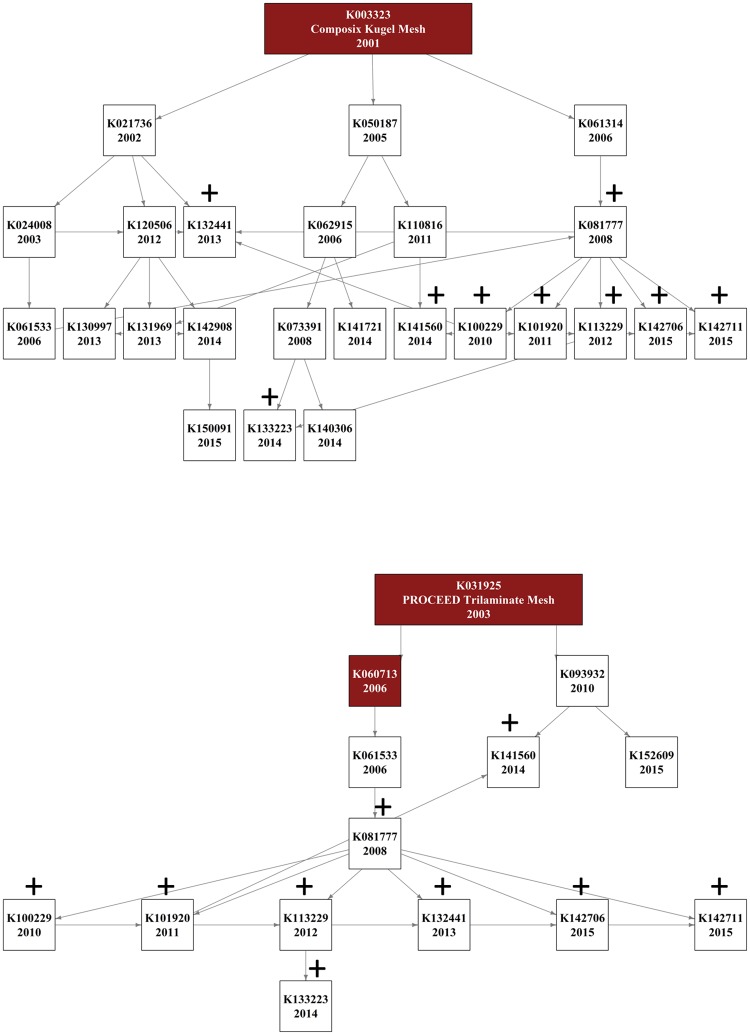
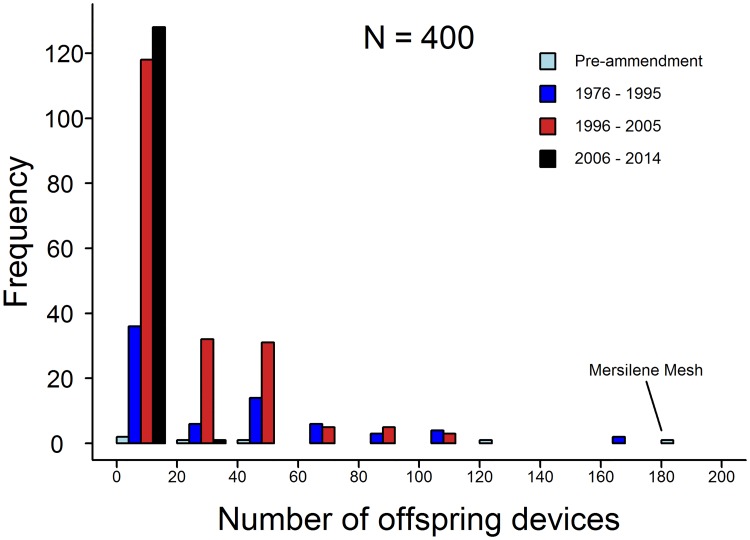
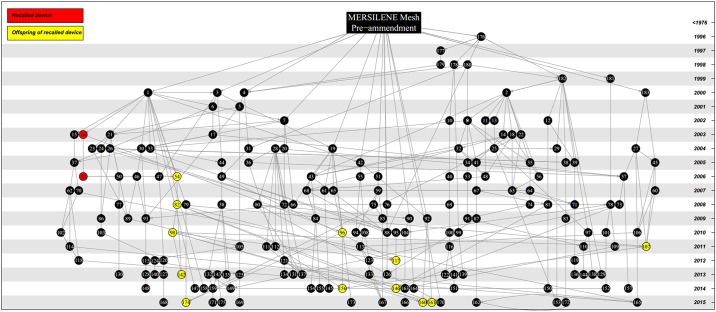
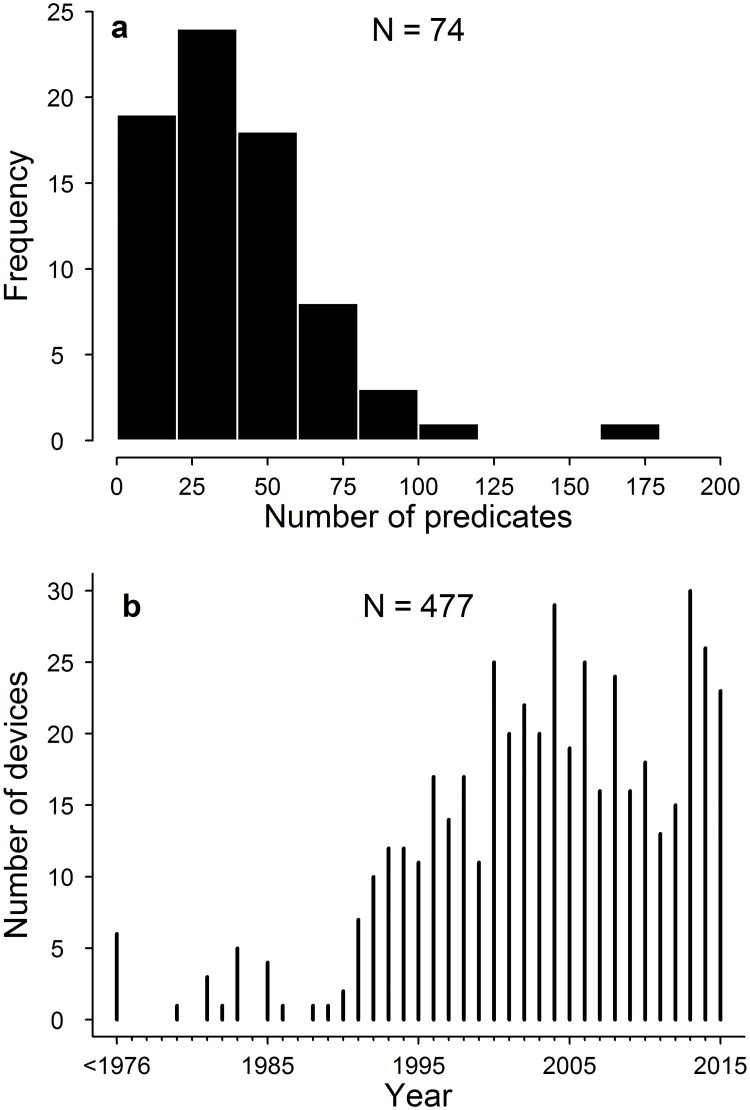
We find that the 77 surgical meshes cleared between 2013 and 2015 are based on 771 interconnected predicate claims of equivalence from 400 other devices. The vast majority of these devices (97%) are descended from only six surgical meshes that were present on the market prior to 1976. One of these ancestral meshes alone, provided the basis of 183 subsequent devices. Furthermore, we show that 16% of recently cleared devices are connected through equivalence claims to the 3 predicate meshes that have been recalled for design and material related flaws causing serious adverse events. Taken together, our results show that surgical meshes are connected through a tangled web of equivalency claims and many meshes recently cleared by the FDA have connections through chains of equivalency to devices which have been recalled from the market due to concerns over clinical safety. These findings raise concerns over the efficacy of the 510(k) route in ensuring patient safety.

摘要

背景

所有进入美国市场的外科用网片都已通过食品和药物管理局(FDA)的 510(k)程序获得临床使用许可,在此程序中,器械只需证明与参比器械具有“实质等同性”,而无需进行临床试验。然而,与不良事件相关的召回网片可能会间接继续作为新器械的参比,这引发了人们对 510(k)途径安全性的担忧。

方法

在这里,我们通过确定最近获得批准的外科用网片的等效性主张的祖先网络,评估这个问题的潜在程度。我们利用 FDA 网站,确定了 2013 年 1 月至 2015 年 12 月期间通过 510(k)途径获得批准的所有外科用网片,以及这些器械的所有上市参比。我们采用网络方法,追踪跨多代等效性主张的参比起源,并确定与已从市场召回的器械相连的网片,以及它们被召回的原因。

结论

我们发现,2013 年至 2015 年间获得批准的 77 个外科用网片,是基于 400 个其他器械的 771 个相互关联的等效性主张。这些器械中的绝大多数(97%)源自于 1976 年之前就已上市的 6 个外科用网片。其中一个单独的祖先网片,为 183 个后续器械提供了基础。此外,我们还表明,最近获得批准的 16%的器械,通过等效性主张与 3 个因设计和材料缺陷导致严重不良事件而被召回的参比网片相连接。总的来说,我们的研究结果表明,外科用网片通过错综复杂的等效性主张网络连接在一起,许多最近获得 FDA 批准的网片通过等效性主张与因临床安全问题而从市场召回的器械相连接。这些发现引发了对 510(k)途径在确保患者安全方面的有效性的担忧。
https://cdn.ncbi.nlm.nih.gov/pmc/blobs/300a/6007828/d492ea5eaf65/pone.0197883.g004.jpg
https://cdn.ncbi.nlm.nih.gov/pmc/blobs/300a/6007828/e6cf0e82b843/pone.0197883.g001.jpg
https://cdn.ncbi.nlm.nih.gov/pmc/blobs/300a/6007828/4f747db7c229/pone.0197883.g002.jpg
https://cdn.ncbi.nlm.nih.gov/pmc/blobs/300a/6007828/df5a9c7d2cf4/pone.0197883.g003.jpg
https://cdn.ncbi.nlm.nih.gov/pmc/blobs/300a/6007828/d492ea5eaf65/pone.0197883.g004.jpg
https://cdn.ncbi.nlm.nih.gov/pmc/blobs/300a/6007828/e6cf0e82b843/pone.0197883.g001.jpg
https://cdn.ncbi.nlm.nih.gov/pmc/blobs/300a/6007828/4f747db7c229/pone.0197883.g002.jpg
https://cdn.ncbi.nlm.nih.gov/pmc/blobs/300a/6007828/df5a9c7d2cf4/pone.0197883.g003.jpg
https://cdn.ncbi.nlm.nih.gov/pmc/blobs/300a/6007828/d492ea5eaf65/pone.0197883.g004.jpg

相似文献

1
The regulatory ancestral network of surgical meshes.手术补片的调控祖网络。
PLoS One. 2018 Jun 19;13(6):e0197883. doi: 10.1371/journal.pone.0197883. eCollection 2018.
2
The Complex Process of Using the Interconnected Knee Arthroplasty Device Clearance Pathway.使用相互关联的膝关节置换装置间隙通路的复杂过程。
HSS J. 2022 Nov;18(4):462-468. doi: 10.1177/15563316221099014. Epub 2022 Jun 20.
3
The Interconnected Ancestral Network of Hip Arthroplasty Device Approval.髋关节置换医疗器械审批的关联祖先网络
J Am Acad Orthop Surg. 2021 Dec 15;29(24):e1362-e1369. doi: 10.5435/JAAOS-D-21-00138.
4
Mapping the genealogy of medical device predicates in the United States.绘制美国医疗器械谓词的谱系图。
PLoS One. 2021 Oct 7;16(10):e0258153. doi: 10.1371/journal.pone.0258153. eCollection 2021.
5
Shoulder arthroplasty device clearance: an ancestral network analysis.肩关节置换术器械审批:一项溯源网络分析
J Shoulder Elbow Surg. 2023 Mar;32(3):671-676. doi: 10.1016/j.jse.2022.09.017. Epub 2022 Oct 21.
6
Use of Recalled Devices in New Device Authorizations Under the US Food and Drug Administration's 510(k) Pathway and Risk of Subsequent Recalls.美国食品和药物管理局 510(k) 途径下新设备授权中使用召回设备以及随后召回的风险。
JAMA. 2023 Jan 10;329(2):136-143. doi: 10.1001/jama.2022.23279.
7
Overview of high-risk medical device recalls in obstetrics and gynecology from 2002 through 2016: implications for device safety.2002年至2016年妇产科高风险医疗器械召回概述:对器械安全性的影响
Am J Obstet Gynecol. 2017 Jul;217(1):42-46.e1. doi: 10.1016/j.ajog.2017.03.021. Epub 2017 May 10.
8
Lack of publicly available scientific evidence on the safety and effectiveness of implanted medical devices.缺乏关于植入式医疗器械安全性和有效性的公开可用科学证据。
JAMA Intern Med. 2014 Nov;174(11):1781-7. doi: 10.1001/jamainternmed.2014.4193.
9
Association Between Regulatory Submission Characteristics and Recalls of Medical Devices Receiving 510(k) Clearance.医疗器械获得 510(k) 许可后与召回相关的监管提交特征。
JAMA. 2023 Jan 10;329(2):144-156. doi: 10.1001/jama.2022.22974.
10
US Food and Drug Administration Clearance of Moderate-Risk Otolaryngologic Devices via the 510(k) Process, 1997-2016.1997 - 2016年美国食品药品监督管理局通过510(k)程序批准的中度风险耳鼻喉科设备
Otolaryngol Head Neck Surg. 2017 Oct;157(4):608-617. doi: 10.1177/0194599817721689. Epub 2017 Aug 8.

引用本文的文献

1
Scoping review on regulation, implementation and postmarket surveillance of medical devices.关于医疗器械监管、实施及上市后监测的范围综述
PLoS One. 2025 May 30;20(5):e0325250. doi: 10.1371/journal.pone.0325250. eCollection 2025.
2
Are Surgeons Going to Be Left Holding the Bag? Incisional Hernia Repair and Intra-Peritoneal Non-Absorbable Mesh Implant Complications.外科医生会成为替罪羊吗?切口疝修补术与腹腔内不可吸收补片植入并发症
J Clin Med. 2024 Feb 9;13(4):1005. doi: 10.3390/jcm13041005.
3
Lifecycle evaluation of medical devices: supporting or jeopardizing patient outcomes? A comparative analysis of evaluation models.

本文引用的文献

1
IDEAL-D: a rational framework for evaluating and regulating the use of medical devices.IDEAL-D:评估和监管医疗设备使用的合理框架。
BMJ. 2016 Jun 9;353:i2372. doi: 10.1136/bmj.i2372.
2
Regulatory approval of new medical devices: cross sectional study.新型医疗器械的监管批准:横断面研究
BMJ. 2016 May 20;353:i2587. doi: 10.1136/bmj.i2587.
3
Analysis of FDA-Approved Orthopaedic Devices and Their Recalls.美国食品药品监督管理局(FDA)批准的骨科器械及其召回情况分析。
医疗器械生命周期评估:支持还是危及患者结局?评估模型的比较分析。
Int J Technol Assess Health Care. 2024 Jan 5;40(1):e2. doi: 10.1017/S026646232300274X.
4
3D-Printed Medical-Grade Polycaprolactone (mPCL) Scaffold for the Surgical Treatment of Vaginal Prolapse and Abdominal Hernias.用于阴道脱垂和腹疝手术治疗的3D打印医用级聚己内酯(mPCL)支架
Bioengineering (Basel). 2023 Oct 24;10(11):1242. doi: 10.3390/bioengineering10111242.
5
Identification of predicate creep under the 510(k) process: A case study of a robotic surgical device.510(k) 流程下谓语扩散的识别:以机器人手术设备为例的研究。
PLoS One. 2023 Mar 28;18(3):e0283442. doi: 10.1371/journal.pone.0283442. eCollection 2023.
6
Association Between Regulatory Submission Characteristics and Recalls of Medical Devices Receiving 510(k) Clearance.医疗器械获得 510(k) 许可后与召回相关的监管提交特征。
JAMA. 2023 Jan 10;329(2):144-156. doi: 10.1001/jama.2022.22974.
7
Use of Recalled Devices in New Device Authorizations Under the US Food and Drug Administration's 510(k) Pathway and Risk of Subsequent Recalls.美国食品和药物管理局 510(k) 途径下新设备授权中使用召回设备以及随后召回的风险。
JAMA. 2023 Jan 10;329(2):136-143. doi: 10.1001/jama.2022.23279.
8
Medical Devices, Invisible Women, Harmful Consequences.医疗器械、隐形女性、有害后果。
Int J Environ Res Public Health. 2022 Nov 5;19(21):14524. doi: 10.3390/ijerph192114524.
9
The Complex Process of Using the Interconnected Knee Arthroplasty Device Clearance Pathway.使用相互关联的膝关节置换装置间隙通路的复杂过程。
HSS J. 2022 Nov;18(4):462-468. doi: 10.1177/15563316221099014. Epub 2022 Jun 20.
10
Mapping the genealogy of medical device predicates in the United States.绘制美国医疗器械谓词的谱系图。
PLoS One. 2021 Oct 7;16(10):e0258153. doi: 10.1371/journal.pone.0258153. eCollection 2021.
J Bone Joint Surg Am. 2016 Mar 16;98(6):517-24. doi: 10.2106/JBJS.15.00286.
4
Lack of publicly available scientific evidence on the safety and effectiveness of implanted medical devices.缺乏关于植入式医疗器械安全性和有效性的公开可用科学证据。
JAMA Intern Med. 2014 Nov;174(11):1781-7. doi: 10.1001/jamainternmed.2014.4193.
5
Improving medical device regulation: the United States and Europe in perspective.改进医疗器械监管:美国和欧洲的视角。
Milbank Q. 2014 Mar;92(1):114-50. doi: 10.1111/1468-0009.12043.
6
Pelvic mesh complications in women before and after the 2011 FDA public health notification.2011年美国食品药品监督管理局发布公共卫生通知前后女性盆腔网片并发症情况
Female Pelvic Med Reconstr Surg. 2013 Nov-Dec;19(6):333-8. doi: 10.1097/SPV.0b013e3182a330c1.
7
The 510(k) ancestry of a metal-on-metal hip implant.金属对金属髋关节植入物的510(k)溯源
N Engl J Med. 2013 Jan 10;368(2):97-100. doi: 10.1056/NEJMp1211581.
8
The FDA approval process for medical devices: an inherently flawed system or a valuable pathway for innovation?美国食品药品监督管理局(FDA)对医疗器械的审批流程:是一个本质上存在缺陷的系统,还是一条有价值的创新途径?
J Neurointerv Surg. 2013 Jul;5(4):269-75. doi: 10.1136/neurintsurg-2012-010400. Epub 2012 Jul 4.
9
How safe are metal-on-metal hip implants?金属对金属髋关节植入物的安全性如何?
BMJ. 2012 Feb 28;344:e1410. doi: 10.1136/bmj.e1410.
10
Regulation of medical devices in the United States and European Union.美国和欧盟的医疗器械监管
N Engl J Med. 2012 Mar 1;366(9):848-55. doi: 10.1056/NEJMhle1113918. Epub 2012 Feb 14.