Departamento de Biologia Celular, Universidade de Brasília, Brasília, 70910-900, Brazil.
Área de Morfologia, Faculdade de Medicina, Universidade de Brasília, Brasília, 70910-900, Brazil.
Sci Rep. 2018 Jun 19;8(1):9368. doi: 10.1038/s41598-018-27263-x.
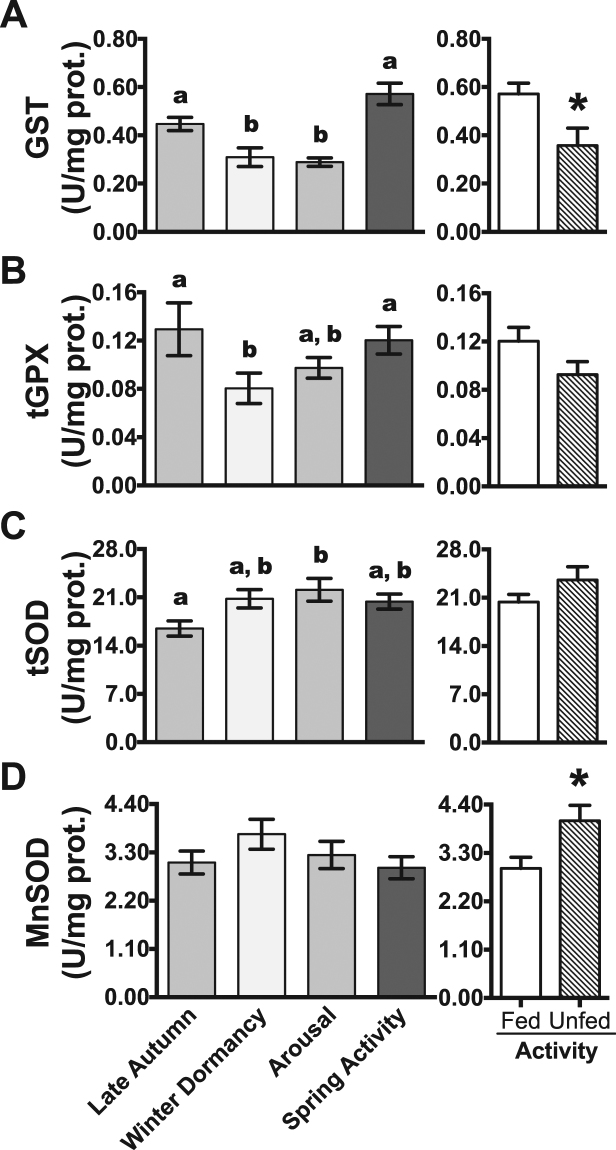
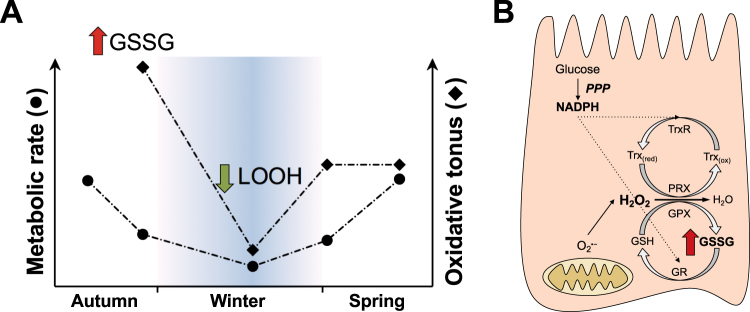
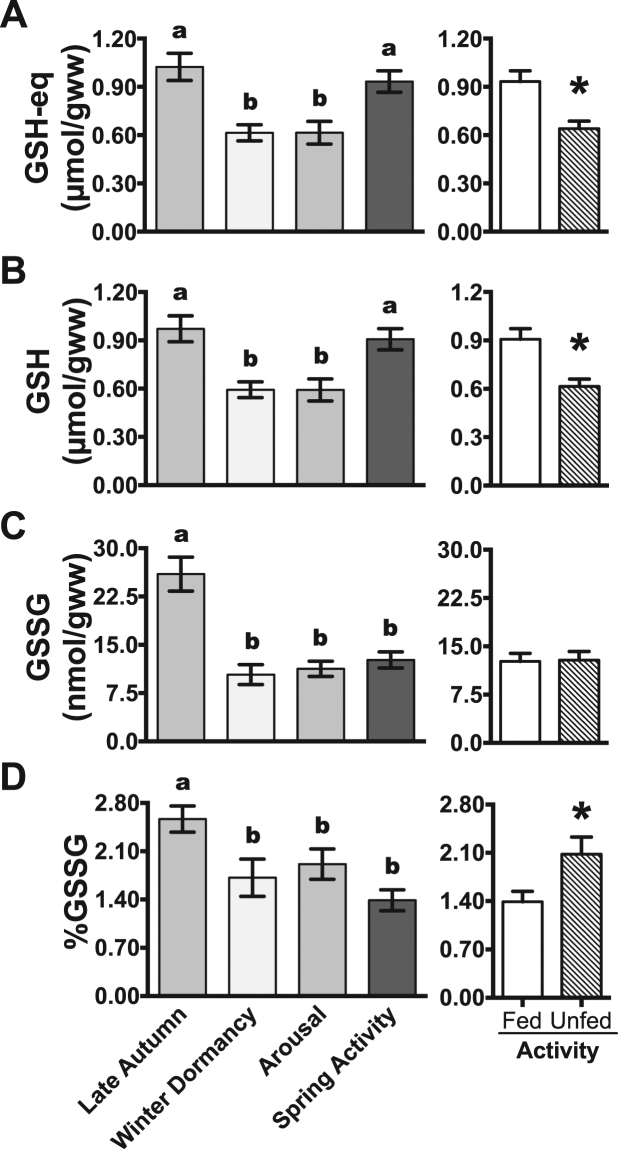
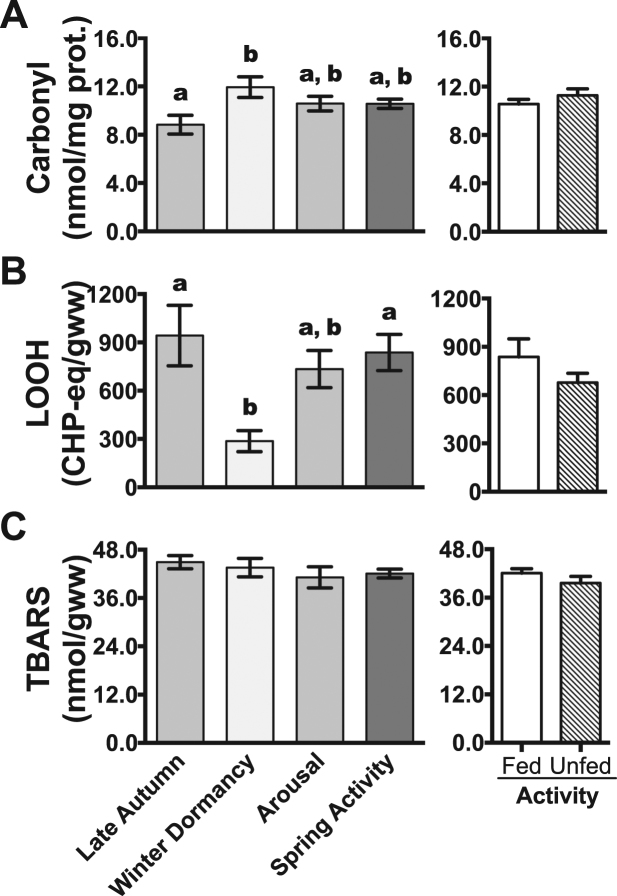
Juvenile tegu lizards (Salvator merianae) experience gradual and mild temperature changes from autumn to winter in their habitat. This tropical/subtropical reptile enter a state of dormancy, with an 80% reduction in metabolic rate, that remains almost constant during winter. The redox metabolism in non-mammalian vertebrates that hibernate under such distinguished conditions is poorly understood. We analyzed the redox metabolism in the intestine of juvenile tegus during different stages of their first annual cycle. The effect of food deprivation (in spring) was also studied to compare with fasting during hibernation. Both winter dormancy and food deprivation caused decreases in reduced glutathione levels and glutathione transferase activity. While glutathione peroxidase and glutathione transferase activities decreased during winter dormancy, as well as glutathione (GSH) levels, other antioxidant enzymes (catalase, superoxide dismutase and glutathione reductase) remained unchanged. Notably, levels of disulfide glutathione (GSSG) were 2.1-fold higher in late autumn, when animals were in the process of depressing metabolism towards hibernation. This increased "oxidative tonus" could be due to a disruption in NADPH-dependent antioxidant systems. In dormancy, GSSG and lipid hydroperoxides were diminished by 60-70%. The results suggest that the entrance into hibernation is the main challenge for the redox homeostasis in the intestine of juvenile tegus.
幼年大鳄蜥(Salvator merianae)在其栖息地经历从秋季到冬季的逐渐温和的温度变化。这种热带/亚热带爬行动物进入休眠状态,代谢率降低 80%,在冬季几乎保持不变。在这种特殊条件下冬眠的非哺乳动物脊椎动物的氧化还原代谢知之甚少。我们分析了幼年大鳄蜥在其第一个年度周期的不同阶段肠道中的氧化还原代谢。还研究了禁食(春季)的影响,以便与冬眠期间的禁食进行比较。冬季休眠和禁食都会导致还原型谷胱甘肽水平和谷胱甘肽转移酶活性降低。虽然冬季休眠期间谷胱甘肽过氧化物酶和谷胱甘肽转移酶活性以及谷胱甘肽 (GSH) 水平下降,但其他抗氧化酶(过氧化氢酶、超氧化物歧化酶和谷胱甘肽还原酶)保持不变。值得注意的是,当动物处于代谢向冬眠抑制的过程中时,晚秋时二硫谷胱甘肽 (GSSG) 的水平增加了 2.1 倍。这种增加的“氧化张力”可能是由于 NADPH 依赖性抗氧化系统的破坏。在休眠期间,GSSG 和脂质氢过氧化物减少了 60-70%。结果表明,进入冬眠是幼年大鳄蜥肠道氧化还原稳态的主要挑战。