Owonikoko Kola M, Tijani Aramide M, Bajowa Olarewaju G, Atanda Oluseyi O
Department of Obstetrics and Gynecology, Ladoke Akintola University of Technology Teaching Hospital, Ogbomoso, Oyo State Nigeria.
AIMS Public Health. 2017 Jan 16;4(1):19-32. doi: 10.3934/publichealth.2017.1.19. eCollection 2017.
Culture has been known to influence practices and beliefs of people world over. Several cultural practices have been noted among pregnant women who were passed from one generation to the next with its potential harmful and beneficial effect. The use of safety pin in is one of such cultural practices that are widely practiced by many pregnant Nigerian women.
We sought to gain a deeper understanding of the source of knowledge and motivation behind the use of safety pin on garments during pregnancy as well as explore potential harmful side effects of this cultural practice.
A total of 419 pregnant women completed questionnaires for a hospital-based cross-sectional study. Safety pin knowledge and motivation for use on garments were assessed using a pre-tested 16 item questionnaire. Consenting women either completed a self-administered structured questionnaire or utilized the help of trained research assistants. Chi-square tests were used to assess relationships between safety pin use on garments and predictor variables. Analysis was done with Statistical Package for Social Sciences version 17.
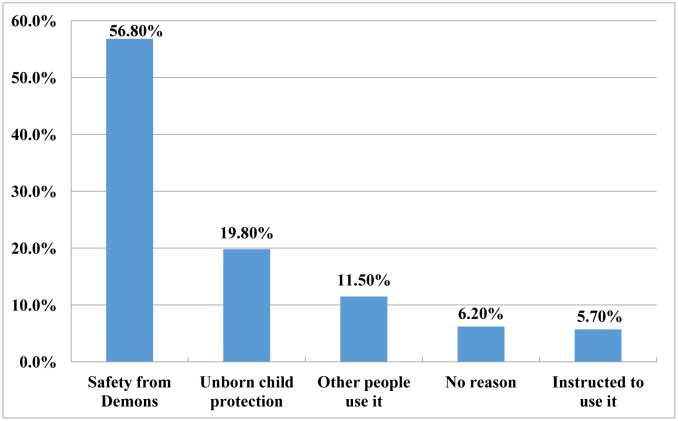
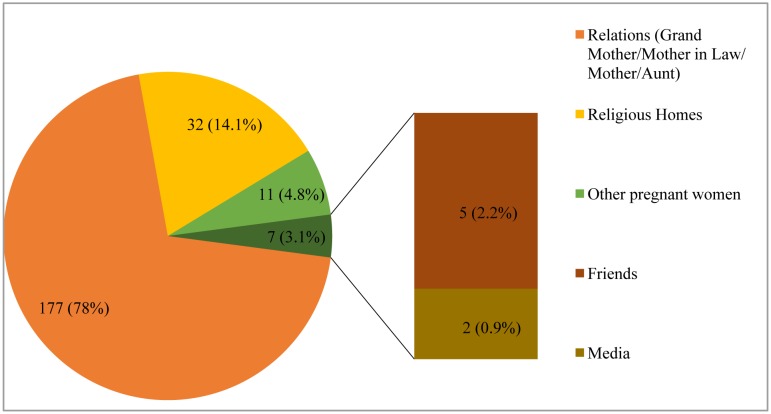
Of 419 participants, over half (n = 227) reported safety pin use on garments in pregnancy. About two-thirds (n = 177) of women who use safety pin reported older female relatives as their source of information. The mean age of the participants was 29.1 ± 5.74 (range 16-45 years). Traditional religion worshippers were more likely (81.2%) and Christians were least likely to use safety pin (50.7%) during pregnancy. Pregnant women with a tertiary education (50.4%) were least likely to use safety pin compared with women with no or less than a tertiary level of education. Protection of pregnancy against demons/witchcrafts was the reason given by 129 (56.8%) of participants using safety pin in pregnancy.
The use of safety pin on garments during pregnancy is a common cultural practice in southwest Nigeria. Our findings also suggest that religion and education are important determinants of safety pin use. Although our study did not find a statistically significant difference in safety pin prick incidents among safety pin users, it remains a potential source of harm. Thus, there is a need to establish community and hospital based strategies that address potential cultural harmful practices while promoting culturally appropriate healthcare services.
众所周知,文化会影响世界各地人们的行为和信仰。在孕妇中存在着一些代代相传的文化习俗,这些习俗既有潜在的有害影响,也有有益影响。在衣服上别安全别针就是许多尼日利亚孕妇广泛践行的此类文化习俗之一。
我们试图更深入地了解孕期在衣服上别安全别针这一行为背后的知识来源和动机,并探究这种文化习俗可能存在的有害副作用。
共有419名孕妇完成了一项基于医院的横断面研究问卷。使用一份经过预测试的包含16个条目的问卷来评估在衣服上别安全别针的知识和动机。同意参与的女性要么自行完成一份结构化问卷,要么在经过培训的研究助理的帮助下完成问卷。采用卡方检验来评估在衣服上别安全别针与预测变量之间的关系。使用社会科学统计软件包第17版进行分析。
在419名参与者中,超过一半(n = 227)报告在孕期会在衣服上别安全别针。在使用安全别针的女性中,约三分之二(n = 177)表示信息来源是年长的女性亲属。参与者的平均年龄为29.1 ± 5.74岁(年龄范围16 - 45岁)。传统宗教信徒在孕期更有可能(81.2%)使用安全别针,而基督徒使用安全别针的可能性最小(50.7%)。与未接受过高等教育或接受高等教育程度较低的女性相比,接受过高等教育的孕妇(50.4%)使用安全别针的可能性最小。129名(56.8%)在孕期使用安全别针的参与者表示这样做的原因是保护孕期免受恶魔/巫术侵害。
在尼日利亚西南部,孕期在衣服上别安全别针是一种常见的文化习俗。我们的研究结果还表明,宗教和教育是使用安全别针的重要决定因素。尽管我们的研究未发现使用安全别针的人在安全别针刺伤事件上存在统计学上的显著差异,但这仍然是一个潜在的危害源。因此,有必要制定基于社区和医院的策略,在促进文化上适宜的医疗服务的同时,应对潜在的有害文化习俗。