Ocanha-Xavier Juliana Polizel, Xavier-Junior José Cândido Caldeira, Marques Mariângela Esther Alencar
Clínica Tiradentes, Araçatuba, SP, Brazil.
Instituto de Patologia de Araçatuba, Araçatuba, SP, Brazil.
An Bras Dermatol. 2018 Jun;93(3):373-376. doi: 10.1590/abd1806-4841.20186690.
The incidence of melanoma has been increasing in Brazil and all over the world. Despite improvements in diagnosis and treatment, mortality remains unchanged.
To associate clinical and histopathological aspects with the evolution of 136 cases of cutaneous melanoma.
Retrospective cohort study that analyzed all patients diagnosed with melanoma during the period from 2003 to 2011, with at least 4 years follow up. Archived slides were analyzed to study histopathological variables (Breslow, ulceration, mitoses and histological regression). Medical records were used to retrieve clinical variables (age, sex, localization, time of appearance, diameter) and progression (metastases or death). Association measures were assessed by statistical analysis.
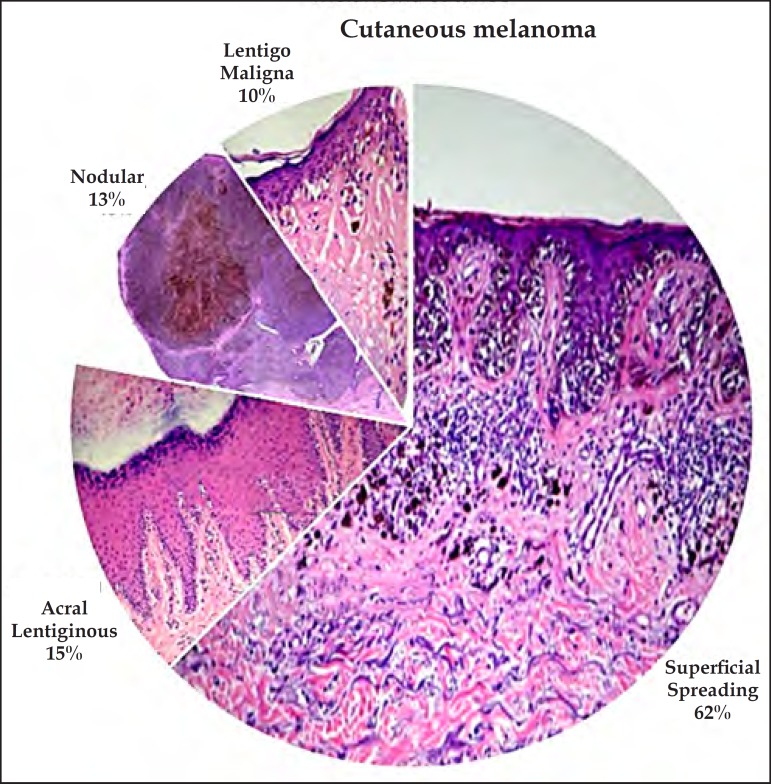
There was no statistically significant difference between groups according to age. Superficial spreading subtype showed lower Breslow (0.5mm) than acral lentiginous and nodular subtypes (2 and 4.6mm respectively), less ulceration and metastases (9.4% against 50 and 70.6%). Nodular subtype had higher mitoses' median (5.0/mm2) than superficial spreading and lentigo maligna (0.0/mm2, for both). Regression was more frequent in superficial spreading and lentigo maligna subtypes. There were only deaths by melanoma in the acral group, however, there were deaths for other reasons in groups superficial spreading one, acral lentiginous one and lentigo maligna two.
Use of medical records as a source of data to the study.
Superficial spreading subtype presents better prognosis indicators. Histological subtype should be considered in follow-up and treatment protocols of patients with cutaneous melanoma.
黑色素瘤的发病率在巴西及全球范围内都呈上升趋势。尽管在诊断和治疗方面有所改进,但死亡率仍未改变。
将136例皮肤黑色素瘤的临床和组织病理学特征与病情发展相关联。
回顾性队列研究,分析了2003年至2011年期间所有诊断为黑色素瘤且随访至少4年的患者。分析存档切片以研究组织病理学变量( Breslow厚度、溃疡形成、有丝分裂和组织学消退)。利用医疗记录获取临床变量(年龄、性别、部位、出现时间、直径)和病情进展(转移或死亡)。通过统计分析评估关联指标。
根据年龄分组,各组之间无统计学显著差异。浅表扩散型的Breslow厚度(0.5mm)低于肢端雀斑样痣型和结节型(分别为2mm和4.6mm),溃疡形成和转移较少(分别为9.4%,而肢端雀斑样痣型和结节型分别为50%和70.6%)。结节型的有丝分裂中位数(5.0/mm²)高于浅表扩散型和恶性雀斑样痣型(两者均为0.0/mm²)。浅表扩散型和恶性雀斑样痣型的消退更为常见。肢端雀斑样痣型组仅有因黑色素瘤死亡的病例,然而,浅表扩散型组、肢端雀斑样痣型组和恶性雀斑样痣型组中有因其他原因死亡的病例。
使用医疗记录作为研究的数据来源。
浅表扩散型具有更好的预后指标。在皮肤黑色素瘤患者的随访和治疗方案中应考虑组织学亚型。