Department of Otolaryngology, Ajou University School of Medicine, Suwon, Republic of Korea.
Department of Otorhinolaryngology - Head and Neck Surgery, Samsung Medical Center, Sungkyunkwan University School of Medicine, 81 Irwon-ro, Gangnam-gu, Seoul, 06351, Republic of Korea.
BMC Cancer. 2018 Jun 20;18(1):672. doi: 10.1186/s12885-018-4578-0.
High-grade salivary gland cancer is a distinct clinical entity that has aggressive disease progression and early systemic spread. However, because of the rarity of the disease, the clinical outcomes, prognostic factors and clinical decision on the optimal treatments have not been fully understood.
In this study, we retrospectively analyzed the clinical data of 124 patients with high-grade salivary gland cancers and performed multivariate survival analyses to evaluate the clinico-pathological factors affecting the treatment outcomes.
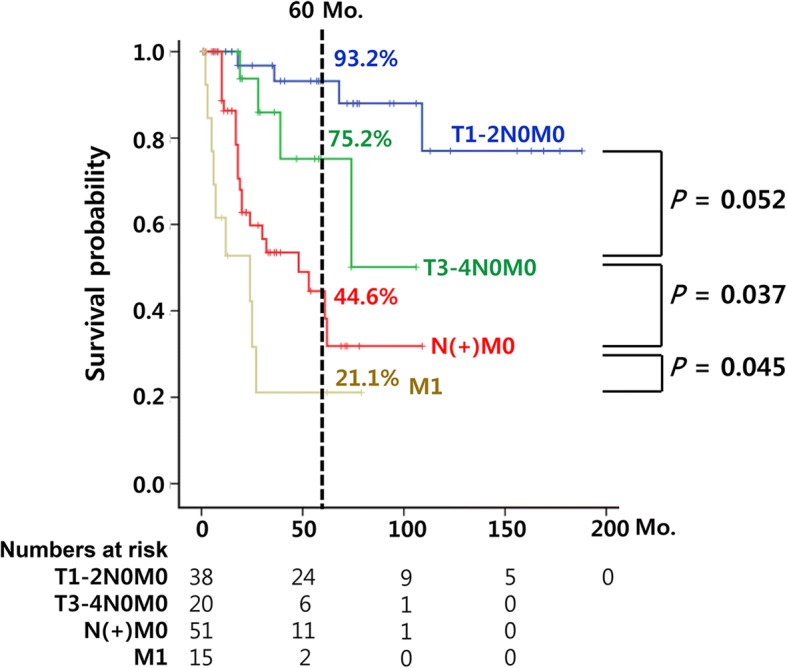
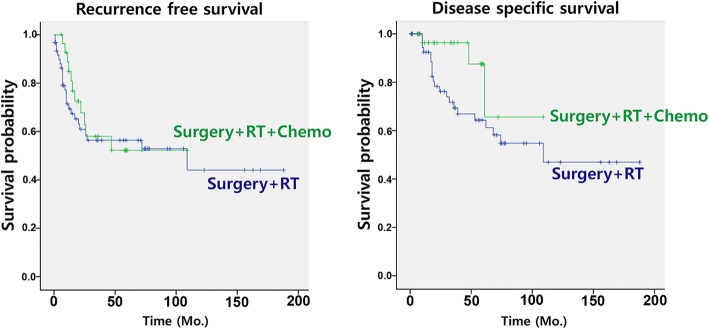
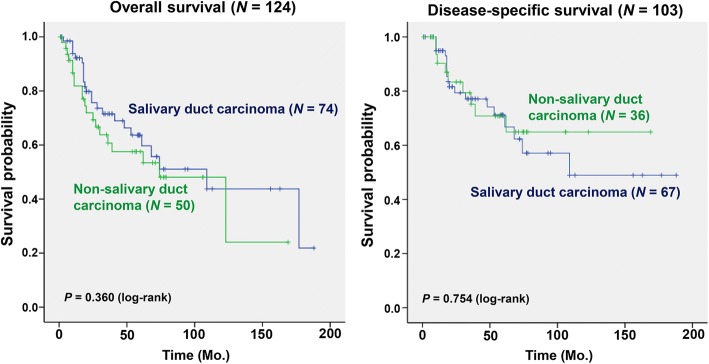
The 5-year disease-specific survival was 63.4% in patients with high-grade salivary gland cancers. Among the clinico-pathological factors, presence of lymph node metastasis (hazard ratio 5.63, 95% confidence interval 2.64-12.03, P < 0.001) and distant metastasis (hazard ratio 4.59, 95% confidence interval 2.10-10.04, P < 0.001) at diagnosis were the most potent unfavorable prognostic factors. Importantly, patients with early-stage disease (T1-2N0M0) showed apparently a relatively excellent prognosis (93.2% 5-year disease-specific survival); meanwhile N (+) and M1 status at diagnosis resulted in dismal outcomes (44.6 and 21.1% 5-year disease-specific survival, respectively). On comparing surgery alone as a treatment modality, surgery plus postoperative radiation significantly benefited the patients, but the difference between adjuvant radiation and chemoradiation was not found to be significant. Pathological subtypes of high-grade salivary gland cancers were not significantly associated with prognosis.
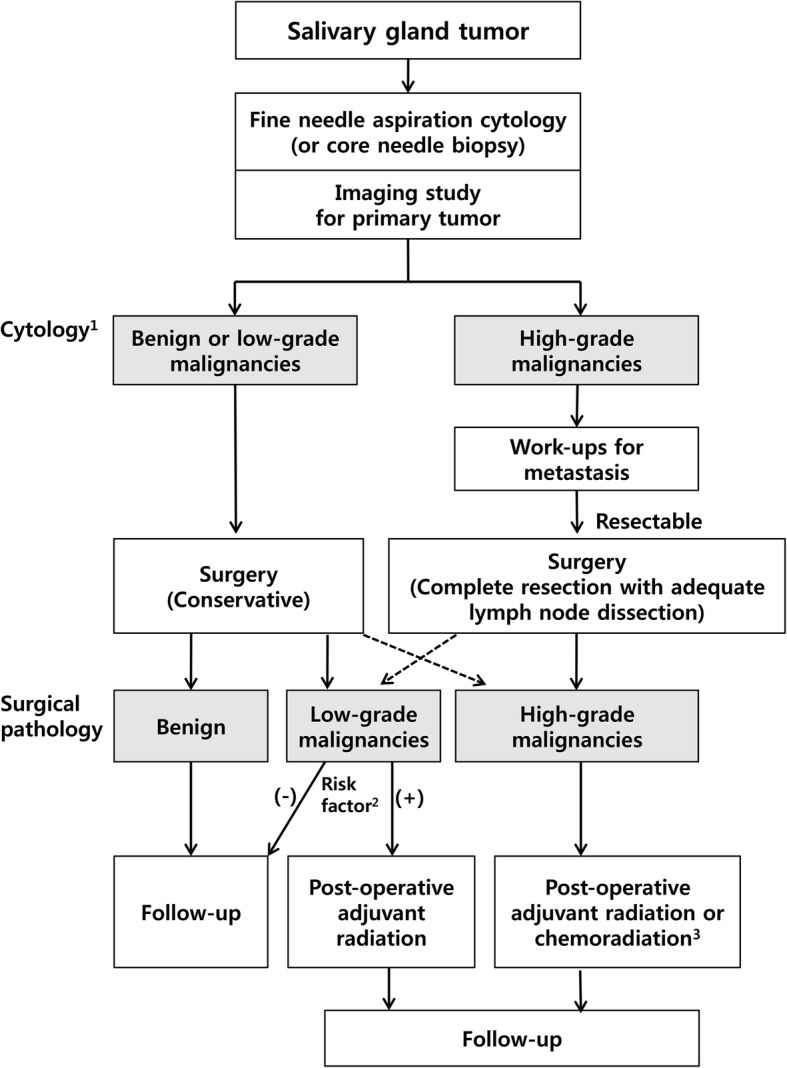
Despite of an overall unfavorable prognosis in high-grade salivary gland cancer, patients with early-stage disease are expected to have excellent prognosis (over 90% survival rates) with surgery plus adjuvant radiation, which may implicate the patients' consultation, therapeutic decision making, and the need for early detection of the disease.
高级别涎腺癌是一种具有侵袭性疾病进展和早期全身扩散的独特临床实体。然而,由于该疾病的罕见性,其临床结局、预后因素和最佳治疗方法的临床决策尚未完全了解。
本研究回顾性分析了 124 例高级别涎腺癌患者的临床资料,并进行了多变量生存分析,以评估影响治疗结局的临床病理因素。
高级别涎腺癌患者的 5 年疾病特异性生存率为 63.4%。在临床病理因素中,诊断时存在淋巴结转移(风险比 5.63,95%置信区间 2.64-12.03,P<0.001)和远处转移(风险比 4.59,95%置信区间 2.10-10.04,P<0.001)是最有力的不良预后因素。重要的是,早期疾病(T1-2N0M0)患者的预后明显较好(93.2%的 5 年疾病特异性生存率);而诊断时的 N(+)和 M1 状态则导致预后不良(分别为 44.6%和 21.1%的 5 年疾病特异性生存率)。与单纯手术作为治疗方式相比,手术加术后放疗明显使患者受益,但辅助放疗与放化疗之间的差异无统计学意义。高级别涎腺癌的病理亚型与预后无显著相关性。
尽管高级别涎腺癌的总体预后不佳,但早期疾病患者的预后预计良好(超过 90%的生存率),可通过手术加辅助放疗实现,这可能提示患者的咨询、治疗决策以及早期发现疾病的必要性。