La Elizabeth M, Smyth Emily Nash, Talbird Sandra E, Li Li, Kaye James A, Lin Aimee Bence, Bowman Lee
Department of Health Economics, RTI Health Solutions, Research Triangle Park, NC.
Oncology, Global Patient Outcomes and Real World Evidence, Lilly Corporate Center, Eli Lilly and Company, Indianapolis, IN.
Eur J Cancer Care (Engl). 2018 Sep;27(5):e12862. doi: 10.1111/ecc.12862. Epub 2018 Jun 21.
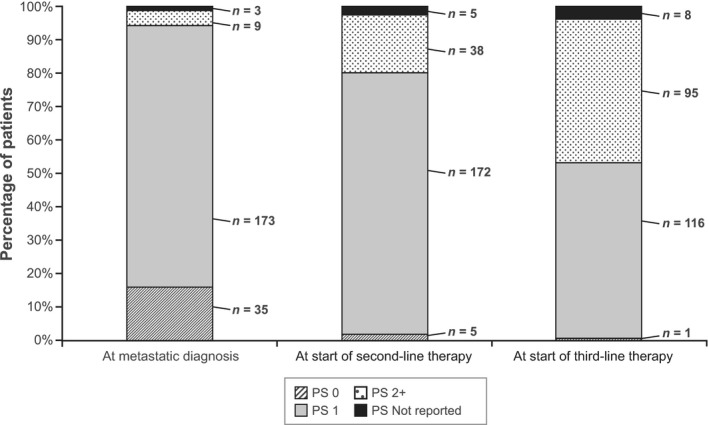
This study evaluated the patterns of care and health care resource use (HCRU) in patients with metastatic squamous cell carcinoma of the head and neck (SCCHN) who received ≥3 lines of systemic therapy in the United Kingdom (UK). Oncologists (n = 40) abstracted medical records for patients with metastatic SCCHN who initiated third-line systemic therapy during 1 January 2011-30 August 2014 (n = 220). Patient characteristics, treatment patterns and SCCHN-related HCRU were summarised descriptively for the metastatic period; exploratory multivariable regression analyses were conducted on select HCRU outcomes. At metastatic diagnosis, most patients had an Eastern Cooperative Oncology Group performance status (PS) of 0/1 (95%). For patients with PS 0/1, the most common first-line treatment was cisplatin+5-fluorouracil (5-FU); docetaxel was the most common second- and third-line treatment. For patients with PS ≥ 2, the most common first-, second-, and third-line treatments were carboplatin+5-FU, cetuximab, and methotrexate, respectively. Most patients received supportive care during (85%) and after (89%) therapy. This study provides useful information, prior to the availability of immunotherapy, on patient characteristics, treatment patterns, HCRU, and survival in a real-world UK population with metastatic SCCHN receiving ≥3 lines of systemic therapy. Patterns of care and HCRU varied among patients with metastatic SCCHN; specific systemic therapies varied by patient PS.
本研究评估了在英国接受≥3线全身治疗的转移性头颈部鳞状细胞癌(SCCHN)患者的护理模式和医疗资源使用(HCRU)情况。肿瘤学家(n = 40)提取了2011年1月1日至2014年8月30日期间开始接受三线全身治疗的转移性SCCHN患者的医疗记录(n = 220)。对转移期的患者特征、治疗模式和与SCCHN相关的HCRU进行了描述性总结;对选定的HCRU结果进行了探索性多变量回归分析。在转移诊断时,大多数患者的东部肿瘤协作组体能状态(PS)为0/1(95%)。对于PS为0/1的患者,最常见的一线治疗是顺铂+5-氟尿嘧啶(5-FU);多西他赛是最常见的二线和三线治疗。对于PS≥2的患者,最常见的一线、二线和三线治疗分别是卡铂+5-FU、西妥昔单抗和甲氨蝶呤。大多数患者在治疗期间(85%)和治疗后(89%)接受了支持性护理。本研究在免疫疗法可用之前,提供了关于在英国接受≥3线全身治疗的转移性SCCHN真实世界人群的患者特征、治疗模式、HCRU和生存情况的有用信息。转移性SCCHN患者的护理模式和HCRU各不相同;特定的全身治疗因患者PS而异。