Department of Biomedical Engineering, Faculty of Medicine and Dentistry, University of Alberta, Edmonton, Alberta, Canada.
Faculty of Kinesiology, Sport, and Recreation, University of Alberta, Edmonton, Alberta, Canada.
PLoS One. 2018 Jun 21;13(6):e0199549. doi: 10.1371/journal.pone.0199549. eCollection 2018.
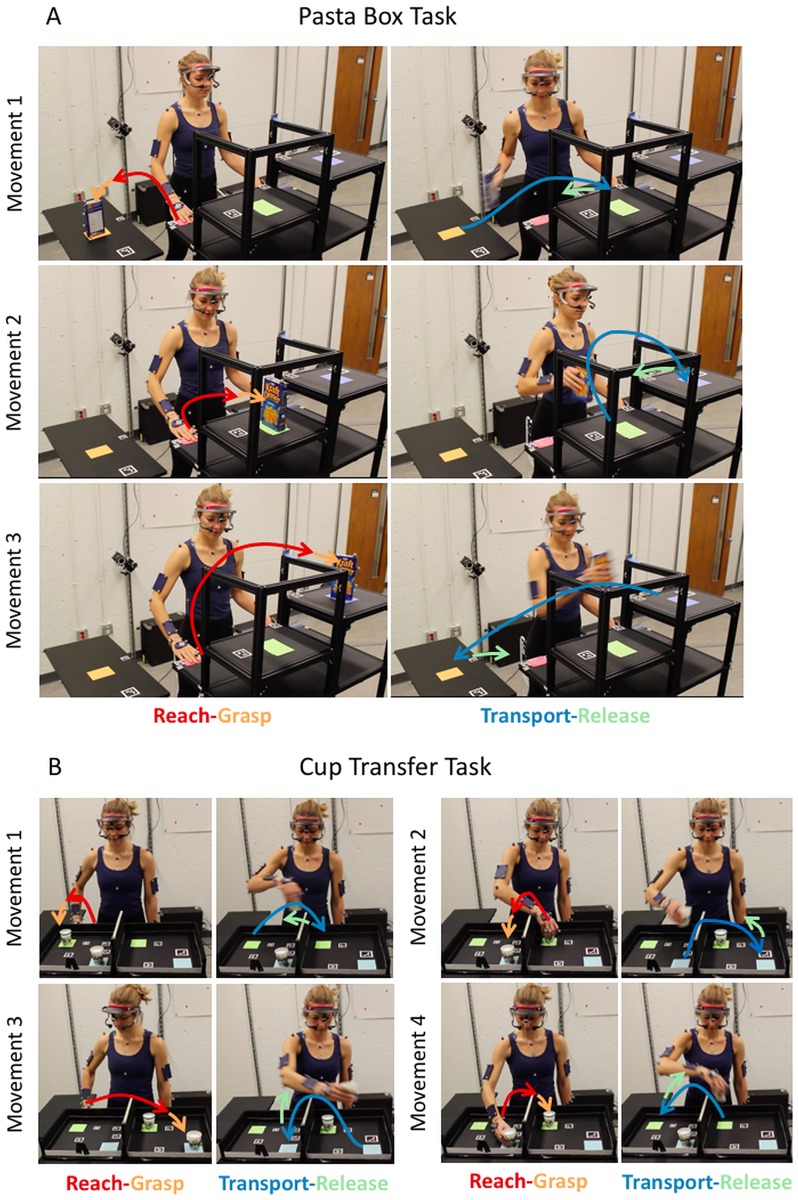
Dexterous hand function is crucial for completing activities of daily living (ADLs), which typically require precise hand-object interactions. Kinematic analyses of hand trajectory, hand velocity, and grip aperture provide valuable mechanistic insights into task performance, but there is a need for standardized tasks representative of ADLs that are amenable to motion capture and show consistent performance in non-disabled individuals. Our objective was to develop two standardized functional upper limb tasks and to quantitatively characterize the kinematics of normative hand movement.
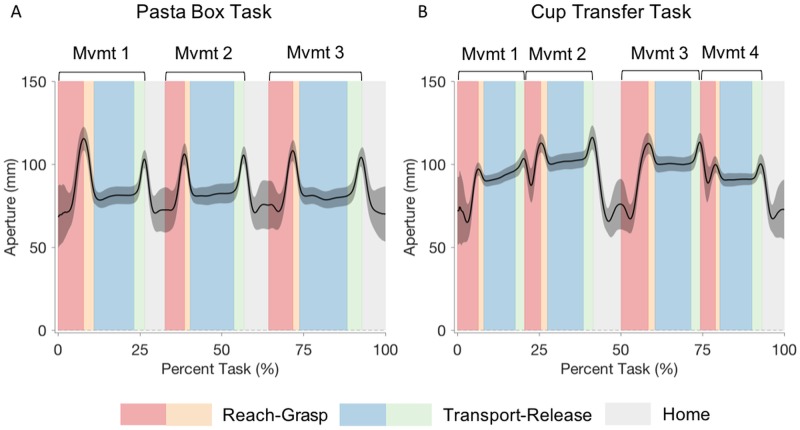
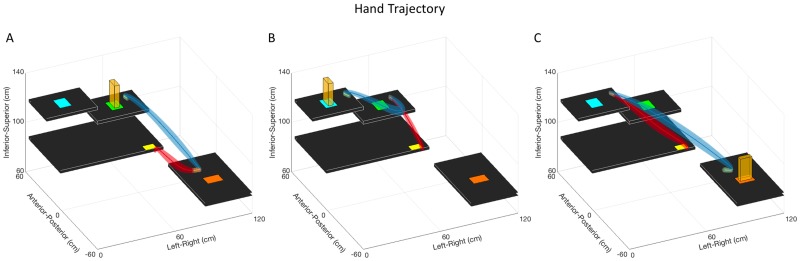
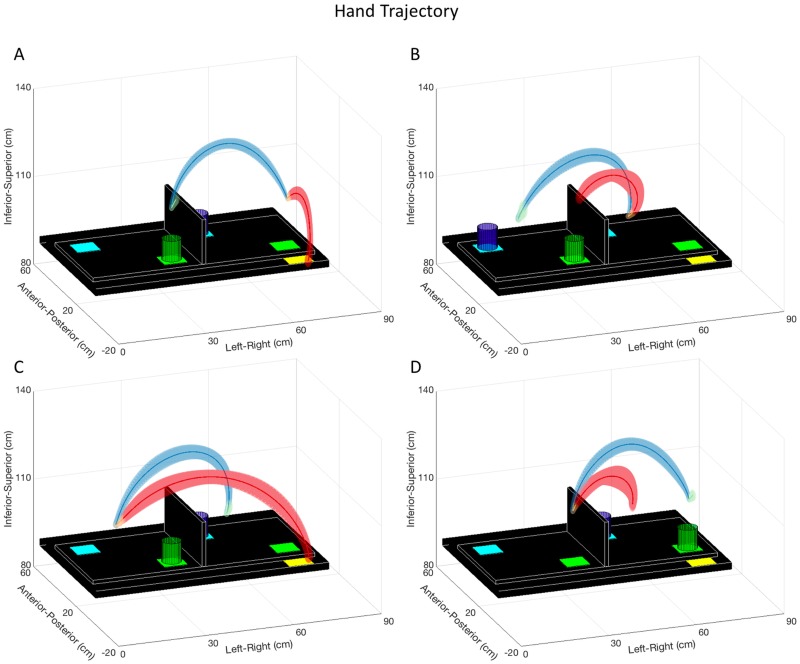
Twenty non-disabled participants were recruited to perform two tasks: the Pasta Box Task and Cup Transfer Task. A 12-camera motion capture system was used to collect kinematic data from which hand movement and grip aperture measures were calculated. Measures reported for reach-grasp and transport-release segments were hand distance travelled, hand trajectory variability, movement time, peak and percent-to-peak hand velocity, number of movement units, peak and percent-to-peak grip aperture, and percent-to-peak hand deceleration. A between-session repeatability analysis was conducted on 10 participants.
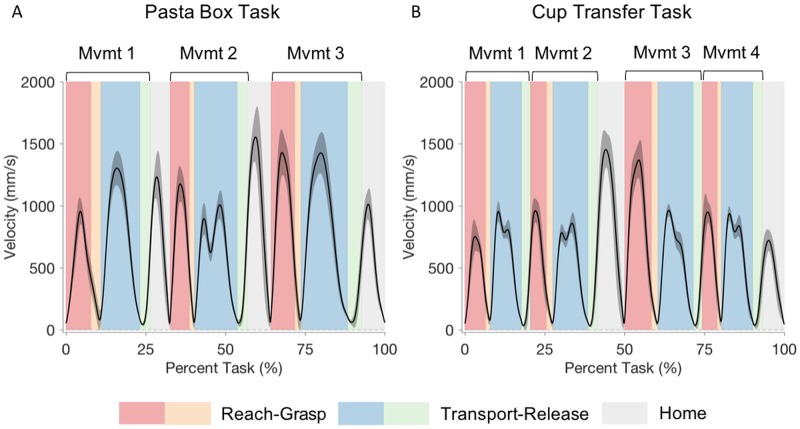
Movement times were longer for transport-release compared to reach-grasp for every movement. Hand and grip aperture measures had low variability, with 55 out of 63 measures showing good repeatability (ICC > 0.75). Cross-body movements in the Pasta Box Task had longer movement times and reduced percent-to-peak hand velocity values. The Cup Transfer Task showed decoupling of peak grip aperture and peak hand deceleration for all movements. Movements requiring the clearing of an obstacle while transporting an object displayed a double velocity peak and typically a longer deceleration phase.
Normative hand kinematics for two standardized functional tasks challenging various aspects of hand-object interactions important for ADLs showed excellent repeatability. The consistency in normative task performance across a variety of task demands shows promise as a potential outcome assessment for populations with upper limb impairment.
灵巧的手部功能对于完成日常生活活动(ADLs)至关重要,这些活动通常需要精确的手-物交互。手部轨迹、手部速度和握持开口的运动学分析为任务表现提供了有价值的机械洞察力,但需要有代表 ADLs 的标准化任务,这些任务适合运动捕捉,并且在非残疾个体中表现出一致的性能。我们的目标是开发两个标准化的功能性上肢任务,并定量描述正常手部运动的运动学。
招募了 20 名非残疾参与者来执行两项任务:意面盒任务和杯子转移任务。使用 12 个摄像机的运动捕捉系统来收集运动学数据,从中计算出手部运动和握持开口的测量值。报告的伸手-抓握和运送-释放阶段的测量值包括手部移动距离、手部轨迹变异性、运动时间、峰值和峰值百分比手速、运动单元数量、峰值和峰值百分比握持开口以及峰值和峰值百分比手部减速。对 10 名参与者进行了两次测试的重复性分析。
与伸手-抓握相比,每个动作的运送-释放的运动时间都更长。手部和握持开口的测量值具有低变异性,其中 63 个测量值中的 55 个具有良好的可重复性(ICC>0.75)。在意面盒任务中的跨身体动作具有更长的运动时间和降低的峰值百分比手速值。对于所有动作,杯子转移任务显示出峰值握持开口和峰值手部减速的解耦。在运送物体时需要清除障碍物的动作会显示出双速度峰值,通常减速阶段更长。
两个具有挑战性的手-物交互的标准化功能性任务的正常手部运动学具有极好的可重复性。在各种任务需求下,正常任务表现的一致性为上肢受损人群的潜在结果评估提供了希望。