Creemers Aafke, Ebbing Eva A, Hooijer Gerrit K J, Stap Lisanne, Jibodh-Mulder Rajni A, Gisbertz Susanne S, van Berge Henegouwen Mark I, van Montfoort Maurits L, Hulshof Maarten C C M, Krishnadath Kausilia K, van Oijen Martijn G H, Bijlsma Maarten F, Meijer Sybren L, van Laarhoven Hanneke W M
Center for Experimental and Molecular Medicine, Laboratory of Experimental Oncology and Radiobiology, Cancer Center Amsterdam, Academic Medical Center, Amsterdam, The Netherlands.
Department of Medical Oncology, Cancer Center Amsterdam, Academic Medical Center, Amsterdam, The Netherlands.
Oncotarget. 2018 Jun 1;9(42):26787-26799. doi: 10.18632/oncotarget.25507.
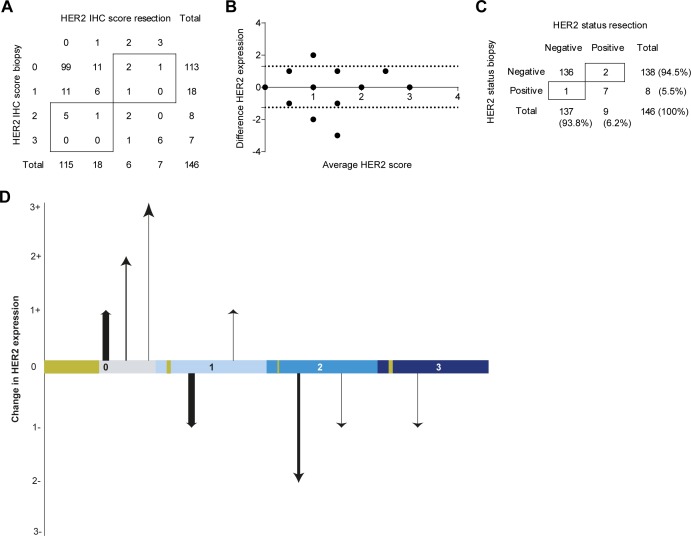
Trastuzumab, a monoclonal antibody against HER2, has become standard of care for metastatic HER2-overexpressing esophagogastric adenocarcinoma and is currently investigated as (neo)adjuvant treatment option in HER2-positive esophagogastric adenocarcinoma. The HER2 status is commonly determined on archived material of the primary tumor. However, this status may change over the course of treatment or disease progression. The aim of this study was to assess the dynamics of HER2 status in esophageal adenocarcinoma (EAC) in patients with resectable and recurrent disease, and to determine the associations of these changes with clinical outcome. Discordance, defined as any change in HER2 status between matched biopsy and post-neoadjuvant chemoradiation therapy resection specimen ( = 170), or between matched resection specimen and recurrence of patients not eligible for curative treatment ( = 61), was determined using the standardized HER2 status scoring system. Clinically relevant positive discordance was defined as a change to HER2 positive status, as this would imply eligibility for HER2-targeted therapy. A difference in HER2 status between biopsy and resection specimen and resection specimen and metachronous recurrence was observed in 2.1% ( = 3) and 3.3% ( = 2) of the paired cases, respectively. Clinically relevant discordance was detected in 1.4% ( = 2) of the resectable patients and 1.6% ( = 1) of the patients with recurrent disease. Patients with HER2-positive status tumors before start of neoadjuvant treatment showed better overall survival, but not statistically significant. No association between HER2 status discordance and survival was found. Clinically relevant HER2 status discordance was observed and in order to prevent under-treatment of patients, the assessment of HER2 status in the metastatic setting should preferably be performed on the most recently developed lesions if the previous HER2 assessment on archival material of the primary tumor was negative.
曲妥珠单抗是一种抗HER2单克隆抗体,已成为转移性HER2过表达食管胃腺癌的标准治疗方案,目前正作为HER2阳性食管胃腺癌的(新)辅助治疗选择进行研究。HER2状态通常在原发性肿瘤的存档材料上确定。然而,这种状态可能会在治疗过程或疾病进展过程中发生变化。本研究的目的是评估可切除和复发性疾病患者食管腺癌(EAC)中HER2状态的动态变化,并确定这些变化与临床结果的关联。使用标准化的HER2状态评分系统确定不一致性,定义为匹配的活检与新辅助放化疗后切除标本之间(n = 170),或匹配的切除标本与不符合根治性治疗条件患者的复发之间(n = 61)HER2状态的任何变化。临床相关的阳性不一致性定义为变为HER2阳性状态,因为这意味着有资格接受HER2靶向治疗。配对病例中,活检与切除标本以及切除标本与异时复发之间HER2状态的差异分别在2.1%(n = 3)和3.3%(n = 2)中观察到。在1.4%(n = 2)的可切除患者和1.6%(n = 1)的复发性疾病患者中检测到临床相关的不一致性。新辅助治疗开始前HER2阳性状态肿瘤的患者总体生存率较好,但无统计学意义。未发现HER2状态不一致与生存之间的关联。观察到临床相关的HER2状态不一致,为防止患者治疗不足,如果先前对原发性肿瘤存档材料的HER2评估为阴性,在转移情况下对HER2状态的评估最好在最新出现的病变上进行。