Zhang Tingting, Yang Haikui, Yang Zichao, Tan Suiyi, Jin Jiabin, Liu Shuwen, Zhang Jiajie
Guangdong Provincial Key Laboratory of New Drug Screening School of Pharmaceutical Sciences Southern Medical University Guangzhou 510515 P.R. China.
ChemistryOpen. 2018 Jun 11;7(6):447-456. doi: 10.1002/open.201800041. eCollection 2018 Jun.
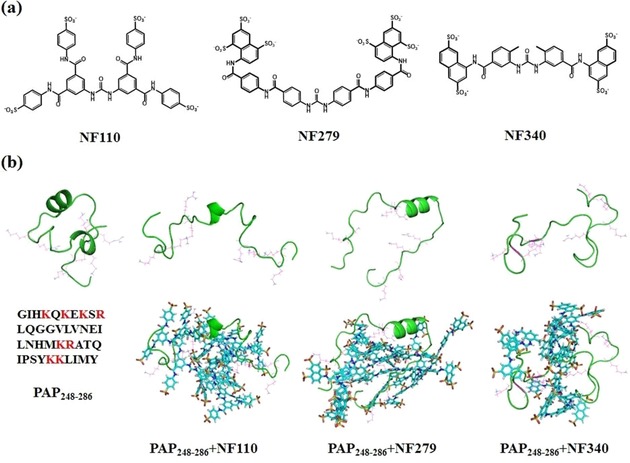
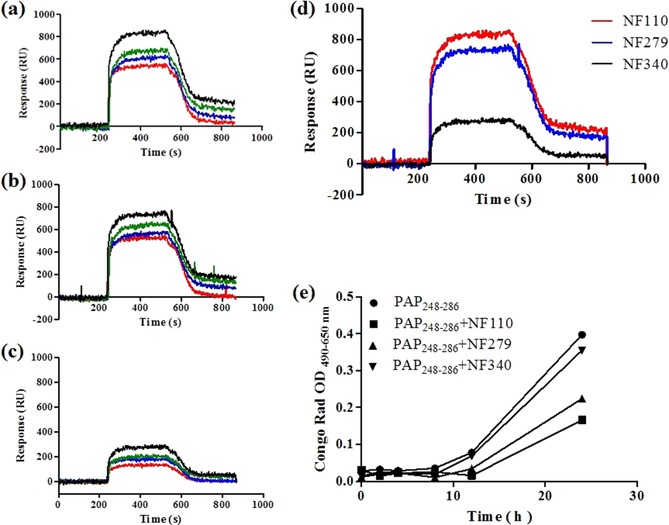
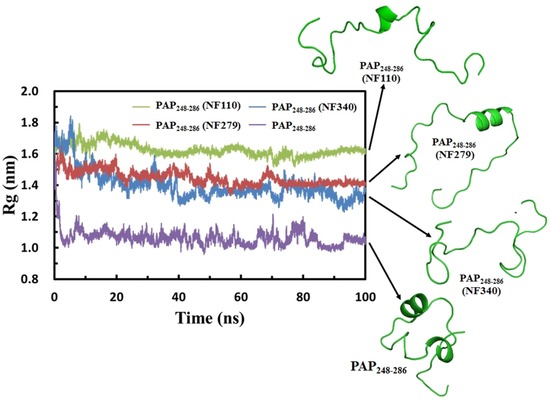
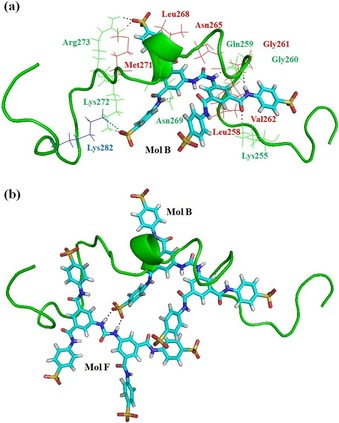
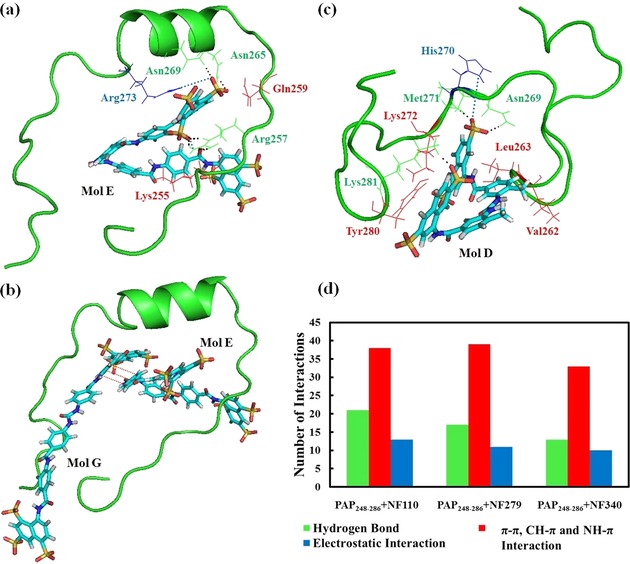
The peptide segment of prostatic acid phosphatase (PAP) aggregates to form SEVI (semen-derived enhancer of virus infection) amyloid fibrils. These are characteristic seminal amyloids that have the ability to promote the effect of HIV infection. In this paper, we explore the binding of sulfonated compounds with PAP through an in silico study. Three derivatives of suramin, NF110, NF279, and NF340, are selected. All of these sulfonated molecules bind to PAP and alter the conformation of the peptide, even though they have various structures, sizes, and configurations. The compounds bind with PAP through multiple interactions, such as hydrogen-bonding interactions, hydrophobic interactions, π-π stacking interactions, and electrostatic interactions. However, NF110, which has an X-shaped configuration, has the highest binding affinity of the three derivatives investigated. We also perform surface plasmon resonance and a Congo red assay to validate the results. The interactions between PAP and the sulfonated compounds are proposed to depend on the orientations of the sulfonate groups and the specific configurations of the compounds instead of the number of sulfonate groups. NF110 molecules occupy the exposed binding sites of PAP, blocking interactions between the peptides. Therefore, these compounds are important in inhibiting the aggregation of PAP. Herein, we provide useful information to develop new efficient microbicides to antagonize seminal amyloid fibrils and to block HIV transmission.
前列腺酸性磷酸酶(PAP)的肽段聚集形成SEVI(精液衍生病毒感染增强剂)淀粉样原纤维。这些是具有促进HIV感染作用能力的典型精液淀粉样蛋白。在本文中,我们通过计算机模拟研究探索了磺化化合物与PAP的结合。选择了苏拉明的三种衍生物NF110、NF279和NF340。尽管这些磺化分子具有不同的结构、大小和构型,但它们都能与PAP结合并改变肽的构象。这些化合物通过多种相互作用与PAP结合,如氢键相互作用、疏水相互作用、π-π堆积相互作用和静电相互作用。然而,具有X形构型的NF110在所研究的三种衍生物中具有最高的结合亲和力。我们还进行了表面等离子体共振和刚果红测定以验证结果。PAP与磺化化合物之间的相互作用被认为取决于磺酸根基团的取向和化合物的特定构型,而不是磺酸根基团的数量。NF110分子占据了PAP暴露的结合位点,阻断了肽之间的相互作用。因此,这些化合物在抑制PAP聚集方面很重要。在此,我们提供了有用的信息,以开发新型高效杀菌剂来对抗精液淀粉样原纤维并阻断HIV传播。