Penas Clara, Navarro Xavier
Institut de Neurociències, Departament de Biologia Cellular, Fisiologia i Immunologia, Universitat Autònoma de Barcelona, Barcelona, Spain.
Centro de Investigación Biomédica en Red sobre Enfermedades Neurodegenerativas, Madrid, Spain.
Front Cell Neurosci. 2018 Jun 7;12:158. doi: 10.3389/fncel.2018.00158. eCollection 2018.
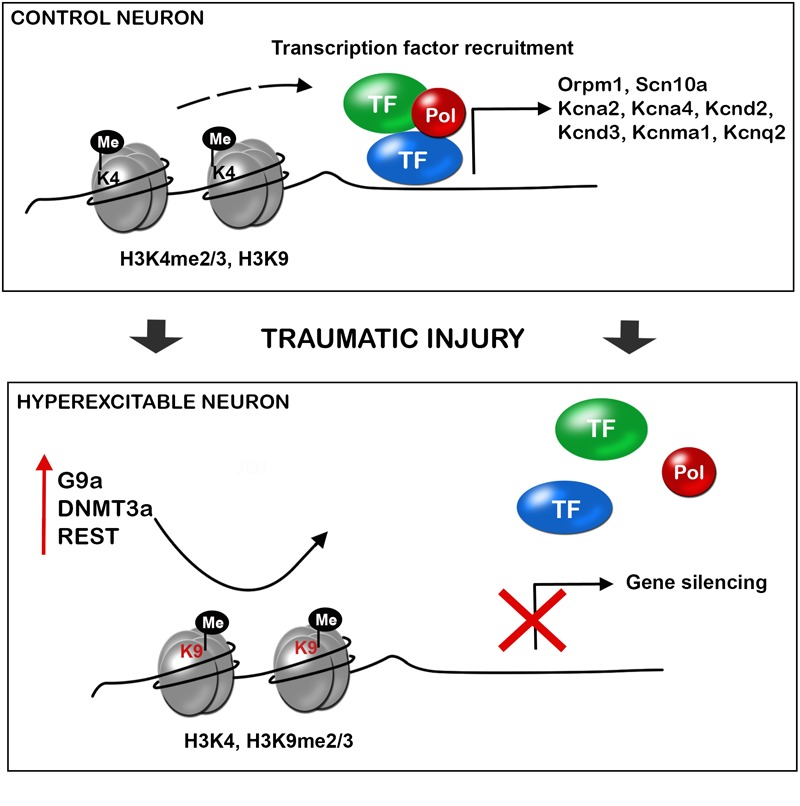
Accumulating evidence suggests that epigenetic alterations lie behind the induction and maintenance of neuropathic pain. Neuropathic pain is usually a chronic condition caused by a lesion, or pathological change, within the nervous system. Neuropathic pain appears frequently after nerve and spinal cord injuries or diseases, producing a debilitation of the patient and a decrease of the quality of life. At the cellular level, neuropathic pain is the result of neuronal plasticity shaped by an increase in the sensitivity and excitability of sensory neurons of the central and peripheral nervous system. One of the mechanisms thought to contribute to hyperexcitability and therefore to the ontogeny of neuropathic pain is the altered expression, trafficking, and functioning of receptors and ion channels expressed by primary sensory neurons. Besides, neuronal and glial cells, such as microglia and astrocytes, together with blood borne macrophages, play a critical role in the induction and maintenance of neuropathic pain by releasing powerful neuromodulators such as pro-inflammatory cytokines and chemokines, which enhance neuronal excitability. Altered gene expression of neuronal receptors, ion channels, and pro-inflammatory cytokines and chemokines, have been associated to epigenetic adaptations of the injured tissue. Within this review, we discuss the involvement of these epigenetic changes, including histone modifications, DNA methylation, non-coding RNAs, and alteration of chromatin modifiers, that have been shown to trigger modification of nociception after neural lesions. In particular, the function on these processes of EZH2, JMJD3, MeCP2, several histone deacetylases (HDACs) and histone acetyl transferases (HATs), G9a, DNMT, REST and diverse non-coding RNAs, are described. Despite the effort on developing new therapies, current treatments have only produced limited relief of this pain in a portion of patients. Thus, the present review aims to contribute to find novel targets for chronic neuropathic pain treatment.
越来越多的证据表明,表观遗传改变是神经性疼痛产生和维持的原因。神经性疼痛通常是一种由神经系统内的损伤或病理变化引起的慢性疾病。神经性疼痛在神经和脊髓损伤或疾病后经常出现,会导致患者身体衰弱并降低生活质量。在细胞水平上,神经性疼痛是中枢和外周神经系统感觉神经元敏感性和兴奋性增加所形成的神经元可塑性的结果。一种被认为导致神经元过度兴奋从而引发神经性疼痛发生的机制是初级感觉神经元所表达的受体和离子通道的表达、转运及功能发生改变。此外,神经元和神经胶质细胞,如小胶质细胞和星形胶质细胞,与血源性巨噬细胞一起,通过释放强大的神经调节剂,如促炎细胞因子和趋化因子,增强神经元兴奋性,在神经性疼痛的产生和维持中起关键作用。神经元受体、离子通道以及促炎细胞因子和趋化因子的基因表达改变与受损组织的表观遗传适应有关。在本综述中,我们讨论了这些表观遗传变化的参与情况,包括组蛋白修饰、DNA甲基化、非编码RNA以及染色质修饰剂的改变,这些变化已被证明会在神经损伤后引发痛觉改变。特别描述了EZH2、JMJD3、MeCP2、几种组蛋白去乙酰化酶(HDAC)和组蛋白乙酰转移酶(HAT)、G9a、DNMT、REST以及多种非编码RNA在这些过程中的作用。尽管在开发新疗法方面付出了努力,但目前的治疗仅使一部分患者的这种疼痛得到了有限缓解。因此,本综述旨在为寻找慢性神经性疼痛治疗的新靶点做出贡献。