Chujan Suthipong, Suriyo Tawit, Ungtrakul Teerapat, Pomyen Yotsawat, Satayavivad Jutamaad
Applied Biological Sciences Program, Chulabhorn Graduate Institute, Chulabhorn Royal Academy, Bangkok 10210, Thailand.
Laboratory of Pharmacology, Chulabhorn Research Institute, Bangkok 10210, Thailand.
Biomed Rep. 2018 Jul;9(1):42-52. doi: 10.3892/br.2018.1101. Epub 2018 May 22.
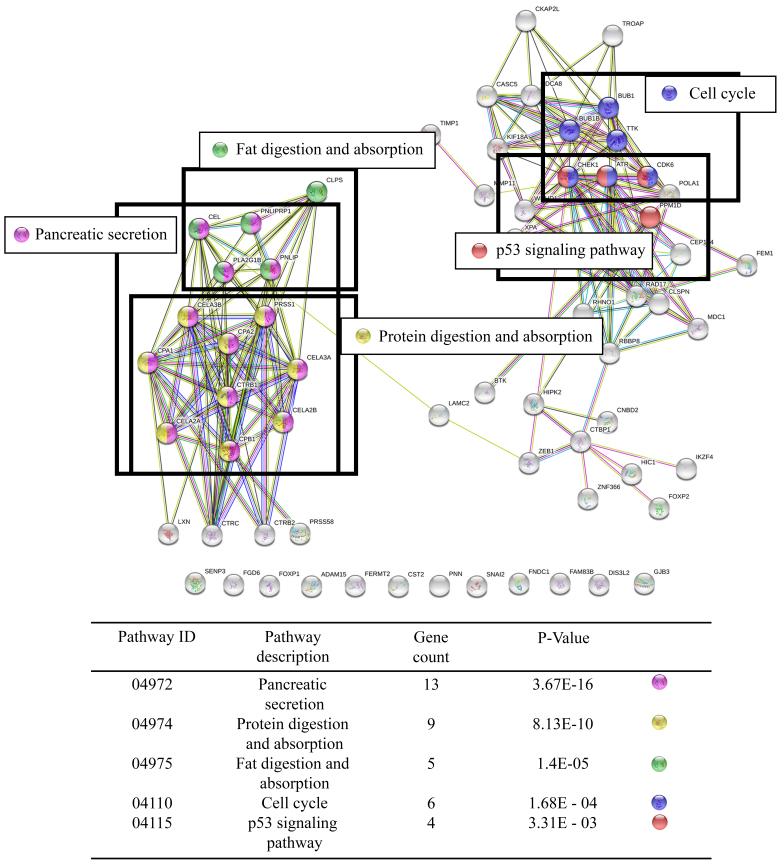
Cholangiocarcinoma (CCA) remains to be a major health problem in several Asian countries including Thailand. The molecular mechanism of CCA is poorly understood. Early diagnosis is difficult, and at present, no effective therapeutic drug is available. The present study aimed to identify the molecular mechanism of CCA by gene expression profile analysis and to search for current approved drugs which may interact with the upregulated genes in CCA. Gene Expression Omnibus (GEO) was used to analyze the gene expression profiles of CCA patients and normal subjects. Using the Kyoto Encyclopedia of Genes and Genomes (KEGG), gene ontology enrichment analysis was also performed, with the KEGG pathway analysis indicating that pancreatic secretion, protein digestion and absorption, fat digestion and absorption, and glycerolipid metabolism may serve important roles in CCA oncogenesis. The drug signature database (DsigDB) was used to search for US Food and Drug Administration (FDA)-approved drugs potentially capable of reversing the effects of the upregulated gene expression in CCA. A total of 61 antineoplastic and 86 non-antineoplastic drugs were identified. Checkpoint kinase 1 was the most interacting with drug signatures. Many of the targeted protein inhibitors that were identified have been approved by the US-FDA as therapeutic agents for non-antineoplastic diseases, including cimetidine, valproic acid and lovastatin. The current study demonstrated an application for bioinformatics analysis in assessing the potential efficacy of currently approved drugs for novel use. The present results suggest novel indications regarding existing drugs useful for CCA treatment. However, further and studies are required to support the current predictions.
胆管癌(CCA)在包括泰国在内的几个亚洲国家仍然是一个主要的健康问题。CCA的分子机制尚不清楚。早期诊断困难,目前尚无有效的治疗药物。本研究旨在通过基因表达谱分析确定CCA的分子机制,并寻找可能与CCA中上调基因相互作用的现有批准药物。利用基因表达综合数据库(GEO)分析CCA患者和正常受试者的基因表达谱。使用京都基因与基因组百科全书(KEGG)进行基因本体富集分析,KEGG通路分析表明胰腺分泌、蛋白质消化与吸收、脂肪消化与吸收以及甘油酯代谢可能在CCA的发生中起重要作用。利用药物特征数据库(DsigDB)搜索美国食品药品监督管理局(FDA)批准的可能能够逆转CCA中上调基因表达影响的药物。共鉴定出61种抗肿瘤药物和86种非抗肿瘤药物。检查点激酶1与药物特征的相互作用最为显著。许多鉴定出的靶向蛋白抑制剂已被美国FDA批准为非抗肿瘤疾病的治疗药物,包括西咪替丁、丙戊酸和洛伐他汀。本研究证明了生物信息学分析在评估现有批准药物新用途潜在疗效方面的应用。目前的结果提示了现有药物对CCA治疗有用的新适应症。然而,需要进一步的研究来支持当前的预测。