Luc-Harkey Brittney A, Franz Jason R, Losina Elena, Pietrosimone Brian
Orthopaedic and Arthritis Center for Outcomes Research, Department of Orthopedic Surgery, Brigham and Women's Hospital, Boston, MA, United States.
Joint Department of Biomedical Engineering, University of North Carolina at Chapel Hill and North Carolina State University, Chapel Hill, NC, United States.
Gait Posture. 2018 Jul;64:220-225. doi: 10.1016/j.gaitpost.2018.06.029. Epub 2018 Jun 18.
Individuals with anterior cruciate ligament reconstruction (ACLR) demonstrate persistent alterations in walking gait characteristics that contribute to poor long-term outcomes. Higher kinesiophobia, or fear of movement/re-injury, may result in the avoidance of movements that increase loading on the ACLR limb.
Determine the association between kinesiophobia and walking gait characteristics in physically active individuals with ACLR.
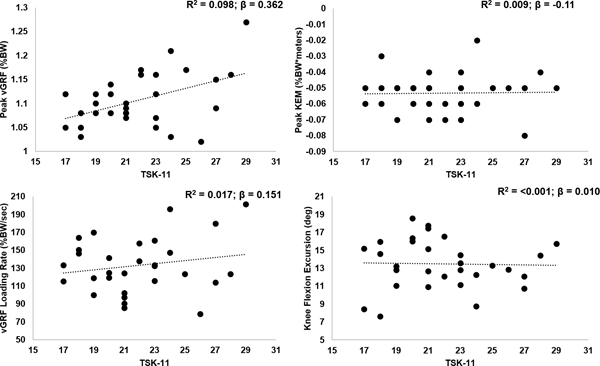
We enrolled thirty participants with a history of unilateral ACLR (49.35 ± 27.29 months following ACLR) into this cross-sectional study. We used the Tampa Scale for Kinesiophobia (TSK-11) to measure kinesiophobia. We collected walking gait characteristics during a 60-s walking trial, which included gait speed, peak vertical ground reaction force (vGRF), instantaneous vGRF loading rate, peak internal knee extension moment (KEM), and knee flexion excursion. We calculated lower extremity kinetic and kinematic measures on the ACLR limb, and limb symmetry indices between ACLR and contralateral limbs (LSI= [ACLR/contralateral]*100). We used linear regression models to determine the association between TSK-11 score and each walking gait characteristic. We determined the change in R (ΔR) when adding TSK-11 scores into the linear regression model after accounting for demographic covariates (sex, Tegner activity score, graft type, time since reconstruction, history of concomitant meniscal procedure).
We did not find a significant association between kinesiophobia and self-selected gait speed (ΔR 0.038, P = 0.319). Kinesiophobia demonstrated weak, non-significant associations with kinetic and kinematic outcomes on the ACLR limb and all LSI outcomes (ΔR range = 0.001-0.098).
These data do not support that kinesiophobia is a critical factor contributing to walking gait characteristics in physically active individuals with ACLR.
前交叉韧带重建(ACLR)患者的步行步态特征持续改变,这导致了较差的长期预后。较高的运动恐惧,即对运动/再次受伤的恐惧,可能导致避免增加ACLR肢体负荷的运动。
确定有运动恐惧与身体活跃的ACLR患者步行步态特征之间的关联。
我们招募了30名有单侧ACLR病史的参与者(ACLR后49.35±27.29个月)进入这项横断面研究。我们使用坦帕运动恐惧量表(TSK-11)来测量运动恐惧。我们在60秒的步行试验中收集步行步态特征,包括步速、垂直地面反作用力峰值(vGRF)、瞬时vGRF加载率、膝关节伸展内力矩峰值(KEM)和膝关节屈曲幅度。我们计算了ACLR肢体的下肢动力学和运动学指标,以及ACLR肢体与对侧肢体之间的肢体对称指数(LSI = [ACLR/对侧]×100)。我们使用线性回归模型来确定TSK-11评分与每个步行步态特征之间的关联。在考虑了人口统计学协变量(性别、Tegner活动评分、移植物类型、重建后的时间、半月板手术史)后,将TSK-11评分加入线性回归模型时,我们确定了R的变化(ΔR)。
我们没有发现运动恐惧与自我选择的步速之间存在显著关联(ΔR 0.038,P = 0.319)。运动恐惧与ACLR肢体的动力学和运动学结果以及所有LSI结果之间显示出微弱的、不显著的关联(ΔR范围 = 0.001 - 0.098)。
这些数据不支持运动恐惧是身体活跃的ACLR患者步行步态特征的关键影响因素这一观点。