Daniel-Wayman Shelby, Fahle Gary, Palmore Tara, Green Kim Y, Prevots D Rebecca
Epidemiology Unit, Laboratory of Clinical Immunology and Microbiology, National Institute of Allergy and Infectious Diseases, National Institutes of Health, 8 West Drive, MSC 2665, Bethesda, MD 20892, USA.
Department of Laboratory Medicine, Clinical Center, National Institutes of Health, 10 Center Drive, Bethesda, MD 20892, USA.
Diagn Microbiol Infect Dis. 2018 Oct;92(2):143-146. doi: 10.1016/j.diagmicrobio.2018.05.017. Epub 2018 May 29.
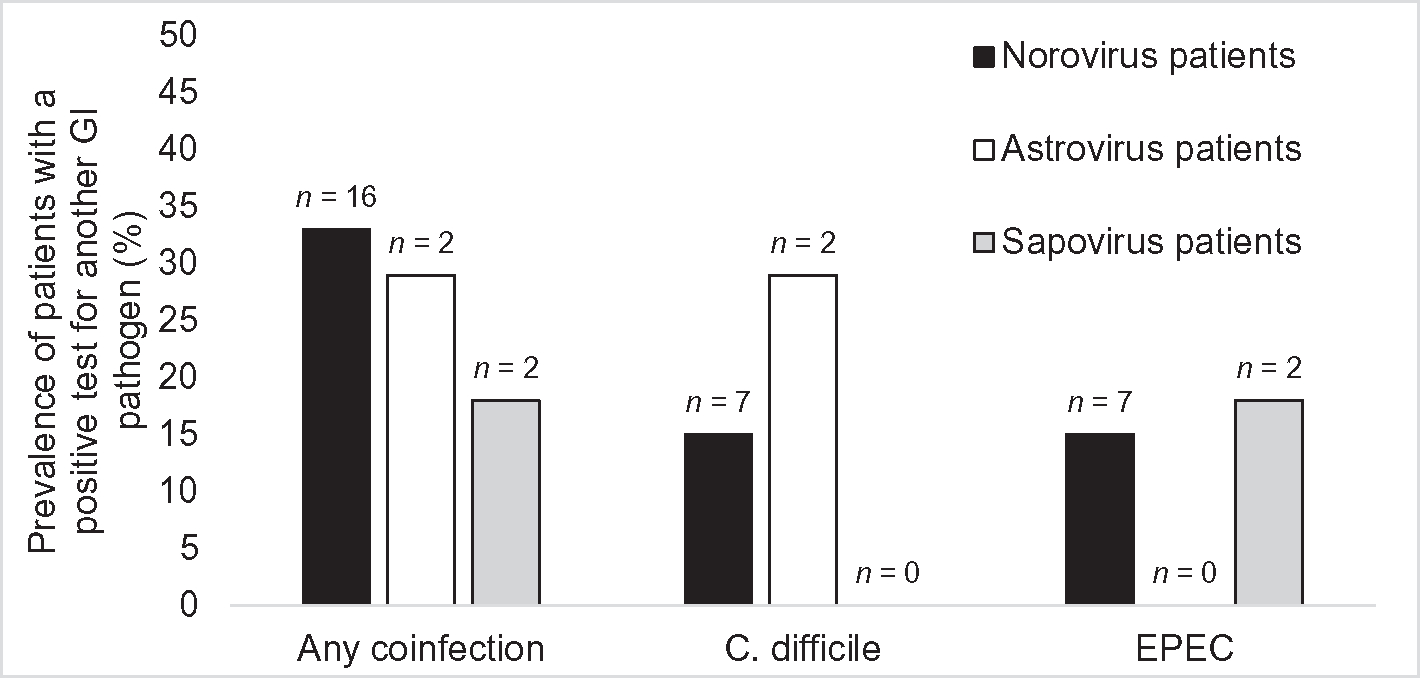
We estimated the prevalence of astrovirus, sapovirus, and norovirus among patients enrolled in research protocols and receiving medical care at the Clinical Center of the National Institutes of Health, Bethesda, MD, a clinical research hospital with a large immunocompromised patient population. We identified patients whose fecal specimens were submitted to the Clinical Center for testing on the Biofire FilmArray Gastrointestinal Panel from September 15, 2015 through November 30, 2016. Among 442 patients with fecal specimens submitted for multiplex testing, 11% had norovirus identified, 2% had astrovirus, and 2% had sapovirus. Like norovirus, astrovirus was detected in multiple sequential samples from a single patient, consistent with chronic infection or the occurrence of multiple reinfections. Coinfection with non-viral gastrointestinal pathogens was detected in 31% of patients with positive results for norovirus, astrovirus, or sapovirus. Norovirus remains common in this immunocompromised patient population, and both sapovirus and astrovirus are present.
我们估计了在国立卫生研究院临床中心(位于马里兰州贝塞斯达,是一家拥有大量免疫功能低下患者的临床研究医院)参与研究方案并接受医疗护理的患者中星状病毒、札幌病毒和诺如病毒的流行情况。我们确定了那些在2015年9月15日至2016年11月30日期间将粪便标本提交至临床中心,用于Biofire FilmArray胃肠道检测板检测的患者。在提交粪便标本进行多重检测的442名患者中,11%检测出诺如病毒,2%检测出星状病毒,2%检测出札幌病毒。与诺如病毒一样,在一名患者的多个连续样本中检测到星状病毒,这与慢性感染或多次再感染的发生情况一致。在诺如病毒、星状病毒或札幌病毒检测结果呈阳性的患者中,31%检测出合并感染非病毒性胃肠道病原体。诺如病毒在这个免疫功能低下的患者群体中仍然很常见,同时也存在札幌病毒和星状病毒。