Zhang Yan, Lu Shan, Niu Yadong, Zhang Liang
School of Medicine and Health Management, Tongji Medical College, Huazhong University of Science and Technology, Wuhan, Hubei, China.
Research Centre for Rural Health Service, Key Research Institute of Humanities & Social Sciences of Hubei Provincial Department of Education, Wuhan, Hubei, China.
BMJ Open. 2018 Jun 22;8(6):e022721. doi: 10.1136/bmjopen-2018-022721.
To identify the characteristics of high-cost (HC) patients and the determinants of the annual medical expenditures of Chinese rural residents.
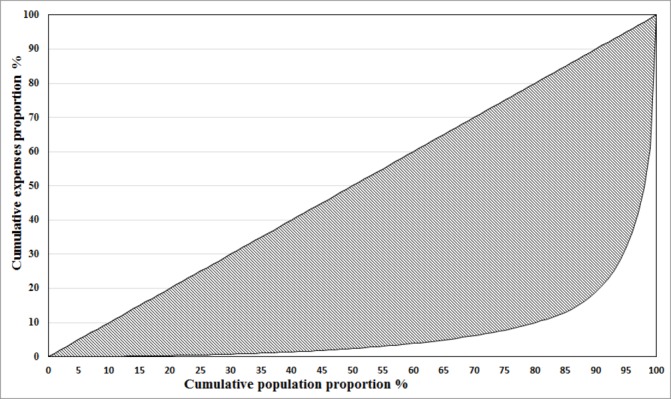
Medical expenditure clustering was performed by Lorentz curve and Gini index. T and X tests were performed to identify the characteristics of the respondents, and a multilevel regression model examined the determinants of their annual medical expenditures.
A cluster sampling study was performed to identify those residents who availed healthcare services and to assign them to HC (top 5%), moderate-cost (top 30%) and low-cost (others) groups based on their annual medical expenditures.
The annual healthcare utilisation was calculated by using data from the population-based database of the 2014 New Rural Cooperative Medical System.
A total of 478 051 residents who availed healthcare services were recruited for the retrospective study in 2014. The annual medical expenditures of these residents were used as the research object.
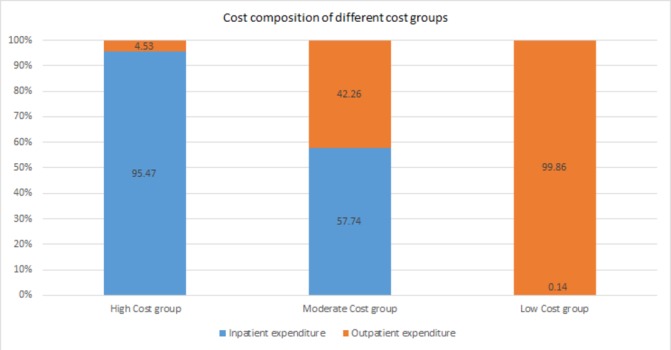
The total medical expenditures of Macheng city residents for the year 2014 have a Gini index of 0.81 and around 68.01% of these expenditures can be attributed to HC patients. Female residents (51.5%) and persons aged over 60 years (34.48%) who are suffering from diseases that are difficult to diagnose have a high tendency to accumulate high medical costs. The annual medical expenditures of people living in the same village or town tend to be approximated. Age, disease category, inpatient status, healthcare utilisation and utilisation level are identified as the determinants of annual medical expenditures.
The medical expenditures of rural residents are clustered at a remarkably high level, and HC patients are suffering from high economic burden. Therefore, policy-makers must guide these patients in seeking appropriate healthcare services and improve their management of healthcare quality to reduce the unnecessary healthcare utilisation of these patients.
ChiCTR-OOR-14005563.
确定中国农村居民中高费用(HC)患者的特征以及年度医疗支出的决定因素。
采用洛伦兹曲线和基尼系数进行医疗支出聚类。进行T检验和X检验以确定受访者的特征,并采用多层次回归模型研究其年度医疗支出的决定因素。
进行一项整群抽样研究,以确定那些使用医疗保健服务的居民,并根据他们的年度医疗支出将其分为HC组(前5%)、中等费用组(前30%)和低费用组(其他)。
利用2014年新型农村合作医疗系统基于人群的数据库中的数据计算年度医疗保健利用率。
2014年共招募了478051名使用医疗保健服务的居民进行回顾性研究。将这些居民的年度医疗支出作为研究对象。
麻城市居民2014年的总医疗支出基尼系数为0.81,其中约68.01%的支出可归因于HC患者。患有难以诊断疾病的女性居民(51.5%)和60岁以上的人群(34.48%)积累高额医疗费用的倾向较高。生活在同一村庄或城镇的居民年度医疗支出往往相近。年龄、疾病类别、住院状况、医疗保健利用率和利用水平被确定为年度医疗支出的决定因素。
农村居民的医疗支出聚集在非常高的水平,HC患者承受着高昂的经济负担。因此,政策制定者必须引导这些患者寻求适当的医疗保健服务,并改善他们对医疗质量的管理,以减少这些患者不必要的医疗保健利用。
ChiCTR-OOR-14005563。