Aydin Emrah, Joshi Rashika, Oria Marc, Varisco Brian Michael, Lim Foong-Yen, Peiro Jose Luis
The Center for Fetal, Cellular and Molecular Therapy, Cincinnati Fetal Center, Division of Pediatric General and Thoracic Surgery, Cincinnati Children's Hospital Medical Center, Cincinnati, Ohio.
The Division of Critical Care Medicine, Department of Pediatrics, Cincinnati Children's Hospital Medical Center, Cincinnati, Ohio.
J Surg Res. 2018 Sep;229:311-315. doi: 10.1016/j.jss.2018.04.028. Epub 2018 May 10.
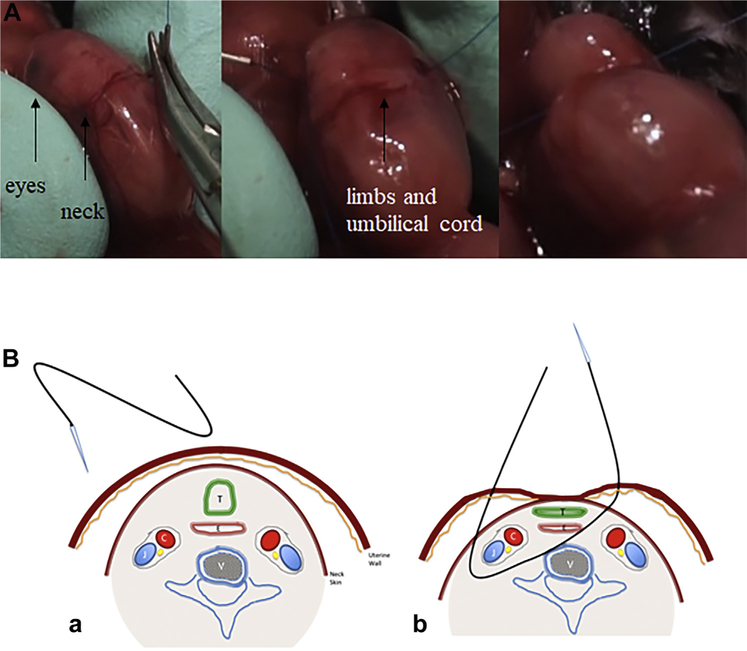
Fetal tracheal occlusion (TO) is an emerging surgical therapy in congenital diaphragmatic hernia that improves the fetal lung growth. Different animal models of congenital diaphragmatic hernia and TO present advantages and disadvantages regarding ethical issues, cost, surgical difficulty, size, survival rates, and available genetic tools. We developed a minimally invasive murine transuterine TO model, which will be useful in defining how TO impacts lung molecular biology, cellular processes, and overall lung physiology.
Time-mated C57BL/6 mice underwent laparotomy at embryonic day 16.5 (E16.5) with transuterine TO performed on two fetuses in each uterine horn. At E18.5, dams were sacrificed and fetuses harvested. The lungs of the TO fetuses were compared with the nonmanipulated counterparts by morphometric and histologic analysis.
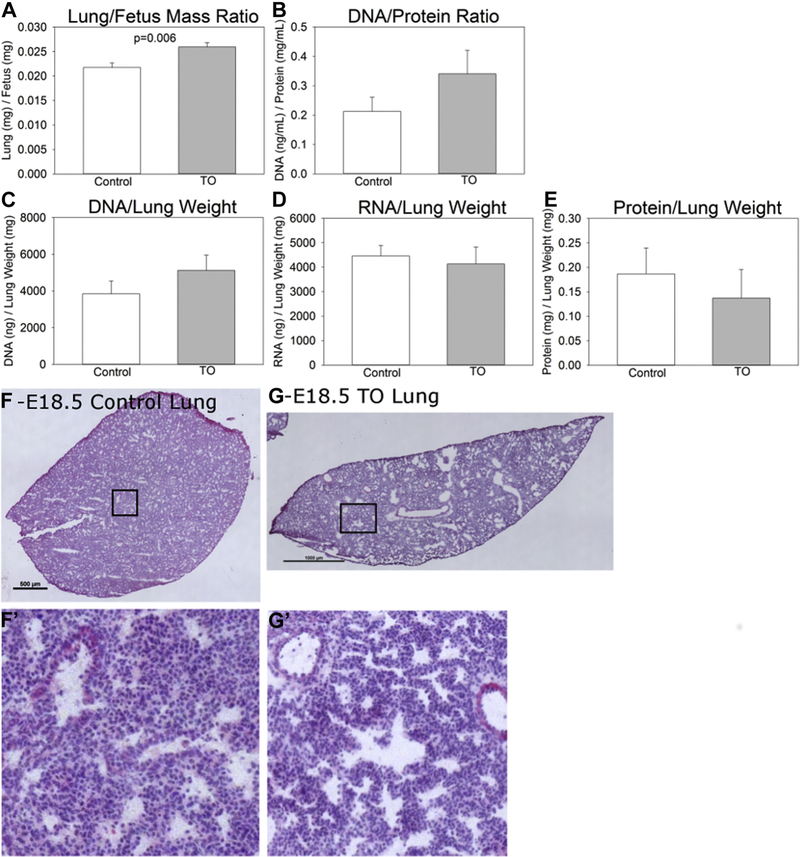
Successful TO was confirmed in 16 of 20 TO fetuses. Twelve of them survived to E18.5 (75%). Fetal weights were comparable, but lung weights were significantly greater in TO (28.41 ± 5.87 versus 23.38 ± 3.09, P = 0.043). Lung to body weight ratio was also greater (0.26 ± 0.003 versus 0.22 ± 0.002, P = 0.006). E18.5 TO lungs demonstrated dilated central and distal airspaces with increased cellularity. DNA/protein and DNA/lung weight ratios were elevated while protein/lung weight ratio was lower in TO compared to control.
Mice fetal transuterine TO is feasible with comparable outcomes to other current animal models. The increase in the lung weight, lung to body weight ratio and the DNA/protein ratio indicate organized lung growth rather than edema or cell hypertrophy.
胎儿气管闭塞(TO)是先天性膈疝中一种新兴的外科治疗方法,可促进胎儿肺生长。不同的先天性膈疝和TO动物模型在伦理问题、成本、手术难度、体型、存活率和可用的基因工具方面各有优缺点。我们开发了一种微创小鼠经子宫TO模型,这将有助于确定TO如何影响肺分子生物学、细胞过程和整体肺生理学。
对处于交配期的C57BL/6小鼠在胚胎第16.5天(E16.5)进行剖腹手术,在每个子宫角的两个胎儿上进行经子宫TO。在E18.5时,处死母鼠并取出胎儿。通过形态计量学和组织学分析,将TO胎儿的肺与未处理的对应胎儿的肺进行比较。
20只接受TO的胎儿中有16只确认TO成功。其中12只存活至E18.5(75%)。胎儿体重相当,但TO组的肺重量明显更大(28.41±5.87对23.38±3.09,P = 0.043)。肺与体重的比值也更高(0.26±0.003对0.22±0.002,P = 0.006)。E_{18.5}时TO组的肺显示中央和远端气腔扩张,细胞增多。与对照组相比,TO组的DNA/蛋白质和DNA/肺重量比值升高,而蛋白质/肺重量比值降低。
小鼠经子宫TO是可行的,其结果与其他现有动物模型相当。肺重量、肺与体重比值以及DNA/蛋白质比值的增加表明肺生长有序,而非水肿或细胞肥大。