Bendik Nathan F, Dries Laurie A
Watershed Protection Department Austin Texas.
Present address: Biodiversity Collections University of Texas at Austin Austin Texas.
Ecol Evol. 2018 May 4;8(11):5912-5923. doi: 10.1002/ece3.4130. eCollection 2018 Jun.
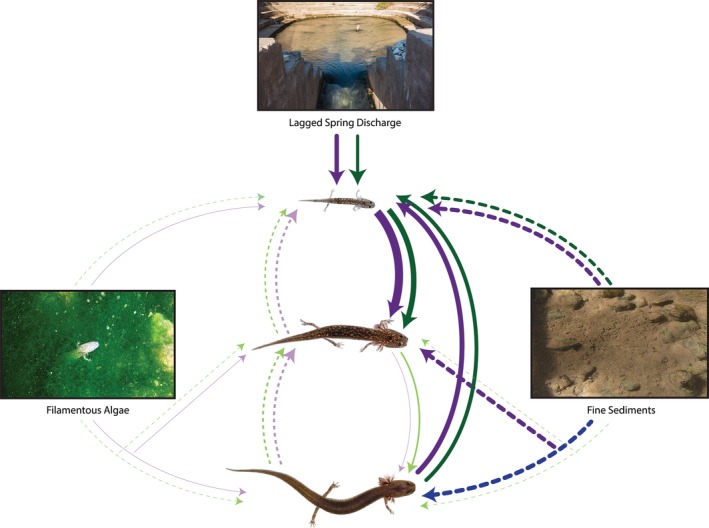
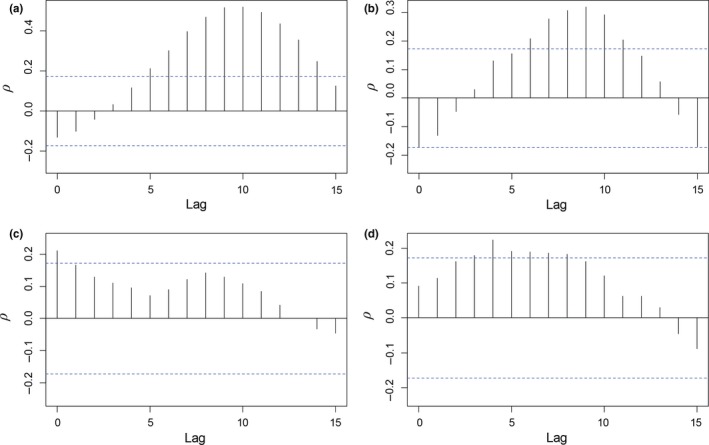
Understanding population change is essential for conservation of imperiled species, such as amphibians. Worldwide amphibian declines have provided an impetus for investigating their population dynamics, which can involve both extrinsic (density-independent) and intrinsic (density-dependent) drivers acting differentially across multiple life stages or age classes. In this study, we examined the population dynamics of the endangered Barton Springs Salamander () using data from a long-term monitoring program. We were interested in understanding both the potential environmental drivers (density-independent factors) and demographic factors (interactions among size classes, negative density dependence) to better inform conservation and management activities. We used data from three different monitoring regimes and multivariate autoregressive state-space models to quantify environmental effects (seasonality, discharge, algae, and sediment cover), intraspecific interactions among three size classes, and intra-class density dependence. Results from our primary data set revealed similar patterns among sites and size classes and were corroborated by our out-of-sample data. Cross-correlation analysis showed juvenile abundance was most strongly correlated with a 9-month lag in aquifer discharge, which we suspect is related to inputs of organic carbon into the aquifer. However, sedimentation limited juvenile abundance at the surface, emphasizing the importance of continued sediment management. Recruitment from juveniles to the sub-adult size class was evident, but negative density-dependent feedback ultimately regulated each size class. Negative density dependence may be an encouraging sign for the conservation of because populations that can reach carrying capacity are less likely to go extinct compared to unregulated populations far below their carrying capacity. However, periodic population declines coupled with apparent migration into the aquifer complicate assessments of species status. Although both density-dependent and density-independent drivers of population change are not always apparent in time series of animal populations, both have important implications for conservation and management of .
了解种群变化对于保护濒危物种(如两栖动物)至关重要。全球两栖动物数量的减少推动了对其种群动态的研究,这可能涉及在多个生命阶段或年龄组中起不同作用的外在(密度独立)和内在(密度依赖)驱动因素。在本研究中,我们利用一个长期监测项目的数据,研究了濒危的巴顿泉蝾螈( )的种群动态。我们有兴趣了解潜在的环境驱动因素(密度独立因素)和人口统计学因素(大小类之间的相互作用、负密度依赖),以便更好地为保护和管理活动提供信息。我们使用来自三种不同监测方案的数据和多元自回归状态空间模型,来量化环境影响(季节性、流量、藻类和沉积物覆盖)、三个大小类之间的种内相互作用以及类内密度依赖。我们主要数据集的结果揭示了不同地点和大小类之间的相似模式,并得到了我们样本外数据的证实。交叉相关分析表明,幼体丰度与含水层流量滞后9个月的相关性最强,我们怀疑这与有机碳输入含水层有关。然而,沉积物的堆积限制了地表幼体的丰度,这凸显了持续进行沉积物管理的重要性。从幼体到亚成体大小类别的补充是明显的,但负密度依赖反馈最终调节了每个大小类。负密度依赖对于 的保护可能是一个令人鼓舞的迹象,因为与远低于其承载能力的未受调控的种群相比,能够达到承载能力的种群灭绝的可能性较小。然而,周期性的种群数量下降以及明显向含水层的迁移,使物种状况的评估变得复杂。尽管在动物种群的时间序列中,种群变化的密度依赖和密度独立驱动因素并不总是明显的,但两者对 的保护和管理都具有重要意义。