Nakamura Rumi, Varsani Ali, Genestreti Kevin J, Le Contel Olivier, Nakamura Takuma, Baumjohann Wolfgang, Nagai Tsugunobu, Artemyev Anton, Birn Joachim, Sergeev Victor A, Apatenkov Sergey, Ergun Robert E, Fuselier Stephen A, Gershman Daniel J, Giles Barbara J, Khotyaintsev Yuri V, Lindqvist Per-Arne, Magnes Werner, Mauk Barry, Petrukovich Anatoli, Russell Christopher T, Stawarz Julia, Strangeway Robert J, Anderson Brian, Burch James L, Bromund Ken R, Cohen Ian, Fischer David, Jaynes Allison, Kepko Laurence, Le Guan, Plaschke Ferdinand, Reeves Geoff, Singer Howard J, Slavin James A, Torbert Roy B, Turner Drew L
Space Research Institute Austrian Academy of Sciences Graz Austria.
Laboratoire de Physique des Plasmas CNRS/Ecole Polytechnique/UPMC Univ Paris 06/University Paris-Sud/Observatoire de Paris Paris France.
J Geophys Res Space Phys. 2018 Feb;123(2):1260-1278. doi: 10.1002/2017JA024686. Epub 2018 Feb 20.
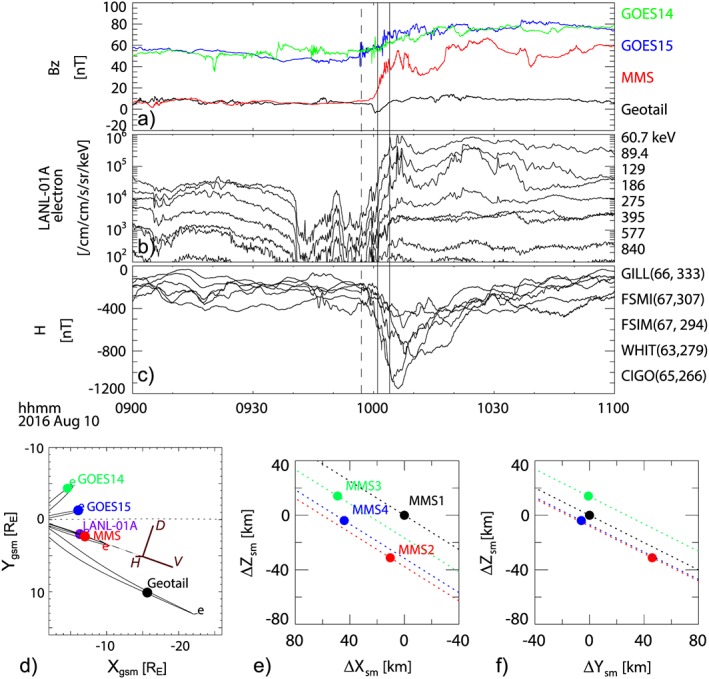
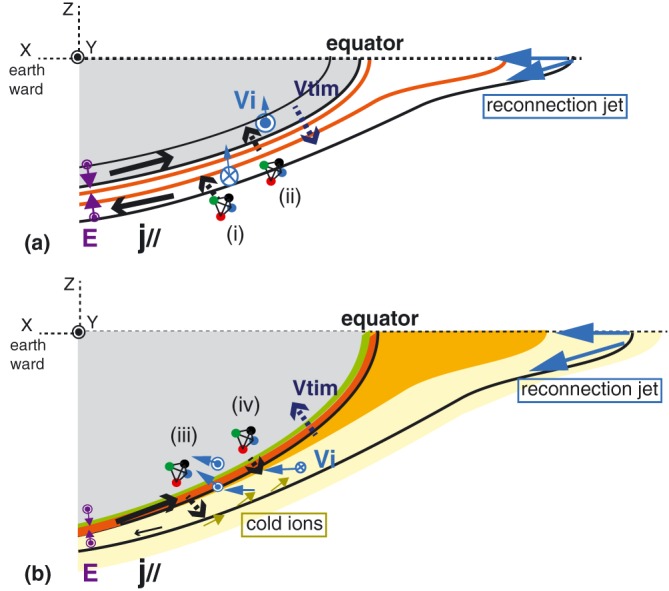
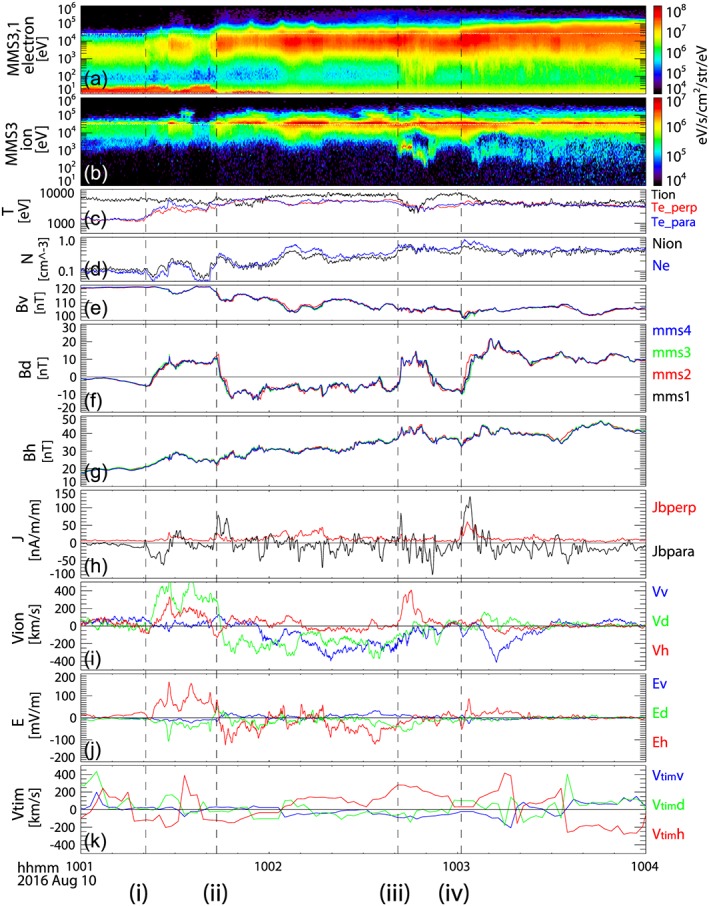
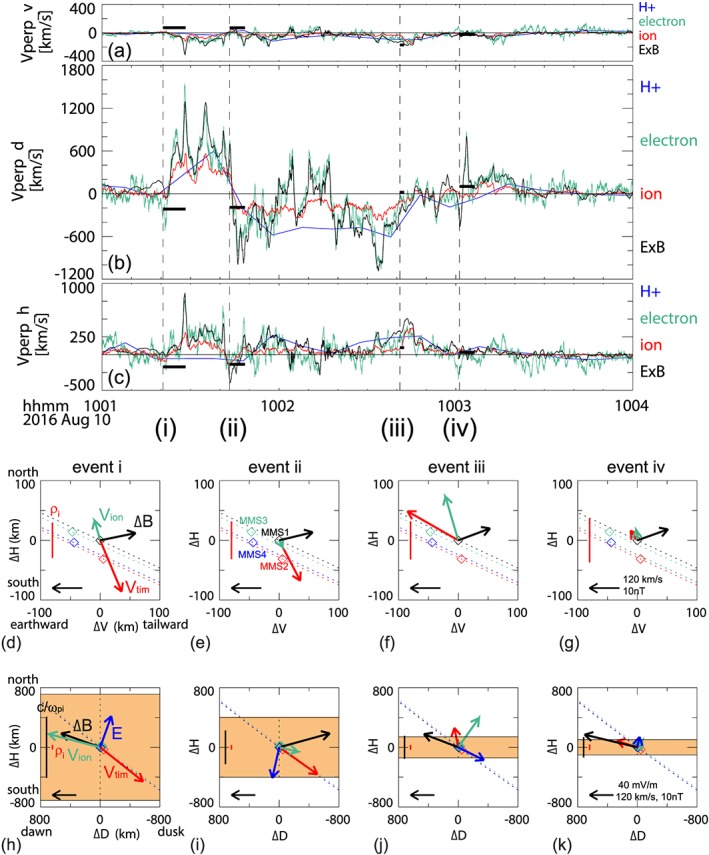
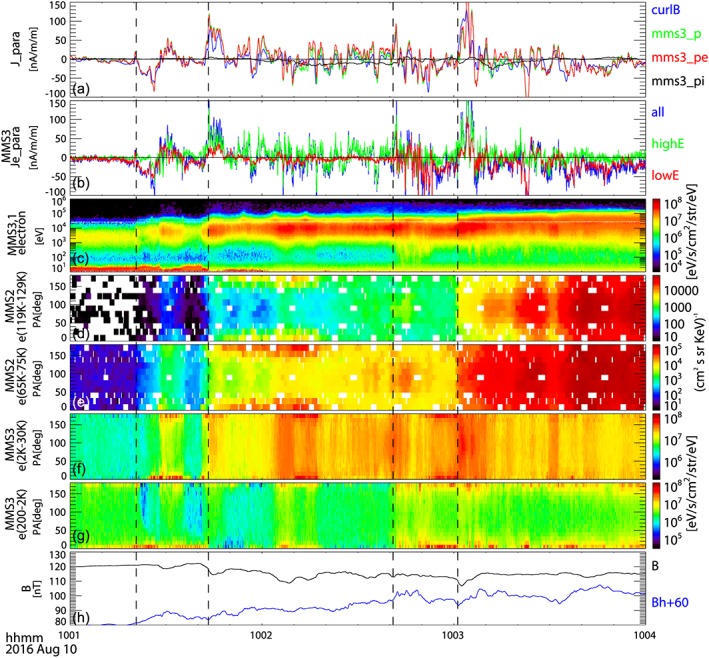
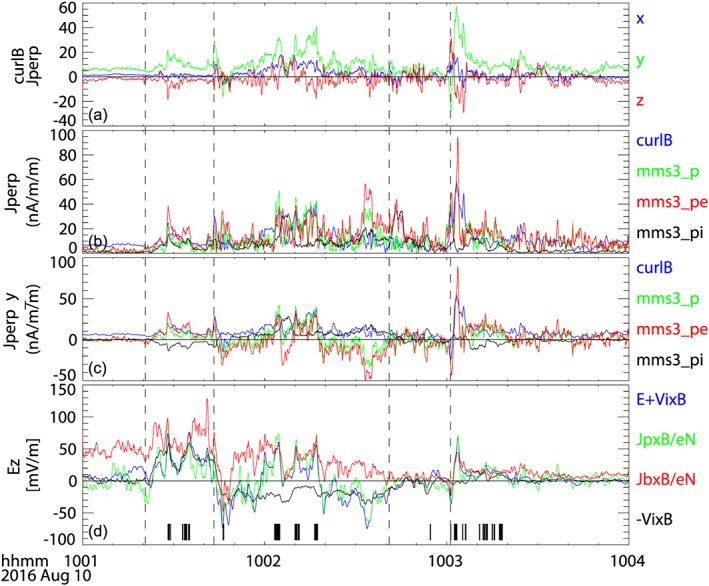
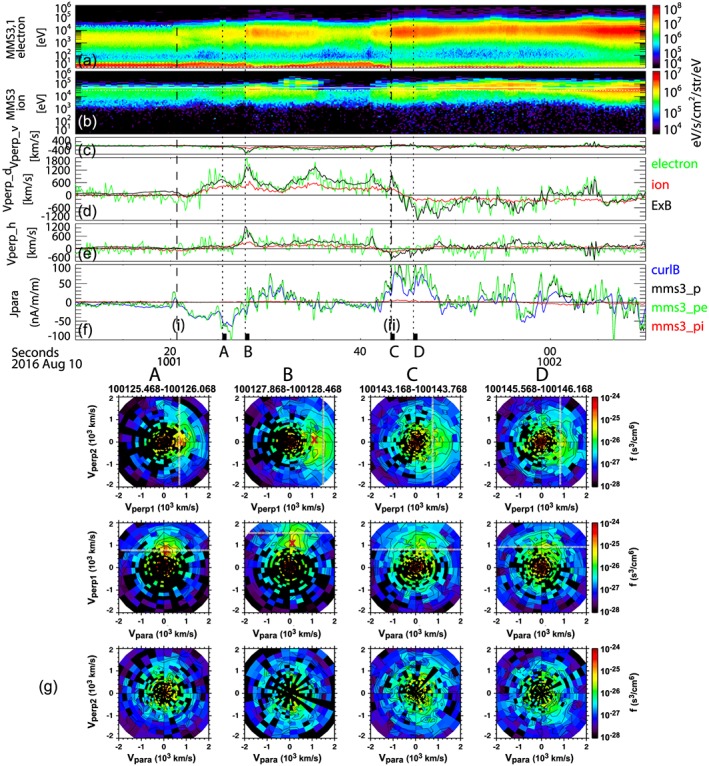
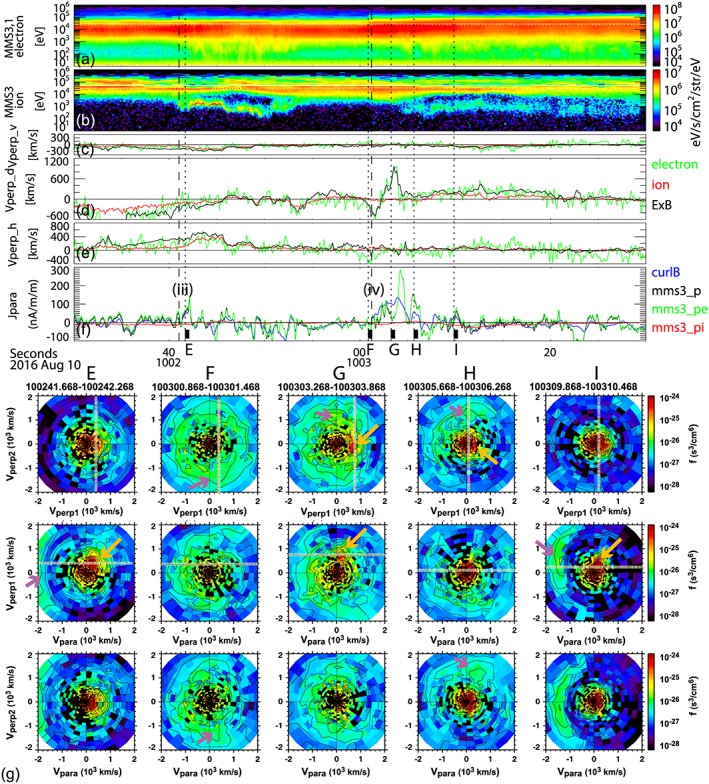
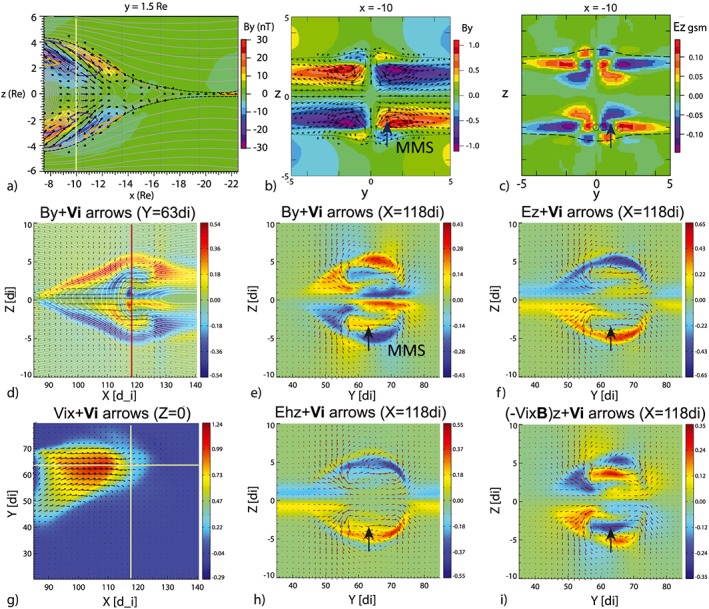
We present characteristics of current layers in the off-equatorial near-Earth plasma sheet boundary observed with high time-resolution measurements from the Magnetospheric Multiscale mission during an intense substorm associated with multiple dipolarizations. The four Magnetospheric Multiscale spacecraft, separated by distances of about 50 km, were located in the southern hemisphere in the dusk portion of a substorm current wedge. They observed fast flow disturbances (up to about 500 km/s), most intense in the dawn-dusk direction. Field-aligned currents were observed initially within the expanding plasma sheet, where the flow and field disturbances showed the distinct pattern expected in the braking region of localized flows. Subsequently, intense thin field-aligned current layers were detected at the inner boundary of equatorward moving flux tubes together with Earthward streaming hot ions. Intense Hall current layers were found adjacent to the field-aligned currents. In particular, we found a Hall current structure in the vicinity of the Earthward streaming ion jet that consisted of mixed ion components, that is, hot unmagnetized ions, cold E × B drifting ions, and magnetized electrons. Our observations show that both the near-Earth plasma jet diversion and the thin Hall current layers formed around the reconnection jet boundary are the sites where diversion of the perpendicular currents take place that contribute to the observed field-aligned current pattern as predicted by simulations of reconnection jets. Hence, multiscale structure of flow braking is preserved in the field-aligned currents in the off-equatorial plasma sheet and is also translated to ionosphere to become a part of the substorm field-aligned current system.
我们展示了在一次与多次双极化相关的强烈亚暴期间,利用磁层多尺度任务的高时间分辨率测量所观测到的赤道附近近地等离子体片边界处电流层的特征。四个磁层多尺度航天器相距约50公里,位于南半球亚暴电流楔黄昏部分。它们观测到快速流动扰动(高达约500公里/秒),在晨昏方向最为强烈。最初在膨胀的等离子体片中观测到场向电流,那里的流动和场扰动呈现出局部流动制动区域预期的独特模式。随后,在向赤道移动的通量管的内边界处检测到强烈的薄场向电流层以及向地球方向流动的热离子。在与场向电流相邻处发现了强烈的霍尔电流层。特别是,我们在向地球方向流动的离子喷流附近发现了一种霍尔电流结构,它由混合离子成分组成,即热的未磁化离子、冷的E×B漂移离子和磁化电子。我们的观测表明,近地等离子体喷流转向以及在重联喷流边界周围形成的薄霍尔电流层都是垂直电流发生转向的位置,这有助于形成如重联喷流模拟所预测的观测到的场向电流模式。因此,流动制动的多尺度结构在赤道外等离子体片的场向电流中得以保留,并且还传递到电离层,成为亚暴场向电流系统的一部分。