Department of Psychiatry, Kbo-IAK, Academic Teaching Hospital of the Ludwig-Maximilian University, Haar/ Munich, Germany.
Department of Psychiatry, Ludwig-Maximilian University, Munich, Germany.
Int J Neuropsychopharmacol. 2018 Sep 1;21(9):814-821. doi: 10.1093/ijnp/pyy048.
Suicidal ideations, suicide attempts, and fatal suicides are rare adverse drug reactions to antidepressant drugs, but they essentially are clinically relevant. Drawing on a larger dataset of the European drug surveillance program, the present naturalistic study updates a previous contribution (Stübner et al., 2010).
First an analysis of the comprehensive data collected in 81 psychiatric hospitals from 1993 to 2014 by the European drug surveillance program Arzneimittelsicherheit in der Psychiatrie was made. All documented single cases of suicidal ideations or behavior judged as adverse drug reactions to antidepressant drugs were carefully assessed as to their clinical features and drug prescriptions.
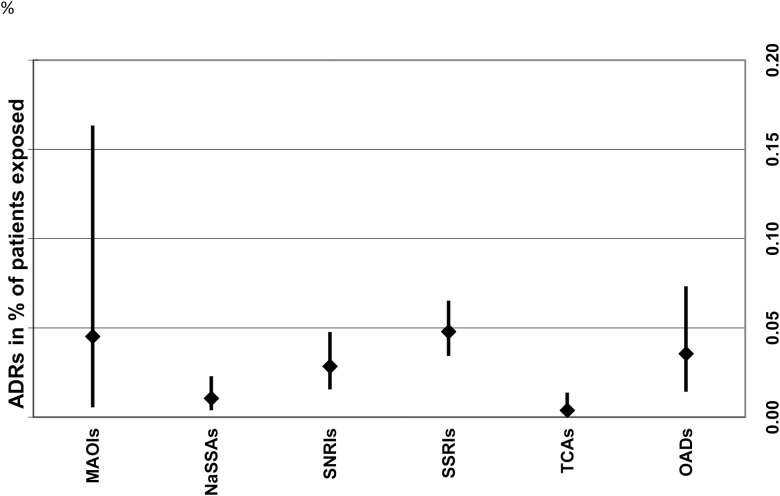
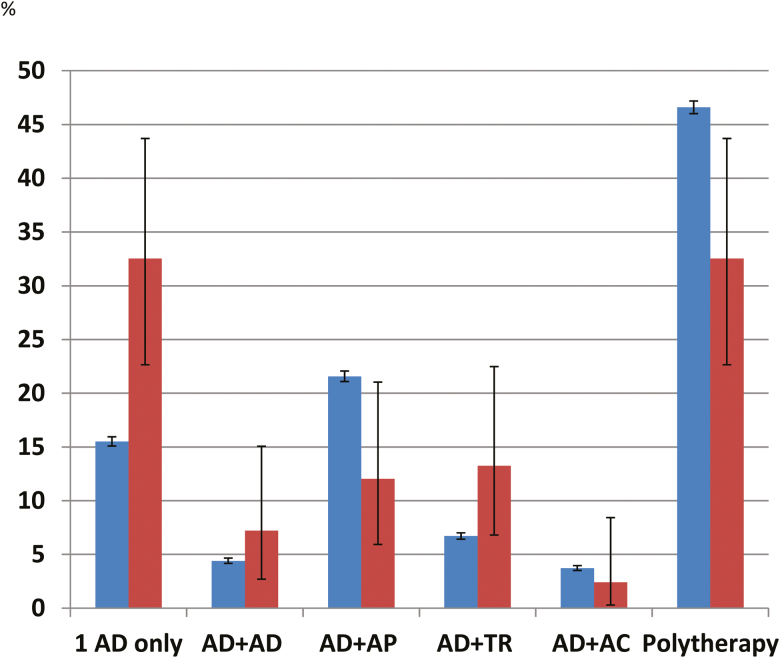
Among 219,635 adult hospitalized patients taking antidepressant drugs under surveillance, 83 cases of suicidal adverse drug reactions occurred (0.04%): 44 cases of suicidal ideation, 34 attempted suicides, and 5 committed suicides were documented. Restlessness was present in 42 patients, ego-dystonic intrusive suicidal thoughts or urges in 39 patients, impulsiveness in 22 patients, and psychosis in 7 patients. Almost all adverse drug reactions occurred shortly after beginning antidepressant drug medication or increasing the dosage. Selective serotonin reuptake inhibitors caused a higher incidence of suicidal ideation and suicidal behavior as adverse drug reactions than noradrenergic and specific serotonergic antidepressants or tricyclic antidepressants, as did monotherapy consisting of one antidepressant drug, compared to combination treatments.
The study supports the view that antidepressant drug-triggered suicidal ideation and suicidal behavior (primarily with selective serotonin reuptake inhibitors) are rare. Special clinical features (restlessness, ego-dystonic thoughts or urges, impulsiveness) may be considered as possible warning signs. A combination therapy might be preferable to antidepressant drug monotherapy when beginning treatment.
自杀意念、自杀企图和致命自杀是抗抑郁药罕见的不良反应,但它们在临床上具有重要意义。本研究利用欧洲药物监测计划更大的数据集,更新了之前的一项研究贡献(Stübner 等人,2010 年)。
首先对欧洲药物监测计划 Arzneimittelsicherheit in der Psychiatrie 于 1993 年至 2014 年在 81 家精神病院收集的综合数据进行分析。对所有记录的被判断为抗抑郁药不良反应的自杀意念或行为的单一病例进行了仔细评估,以了解其临床特征和药物处方。
在接受监测的 219635 名成年住院患者中,有 83 例发生自杀不良反应(0.04%):44 例自杀意念,34 例自杀企图,5 例自杀。42 例患者出现不安,39 例患者出现自我歪曲的侵入性自杀念头或冲动,22 例患者出现冲动,7 例患者出现精神病。几乎所有的不良反应都发生在开始抗抑郁药治疗或增加剂量后不久。与去甲肾上腺素能和特异性 5-羟色胺能抗抑郁药或三环类抗抑郁药相比,选择性 5-羟色胺再摄取抑制剂引起的自杀意念和自杀行为不良反应发生率更高,与使用一种抗抑郁药的单药治疗相比,联合治疗引起的不良反应发生率更高。
该研究支持这样一种观点,即抗抑郁药引发的自杀意念和自杀行为(主要是选择性 5-羟色胺再摄取抑制剂)较为罕见。特殊的临床特征(不安、自我歪曲的想法或冲动、冲动)可被视为可能的预警信号。在开始治疗时,联合治疗可能优于抗抑郁药单药治疗。