Department of Radiology and Nuclear Medicine, Erasmus University Medical Center, Rotterdam, The Netherlands.
Department of Radiology, Erasmus Medical Center Rotterdam, P.O Box 2040, 3015, CE, Rotterdam, The Netherlands.
Eur Radiol. 2019 Jan;29(1):309-318. doi: 10.1007/s00330-018-5510-3. Epub 2018 Jun 25.
To compare MR imaging with or without DWI and clinical response evaluation (CRE) in the local control evaluation of cervical carcinoma after radiotherapy.
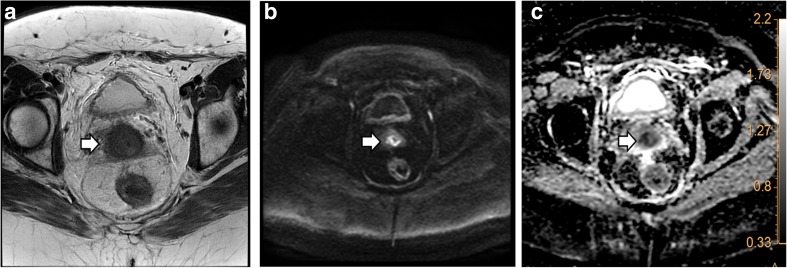
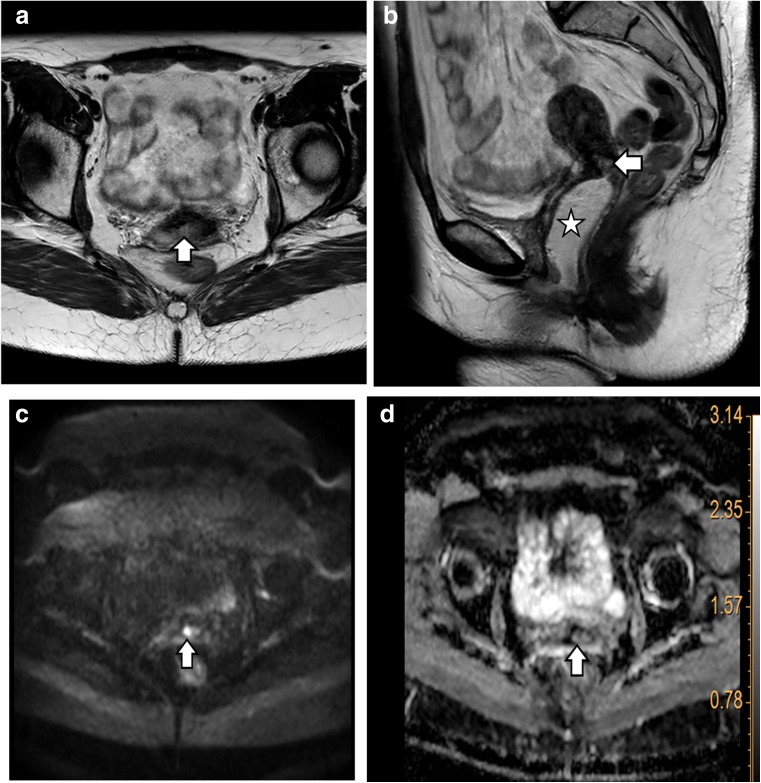
In a multicentre university setting, we prospectively included 107 patients with primary cervical cancer treated with radiotherapy. Sensitivity and specificity for CRE and MR imaging (with pre-therapy MR imaging as reference) (2 readers) were evaluated using cautious and strict criteria for identifying residual tumour. Nested logistic regression models were constructed for CRE, subsequently adding MR imaging with and without DWI as independent variables, as well as the pre- to post-treatment change in apparent diffusion coefficient (delta ADC).
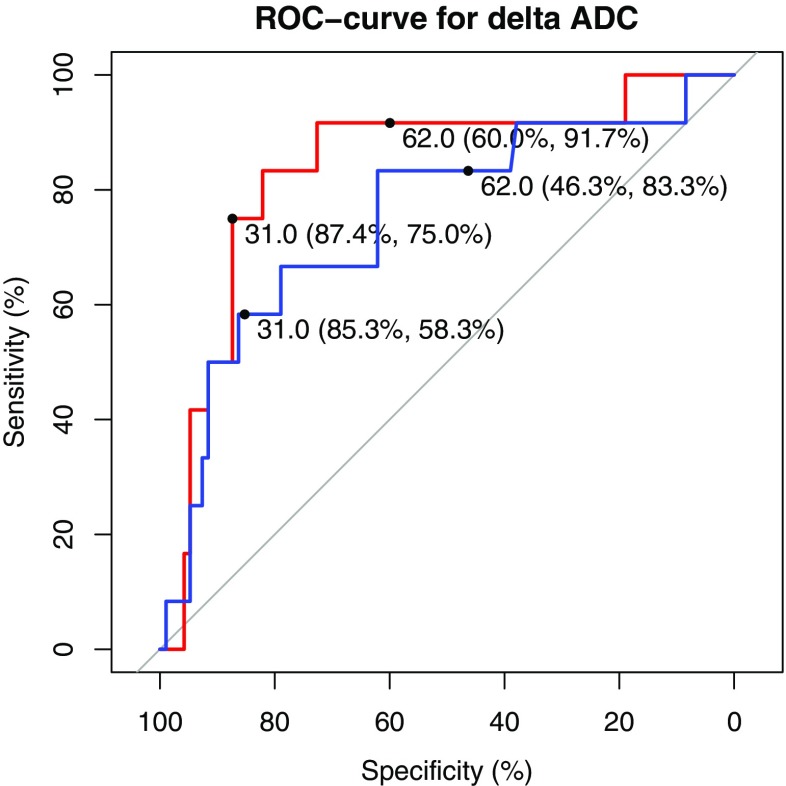
Using cautious criteria, CRE and MR imaging with DWI (reader 1/reader 2) have comparable high specificity (83% and 89%/95%, respectively), whereas MR imaging without DWI showed significantly lower specificity (63%/53%) than CRE. Using strict criteria, CRE and MR imaging with DWI both showed very high specificity (99% and 92%/95%, respectively), whereas MR imaging without DWI showed significantly lower specificity (89%/77%) than CRE. All sensitivities were not significantly different. Addition of MR imaging with DWI to CRE has statistically significant incremental value in identifying residual tumour (reader 1: estimate, 1.06; p = 0.001) (reader 2: estimate, 0.62; p = 0.02). Adding the delta ADC did not have significant incremental value in detecting residual tumour.
DWI significantly increases the specificity of MR imaging in the detection of local residual tumour. Furthermore, MR imaging with DWI has significant incremental diagnostic value over CRE, whereas adding the delta ADC has no incremental diagnostic value.
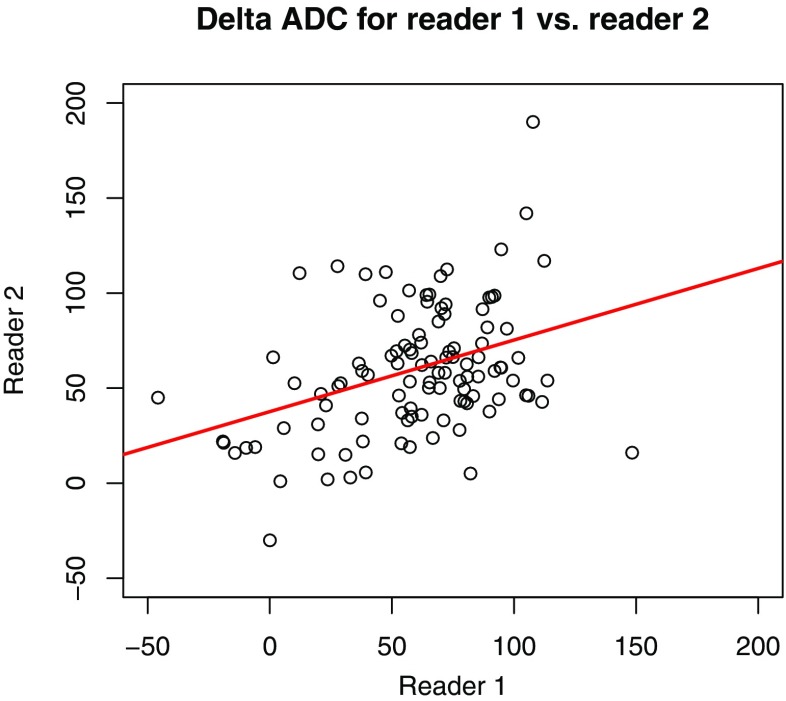
• If MR imaging is used for response evaluation, DWI should be incorporated • MR imaging with DWI has diagnostic value comparable/complementary to clinical response evaluation • Inter-reader agreement is moderate to fair for two experienced radiologist readers • Quantitative measurements of ADC early post-therapy have limited diagnostic value.
比较磁共振成像(MR 成像)加或不加弥散加权成像(DWI)与临床反应评估(CRE)在宫颈癌放疗后局部控制评估中的作用。
在多中心大学环境中,我们前瞻性地纳入了 107 例接受放疗的原发性宫颈癌患者。使用谨慎和严格的标准来识别残留肿瘤,评估 CRE 和 MR 成像(以治疗前的 MR 成像作为参考)(2 位读者)的敏感性和特异性。构建嵌套逻辑回归模型,将 CRE 作为因变量,MR 成像加或不加 DWI 以及表观扩散系数(ADC)的治疗前后变化(delta ADC)作为独立变量。
使用谨慎标准,CRE 和 MR 成像加 DWI(读者 1/读者 2)的特异性具有可比性(分别为 83%和 89%/95%),而不加 DWI 的 MR 成像特异性显著较低(分别为 63%/53%)。使用严格标准,CRE 和 MR 成像加 DWI 均显示出非常高的特异性(分别为 99%和 92%/95%),而不加 DWI 的 MR 成像特异性显著较低(分别为 89%/77%)。所有的敏感性均无显著差异。MR 成像加 DWI 与 CRE 联合应用具有统计学意义的识别残留肿瘤的增量价值(读者 1:估计值,1.06;p = 0.001)(读者 2:估计值,0.62;p = 0.02)。添加 delta ADC 对检测残留肿瘤没有显著的增量价值。
DWI 显著提高了 MR 成像检测局部残留肿瘤的特异性。此外,MR 成像加 DWI 比 CRE 具有显著的增量诊断价值,而添加 delta ADC 则没有增量诊断价值。
如果使用 MR 成像进行反应评估,则应纳入 DWI。
MR 成像加 DWI 具有与临床反应评估相当/互补的诊断价值。
两位有经验的放射科医生读者的读者间一致性为中等至良好。
治疗后早期 ADC 的定量测量值具有有限的诊断价值。