Gonsalez Sabrina Ribeiro, Ferrão Fernanda Magalhães, Souza Alessandro Miranda de, Lowe Jennifer, Morcillo Lucienne da Silva Lara
Universidade Federal do Rio de Janeiro, Instituto de Ciências Biomédicas, Rio de Janeiro, RJ, Brasil.
Universidade do Estado do Rio de Janeiro, Instituto de Biologia Roberto Alcântara Gomes, Rio de Janeiro, RJ, Brasil.
J Bras Nefrol. 2018 Apr-Jun;40(2):170-178. doi: 10.1590/2175-8239-jbn-3661. Epub 2018 Jun 18.
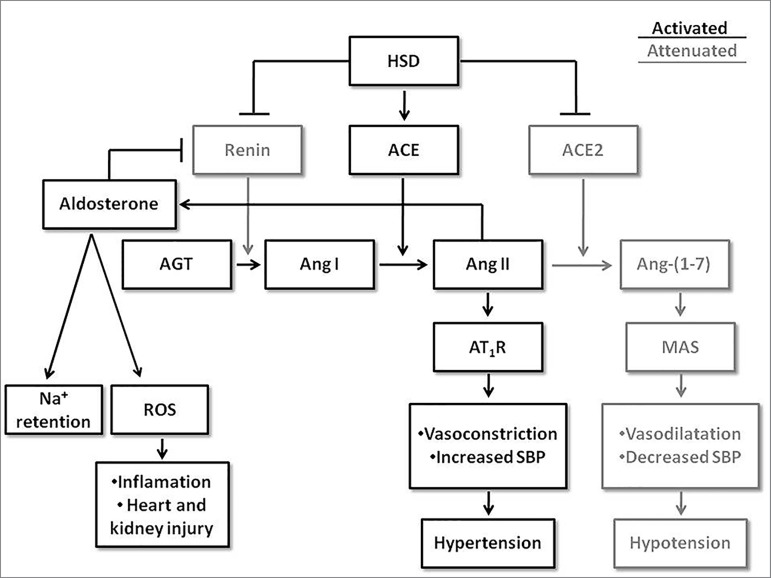
Although there is a general agreement on the recommendation for reduced salt intake as a public health issue, the mechanism by which high salt intake triggers pathological effects on the cardio-renal axis is not completely understood. Emerging evidence indicates that the renin-angiotensin-aldosterone system (RAAS) is the main target of high Na+ intake. An inappropriate activation of tissue RAAS may lead to hypertension and organ damage. We reviewed the impact of high salt intake on the RAAS on the cardio-renal axis highlighting the molecular pathways that leads to injury effects. We also provide an assessment of recent observational studies related to the consequences of non-osmotically active Na+ accumulation, breaking the paradigm that high salt intake necessarily increases plasma Na+ concentration promoting water retention.
尽管将减少盐摄入量作为一个公共卫生问题的建议已达成普遍共识,但高盐摄入对心肾轴引发病理效应的机制尚未完全明确。新出现的证据表明,肾素-血管紧张素-醛固酮系统(RAAS)是高钠摄入的主要靶点。组织RAAS的不适当激活可能导致高血压和器官损伤。我们综述了高盐摄入对心肾轴上RAAS的影响,重点关注导致损伤效应的分子途径。我们还对近期与非渗透活性钠积累后果相关的观察性研究进行了评估,打破了高盐摄入必然会增加血浆钠浓度并促进水潴留的范式。