MRC Centre for Global Infectious Disease Analysis, Department of Infectious Disease Epidemiology, Imperial College London, London, United Kingdom.
PLoS One. 2018 Jun 26;13(6):e0199450. doi: 10.1371/journal.pone.0199450. eCollection 2018.
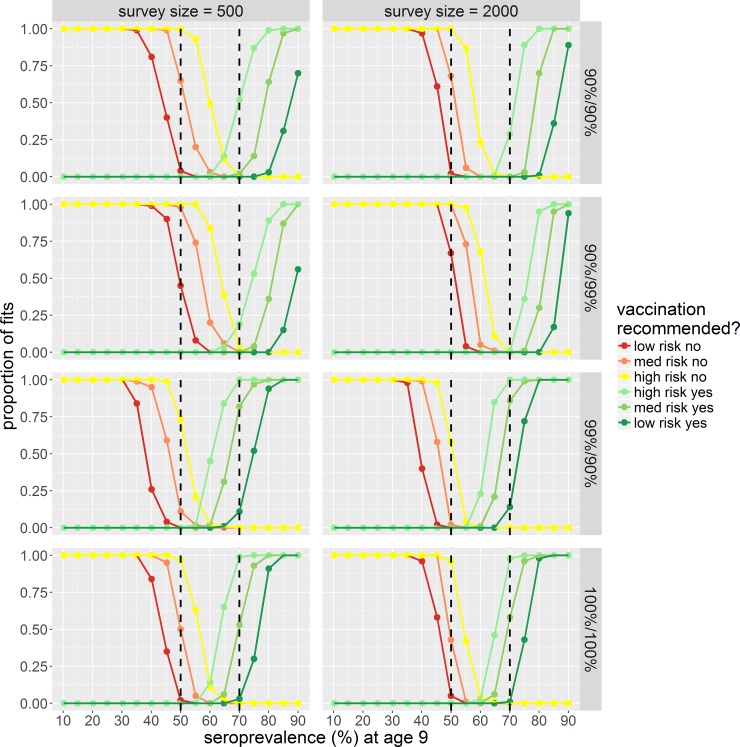
The CYD-TDV vaccine was unusual in that the recommended target population for vaccination was originally defined not only by age, but also by transmission setting as defined by seroprevalence. WHO originally recommended countries consider vaccination against dengue with CYD-TDV vaccine in geographic settings only where prior infection with any dengue serotype, as measured by seroprevalence, was >170% in the target age group. Vaccine was not recommended in settings where seroprevalence was <50%. Test-and-vaccinate strategies suggested following new analysis by Sanofi will still require age-stratified seroprevalence surveys to optimise age-group targeting. Here we address considerations for serosurvey design in the context of vaccination program planning.
To explore how the design of seroprevalence surveys affects estimates of transmission intensity, 100 age-specific seroprevalence surveys were simulated using a beta-binomial distribution and a simple catalytic model for different combinations of age-range, survey size, transmission setting, and test sensitivity/specificity. We then used a Metropolis-Hastings Markov Chain Monte-Carlo algorithm to estimate the force of infection from each simulated dataset.
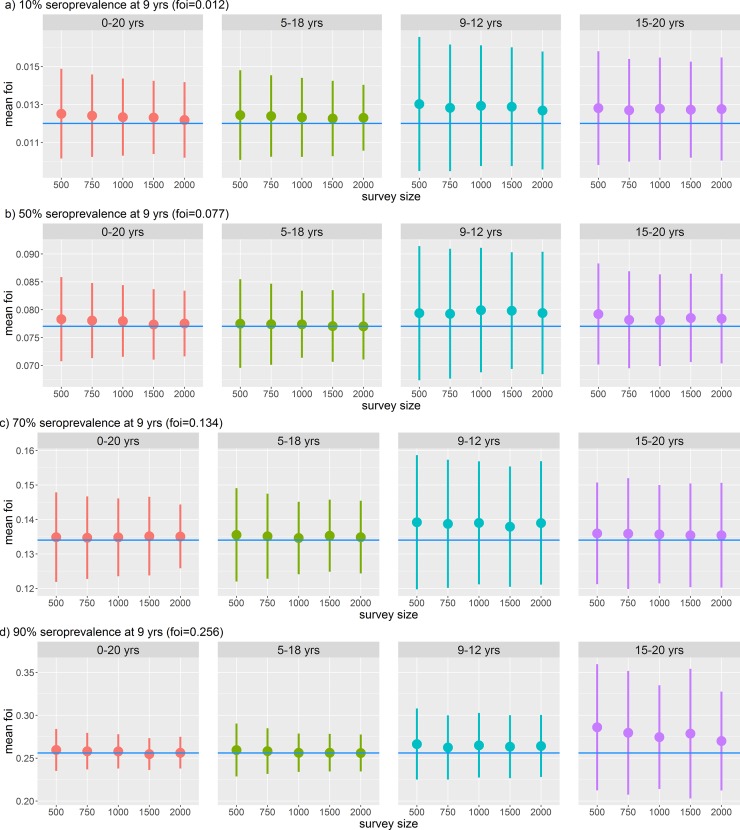
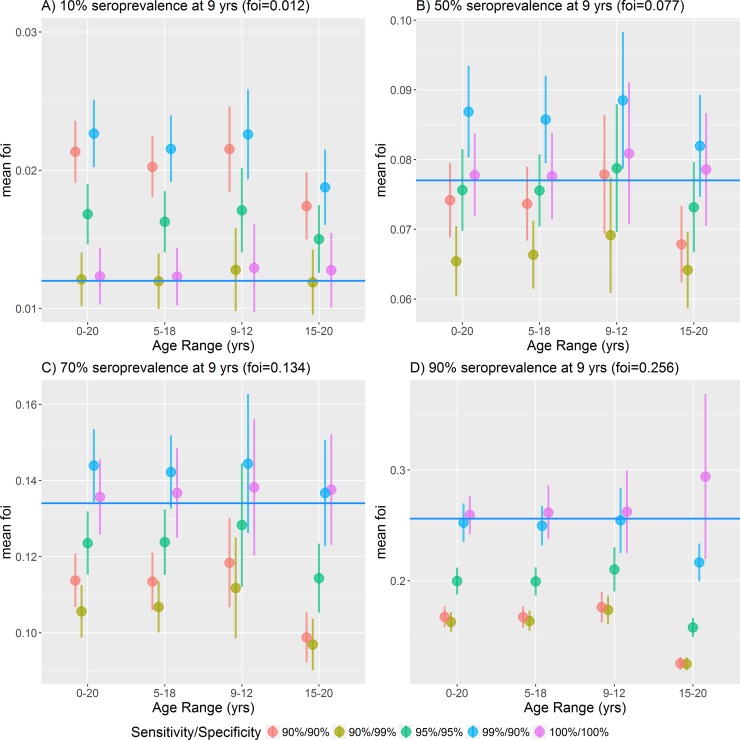
Sampling from a wide age-range led to more accurate estimates than merely increasing sample size in a narrow age-range. This finding was consistent across all transmission settings. The optimum test sensitivity and specificity given an imperfect test differed by setting with high sensitivity being important in high transmission settings and high specificity important in low transmission settings.
When assessing vaccination suitability by seroprevalence surveys, countries should ensure an appropriate age-range is sampled, considering epidemiological evidence about the local burden of disease.
CYD-TDV 疫苗不同寻常,因为最初推荐的接种目标人群不仅按年龄定义,还按血清流行率定义的传播环境定义。世界卫生组织最初建议各国仅在目标年龄组的血清流行率通过血清流行率测量大于 170%的地理环境中考虑使用 CYD-TDV 疫苗预防登革热。在血清流行率 <50%的环境中不推荐使用疫苗。赛诺菲公司进行的新分析建议采用检测和接种策略,仍需要分层血清流行率调查,以优化年龄组的目标人群。在这里,我们针对疫苗接种规划背景下的血清学调查设计问题进行探讨。
为了探讨血清流行率调查的设计如何影响传播强度的估计,我们使用贝塔二项式分布和简单的催化模型,针对不同的年龄范围、调查规模、传播环境和检测敏感性/特异性组合,模拟了 100 个特定年龄的血清流行率调查。然后,我们使用 Metropolis-Hastings 马尔可夫链蒙特卡罗算法,从每个模拟数据集估计感染率。
与在狭窄年龄范围内仅增加样本量相比,从广泛的年龄范围采样可以得出更准确的估计值。这一发现适用于所有传播环境。在给定不完美检测的情况下,最优检测敏感性和特异性因环境而异,高传播环境中重要的是高敏感性,低传播环境中重要的是高特异性。
在通过血清流行率调查评估疫苗接种适宜性时,各国应考虑当地疾病负担的流行病学证据,确保适当的年龄范围被采样。