Dwommoh Rebecca, Sorsdahl Katherine, Myers Bronwyn, Asante Kwaku Poku, Naledi Tracey, Stein Dan J, Cleary Susan
1Health Economics Unit, School of Public Health and Family Medicine, Faculty of Health Sciences, University of Cape Town, Observatory, Cape Town, 7925 South Africa.
2Kintampo Health Research Centre, P.O. Box 200, Kintampo, Ghana.
Cost Eff Resour Alloc. 2018 Jun 18;16:24. doi: 10.1186/s12962-018-0109-8. eCollection 2018.
There are limited data describing the cost-effectiveness of brief interventions for substance use in resource-poor settings. Using a patient and provider perspective, this study investigates the cost-effectiveness of a brief motivational interviewing (MI) intervention versus a combined intervention of MI and problem solving therapy (MI-PST) for reducing substance use among patients presenting to emergency departments, in comparison to a control group.
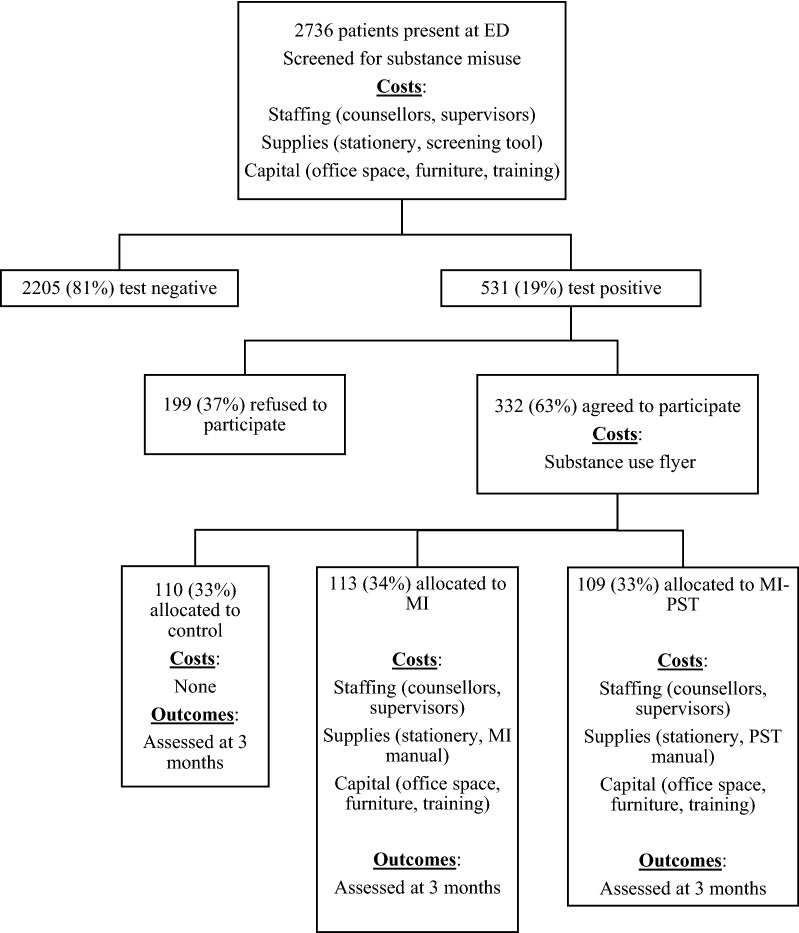
Effectiveness data were extracted from Project STRIVE (Substance use and Trauma InterVention) conducted in South Africa. Patients were randomised to either receive 1 session of MI (n = 113) or MI in addition to four sessions of PST (n = 109) or no intervention [control (n = 110)]. Costs included the direct health care costs associated with the interventions. Patient costs included out of pocket payments incurred accessing the MI-PST intervention. Outcome measures were patients' scores on the Alcohol, Smoking and Substance Use Involvement Screening Test (ASSIST) and the Centre for Epidemiological Studies Depression Scale (CES-D).
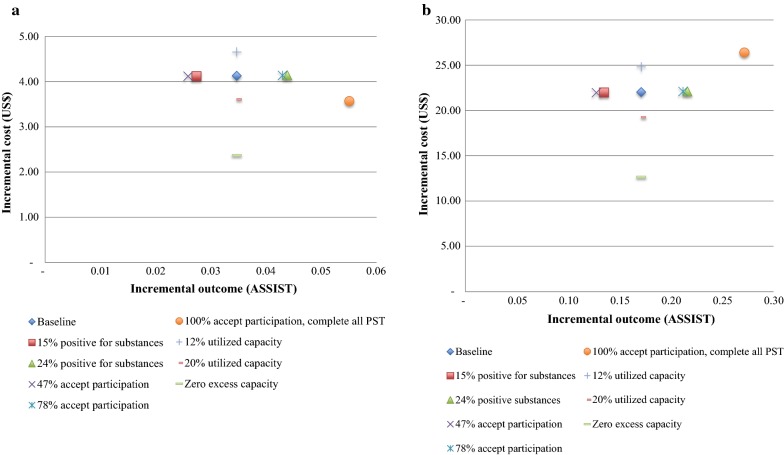
Cost per patient was low in all three groups; US$16, US$33 and US$11, and for MI, MI-PST and control respectively. Outcomes were 0.92 (MI), 1.06 (MI-PST) and 0.88 (control) for ASSIST scores; and 0.74 (MI), 1.27 (MI-PST) and 0.53 (control) for CES-D scores. In comparison to the control group, the MI intervention costs an additional US$119 per unit reduction in ASSIST score, (US$20 for CES-D); MI-PST in comparison to MI costs US$131 or US$33 per unit reduction in ASSIST or CES-D scores respectively. The sensitivity analyses showed that increasing the number of patients who screened positive and thus received the intervention could improve the effectiveness and cost-effectiveness of the interventions.
MI or MI-PST interventions delivered by lay counsellors have the potential to be cost-effective strategies for the reduction of substance use disorder and depressive symptoms among patients presenting at emergency departments in resource poor settings. Given the high economic, social and health care cost of substance use disorders in South Africa, these results suggest that these interventions should be carefully considered for future implementation. This study is part of a trial registered with the Pan African Clinical Trial Registry (PACTR201308000591418).
关于在资源匮乏环境中针对物质使用进行简短干预的成本效益的数据有限。本研究从患者和提供者的角度,调查了与对照组相比,简短动机性访谈(MI)干预与MI和问题解决疗法相结合的干预措施(MI-PST)在减少急诊科患者物质使用方面的成本效益。
有效性数据取自于在南非开展的“努力项目”(物质使用与创伤干预)。患者被随机分为三组,分别接受1次MI干预(n = 113)、除4次PST外还接受MI干预(n = 109)或不接受干预(对照组,n = 110)。成本包括与干预相关的直接医疗保健成本。患者成本包括接受MI-PST干预产生的自付费用。结果指标为患者在酒精、吸烟及物质使用参与度筛查测试(ASSIST)和流行病学研究中心抑郁量表(CES-D)上的得分。
三组中每位患者的成本都很低,MI组为16美元,MI-PST组为33美元,对照组为11美元。ASSIST得分方面,MI组为0.92,MI-PST组为1.06,对照组为0.88;CES-D得分方面,MI组为0.74,MI-PST组为1.27,对照组为0.53。与对照组相比,MI干预每降低一个ASSIST得分单位额外花费119美元(CES-D得分为20美元);MI-PST与MI相比,每降低一个ASSIST或CES-D得分单位分别额外花费131美元或33美元。敏感性分析表明,增加筛查呈阳性并因此接受干预的患者数量可提高干预措施的有效性和成本效益。
由非专业咨询师提供的MI或MI-PST干预措施有可能成为在资源匮乏环境中减少急诊科患者物质使用障碍和抑郁症状的具有成本效益的策略。鉴于南非物质使用障碍在经济、社会和医疗保健方面的高昂成本,这些结果表明这些干预措施在未来实施时应予以仔细考虑。本研究是在泛非临床试验注册中心(PACTR201308000591418)注册的一项试验的一部分。