Dong Pengxin, Hu Hao, Guan Xiaodong, Ung Carolina Oi Lam, Shi Luwen, Han Sheng, Yu Shuwen
1School of Pharmaceutical Sciences, Shandong University, Jinan, Shandong China.
2International Research Center of Medical Administration, Peking University, Beijing, China.
Chin Med. 2018 Jun 14;13:28. doi: 10.1186/s13020-018-0185-x. eCollection 2018.
Complicated with the impact of aging population and urbanization, coronary heart disease (CHD) incurs more and more disease burdens in China. Salvianolate injection is a Chinese patent drug widely used for treating CHD in China. A series of studies have verified the efficacy of salvianolate injection , but the high drug cost has raised concerns. It is, therefore, important to conduct cost-consequence analysis to demonstrate whether salvianolate injection is associated with outcome improvement and cost containment. The aim of this study was to retrospectively evaluate the cost-consequence of salvianolate injection for the treatment of coronary heart disease by combining salvianolate injection with conventional treatment from a societal perspective.
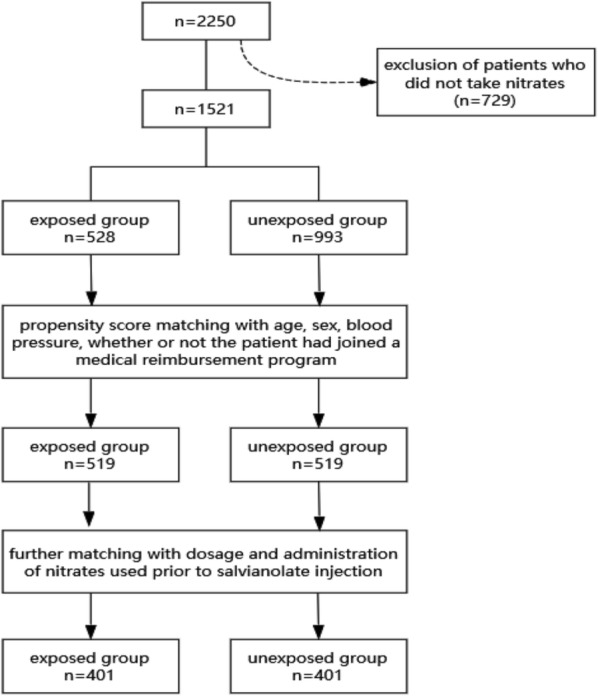
We retrospectively studied hospitalized patients with CHD from August 2011 to December 2015 by using electronic medical record database. Patients who received salvianolate injection combined with conventional treatment were selected as exposed group, while those who received conventional treatment alone were selected as unexposed group. Propensity score matching (PSM) analysis was used to balance the characteristics of patients. After PSM, we evaluated hospital stay, total nitrates dosage, total medical costs, and subcategories costs. Patients with chronic ischemic heart disease were analyzed as a highly selected subcohort.
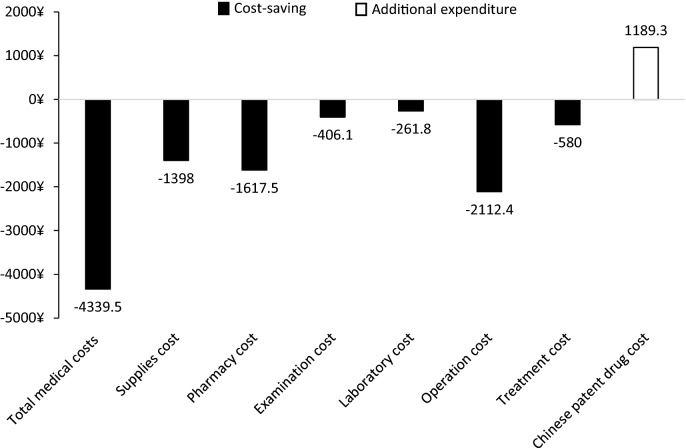
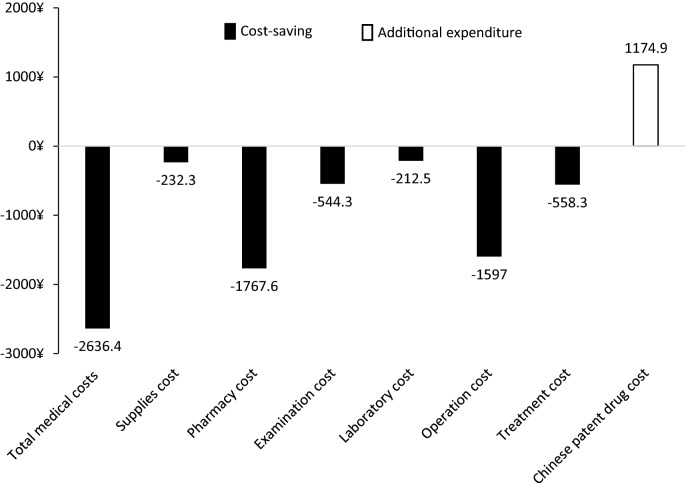
For the overall group, hospital stay was significantly decreased by 2.9 days ( < 0.05) and total nitrates dosage was significantly decreased by 172.4 mg ( < 0.05) in exposed group; cost savings of pharmacy cost, examination cost, laboratory cost, operation cost and treatment was observed as significant (at < 0.05); and the additional expenditure of Chinese patent drug (1174.9 CNY) was less than the saving of total medical costs (2636.4 CNY). For chronic ischemic heart disease subcohort, compared with unexposed group, significant decreases were also found in hospital stay and total nitrates dosage ( < 0.05); cost savings were significant ( < 0.05) for exposed group in terms of total medical costs (4339.5 CNY) and subcategories costs (including pharmacy cost, examination cost, operation cost and treatment cost); and the additional expenditure of Chinese patent drug (1189.3 CNY) was less than the saving of total medical costs.
Compared with conventional treatment for the treatment of CHD, combination of salvianolate injection and conventional treatment was associated with a reduction in hospital stay and total nitrates dosage. The acquisition cost of Chinese patent drug (including salvianolate injection) was offset by a higher reduction in total medical costs, especially for chronic ischemic heart disease.
随着人口老龄化和城市化的影响,冠心病(CHD)在中国造成的疾病负担越来越重。注射用丹参多酚酸盐是中国广泛用于治疗冠心病的一种专利药物。一系列研究证实了注射用丹参多酚酸盐的疗效,但药物成本高昂引发了关注。因此,进行成本-效果分析以证明注射用丹参多酚酸盐是否与改善预后和控制成本相关非常重要。本研究的目的是从社会角度回顾性评估注射用丹参多酚酸盐联合常规治疗冠心病的成本-效果。
我们利用电子病历数据库对2011年8月至2015年12月期间住院的冠心病患者进行回顾性研究。将接受注射用丹参多酚酸盐联合常规治疗的患者选为暴露组,将仅接受常规治疗的患者选为非暴露组。采用倾向得分匹配(PSM)分析来平衡患者特征。PSM后,我们评估住院时间、硝酸酯类药物总用量、总医疗费用及各分项费用。对慢性缺血性心脏病患者作为一个高度选择的亚组进行分析。
对于总体组,暴露组住院时间显著缩短2.9天(P<0.05),硝酸酯类药物总用量显著减少172.4毫克(P<0.05);药房费用、检查费用、检验费用、手术费用和治疗费用均有显著节省(P<0.05);专利药额外支出(1174.9元)低于总医疗费用节省(2636.4元)。对于慢性缺血性心脏病亚组,与非暴露组相比,住院时间和硝酸酯类药物总用量也显著减少(P<0.05);暴露组在总医疗费用(4339.5元)和各分项费用(包括药房费用、检查费用、手术费用和治疗费用)方面有显著节省(P<0.05);专利药额外支出(1189.3元)低于总医疗费用节省。
与冠心病常规治疗相比,注射用丹参多酚酸盐联合常规治疗可缩短住院时间并减少硝酸酯类药物总用量。专利药(包括注射用丹参多酚酸盐)的购置成本被总医疗费用的更大幅度降低所抵消,尤其是对于慢性缺血性心脏病。