Cannizzaro Matteo Angelo, Okatyeva Valeriya, Lo Bianco Salvatore, Caruso Valerio, Buffone Antonino
Department of "Scienze Mediche, Chirurgiche e tecnologie Avanzate - G. F. Ingrassia", University of Catania, Endocrinesurgery Unit, "Policlinico-Vittorio Emanuele" Hospital, via Santa Sofia 78, 95123, Catania, Italy.
Endocrinesurgery Unit, "Policlinico-Vittorio Emanuele" Hospital, Catania, Italy.
Ann Med Surg (Lond). 2018 May 3;30:42-45. doi: 10.1016/j.amsu.2018.04.032. eCollection 2018 Jun.
Hypocalcemia is the most common complication of thyroid surgery. The aim of this study was to determine the early predictive factors of postoperative hypocalcemia and to analyze their efficiency.
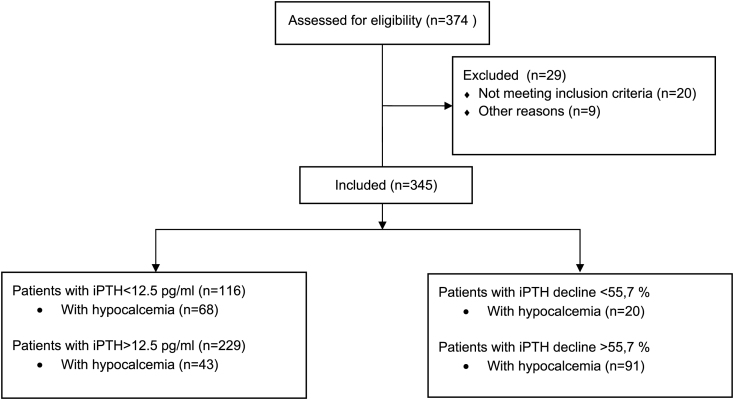
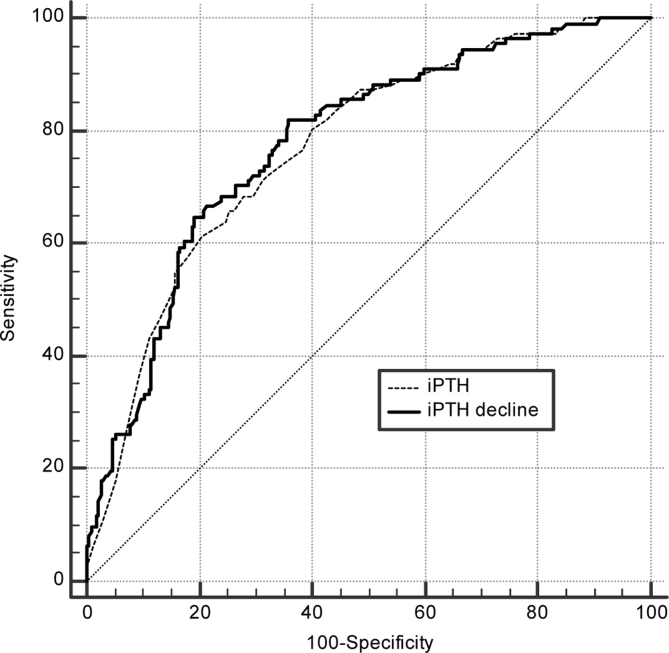
We performed a retrospective study of 345 consecutive patients who underwent total thyroidectomy at the Endocrine Surgery Department (Policlinico G. Rodolico Hospital of Catania) between January 2011 and November 2013. We measured serum intact parathormone (iPTH) levels preoperatively and 4 h after surgery. The threshold values of hypocalcemia for iPTH levels and iPTH relative decline were obtained by receiver operating curves (ROC) analysis.
The incidence of hypocalcemia was 32.2% (111 of 345 patients). Our statistical analysis revealed that hypocalcemia rate was strongly correlated with the lower iPTH values and greater iPTH decline (P < 0.001). The threshold enabling prediction of hypocalcemia were 12,5 pg/mL for iPTH and 55,7% for relative iPTH decline. Patients with iPTH <12,5 pg/mL developed hypocalcemia in 58.6% of cases while those with iPTH ≥12,5 pg/dl in 18.8%. Among 175 patients with iPTH relative decline greater than 55,7% hypocalcemia was diagnosed in 91 cases (52%), while other 170 patients with iPTH relative decline less than 55,7% developed hypocalcemia only in 20 cases (11,7%).
The decreased iPTH levels and increased iPTH relative decline resulted to be an accurate predictive factors of postoperative hypocalcemia. The early administration of Calcium and vitamin D in the high-risk patients should be put on in order to prevent the symptoms of hypocalcemia and to reduce the costs and duration of hospitalization.
低钙血症是甲状腺手术最常见的并发症。本研究的目的是确定术后低钙血症的早期预测因素并分析其有效性。
我们对2011年1月至2013年11月在卡塔尼亚市G. Rodolico综合医院内分泌外科接受全甲状腺切除术的345例连续患者进行了回顾性研究。我们在术前和术后4小时测量血清完整甲状旁腺激素(iPTH)水平。通过受试者操作曲线(ROC)分析获得iPTH水平和iPTH相对下降的低钙血症阈值。
低钙血症的发生率为32.2%(345例患者中的111例)。我们的统计分析显示,低钙血症发生率与较低的iPTH值和较大的iPTH下降密切相关(P<0.001)。预测低钙血症的阈值为iPTH 12.5 pg/mL和iPTH相对下降55.7%。iPTH<12.5 pg/mL的患者58.6%发生低钙血症,而iPTH≥12.5 pg/dl的患者为18.8%。在175例iPTH相对下降大于55.7%的患者中,91例(52%)诊断为低钙血症,而其他170例iPTH相对下降小于55.7%的患者仅20例(11.7%)发生低钙血症。
iPTH水平降低和iPTH相对下降增加是术后低钙血症的准确预测因素。应尽早对高危患者给予钙和维生素D,以预防低钙血症症状,降低成本和缩短住院时间。