
迷宫IV手术联合治疗心房颤动患者的长期疗效。
The long-term efficacy of concomitant maze IV surgery in patients with atrial fibrillation.
作者信息
Engelsgaard Camilla Skals, Pedersen Kenneth Bruun, Riber Lars Peter, Pallesen Peter Appel, Brandes Axel
机构信息
Department of Cardiology, Odense University Hospital, Odense, Denmark.
Department of Thoracic Surgery, Odense University Hospital, Odense, Denmark.
出版信息
Int J Cardiol Heart Vasc. 2018 Apr 13;19:20-26. doi: 10.1016/j.ijcha.2018.03.009. eCollection 2018 Jun.
BACKGROUND
Atrial fibrillation (AF) is the most common cardiac arrhythmia, and associated with increased risk of morbidity and mortality. AF surgery is widely used for rhythm control of AF, but previous studies have shown varying results. This study sought to investigate the long-term efficacy of concomitant maze IV (CMIV) surgery in an unselected AF population and identify predictors of late AF recurrence.
METHODS
In total 144 consecutive patients, who underwent CMIV between January 2006 and December 2010 were enrolled. By data from electronic medical records, registers, and rhythm prints, late AF recurrences and heart rhythm at latest follow-up were retrospectively registered. All patients still alive were invited to an ambulant follow-up to update rhythm status.
RESULTS
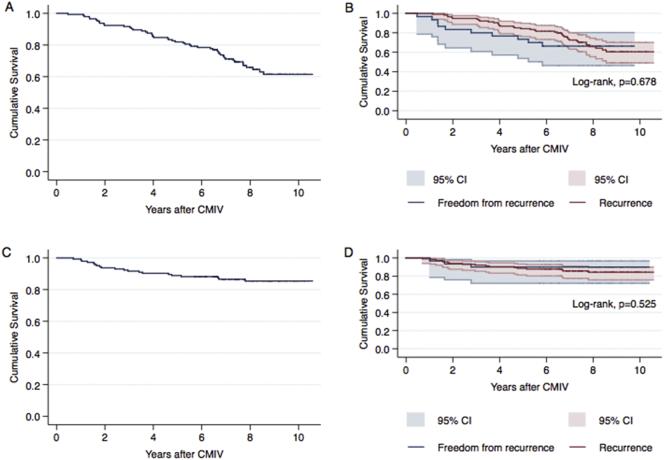
During a median (IQR) follow-up of 7.39 (2.67) years, 114 (79.2%) patients had recurrence. The cumulative incidence of sinus rhythm (SR) without antiarrhythmic drugs (AADs) was 52.3% after 1 year. Long-term results after 2, 5 and 7 years were 47.9%, 32.6% and 25.1%, respectively. At latest follow-up 34.7% were in SR off AADs. No difference in 10-year event-free survival stratified by recurrence were found ( = 0.678). Contrary, time to death (5.40 vs. 3.43 years, = 0.004) revealed death as competing risk event. The Fine-Gray model identified preoperative sustained AF (SAF) (SHR 3.54, 95%CI [2.35;5.32], < 0.001), AF duration (1.08, [1.05;1.11], < 0.001), and postoperative atrial tachyarrhythmia (ATA) (2.29, [1.21;4.35], = 0.011) as predictors.
CONCLUSION
CMIV in the present cohort provided limited long-term success in obtaining SR. SAF, longer AF duration, and postoperative ATA were associated with late AF recurrence.
背景
心房颤动(AF)是最常见的心律失常,与发病率和死亡率增加相关。AF手术广泛用于AF的节律控制,但先前的研究结果各异。本研究旨在调查在未选择的AF人群中迷宫IV(CMIV)联合手术的长期疗效,并确定晚期AF复发的预测因素。
方法
纳入2006年1月至2010年12月期间连续接受CMIV手术的144例患者。通过电子病历、登记册和心律记录的数据,回顾性登记晚期AF复发情况和最新随访时的心律。邀请所有仍存活的患者进行门诊随访以更新心律状态。
结果
在中位(IQR)随访7.39(2.67)年期间,114例(79.2%)患者复发。1年后无抗心律失常药物(AADs)时窦性心律(SR)的累积发生率为52.3%。2年、5年和7年后的长期结果分别为47.9%、32.6%和25.1%。在最新随访时,34.7%的患者在停用AADs后处于SR。按复发分层的10年无事件生存率无差异( = 0.678)。相反,死亡时间(5.40对3.43年, = 0.004)显示死亡为竞争风险事件。Fine-Gray模型确定术前持续性AF(SAF)(风险比3.54,95%置信区间[2.35;5.32], < 0.001)、AF持续时间(1.08,[1.05;1.11], < 0.001)和术后房性快速心律失常(ATA)(2.29,[1.21;4.35], = 0.011)为预测因素。
结论
本队列中的CMIV在获得SR方面长期成功率有限。SAF、较长的AF持续时间和术后ATA与晚期AF复发相关。


 Zotero 插件