Programa de Pós-graduação em Ecologia e Evolução, Departamento de Ciências Biológicas, Universidade Estadual de Feira de Santana, Novo Horizonte, Bahia, Brazil.
Departamento de Ecologia e Biologia Evolutiva, Universidade Federal de São Paulo, Diadema, São Paulo, Brazil.
PLoS One. 2018 Jun 27;13(6):e0199764. doi: 10.1371/journal.pone.0199764. eCollection 2018.
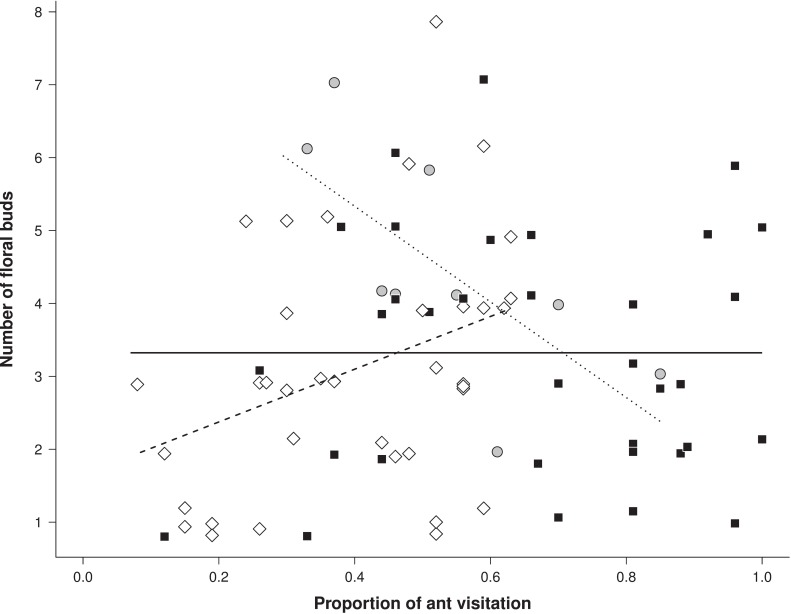
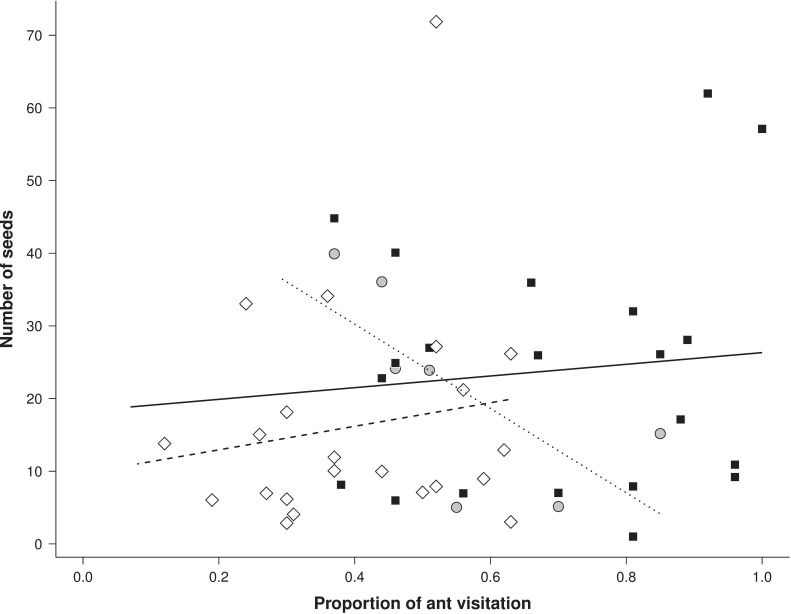
Variation in partner species and frequency of interaction between species pairs are potential drivers of the net outcome of generalized mutualisms. In ant-plant mutualisms, the quality of defence provided by ants is related to ant aggressiveness. Hence, we hypothesize that the performance of plants bearing extrafloral nectaries will be higher when they interact more frequently with more aggressive ant species. We estimated ant aggressiveness in the field by observing their behaviour towards soil baits. Afterwards, we observed the frequency with which individuals from these ant species visited plants through an entire reproductive cycle. We measured the production and persistence of plants reproductive structures through this period and the total seed production. Increasing in the interaction frequency with highly aggressive ants reduced the number of floral buds and seeds produced. Increased visitation frequency by less aggressive ants increased the number of floral buds and seeds per branch. The inverse relationship between ant aggressiveness and seed production may be influenced by the costs imposed by different mutualistic partners. Thus, frequent interaction with highly aggressive ants may lead to a higher accumulation of costs through time, resulting in a negative net outcome for the plants. Our results bring new evidence highlighting the importance to incorporate temporal aspects in the study of mutualistic interactions. We suggests that the quality of mutualistic partners must be understood as a function of its per-interaction benefit and their cumulative costs to their partner over time, what puts in check our current classification regarding partner quality in mutualistic systems.
种间伙伴的变化和物种对之间相互作用的频率是广义共生关系净结果的潜在驱动因素。在蚂蚁-植物共生关系中,蚂蚁提供的防御质量与蚂蚁的攻击性有关。因此,我们假设,当具有额外花蜜的植物与更具攻击性的蚂蚁物种更频繁地相互作用时,它们的表现将更高。我们通过观察它们对土壤诱饵的行为在野外估计蚂蚁的攻击性。之后,我们观察了这些蚂蚁物种在整个繁殖周期内访问植物的频率。在此期间,我们通过测量植物繁殖结构的产生和持续时间以及总种子产量来测量植物的性能。与高度攻击性蚂蚁的相互作用频率增加会减少产生的花芽和种子数量。攻击性较低的蚂蚁的访问频率增加会增加每个分支的花芽和种子数量。蚂蚁攻击性和种子产量之间的反比关系可能受到不同共生伙伴施加的成本的影响。因此,与高度攻击性蚂蚁的频繁相互作用可能会随着时间的推移导致更高的成本积累,从而对植物产生负面的净结果。我们的研究结果提供了新的证据,强调了在研究共生关系时纳入时间方面的重要性。我们建议,必须将共生伙伴的质量理解为其每次相互作用的收益及其随时间累积对其伙伴的成本的函数,这检验了我们目前关于共生系统中伙伴质量的分类。