Tzarum Netanel, Wilson Ian A, Law Mansun
Department of Integrative Structural and Computational Biology, The Scripps Research Institute, La Jolla, CA, United States.
Skaggs Institute for Chemical Biology, The Scripps Research Institute, La Jolla, CA, United States.
Front Immunol. 2018 Jun 11;9:1315. doi: 10.3389/fimmu.2018.01315. eCollection 2018.
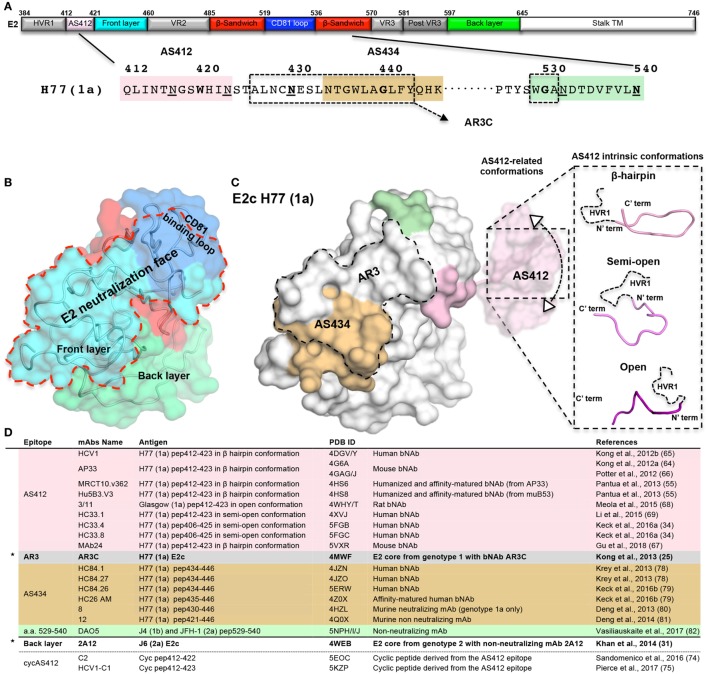
The high genetic variability of hepatitis C virus, together with the high level of glycosylation on the viral envelope proteins shielding potential neutralizing epitopes, pose a difficult challenge for vaccine development. An effective hepatitis C virus (HCV) vaccine must target conserved epitopes and the HCV E2 glycoprotein is the main target for such neutralizing antibodies (NAbs). Recent structural investigations highlight the presence of a highly conserved and accessible surface on E2 that is devoid of N-linked glycans and known as the E2 neutralizing face. This face is defined as a hydrophobic surface comprising the front layer (FL) and the CD81 binding loop (CD81bl) that overlap with the CD81 receptor binding site on E2. The neutralizing face consists of highly conserved residues for recognition by cross-NAbs, yet it appears to be high conformationally flexible, thereby presenting a moving target for NAbs. Three main overlapping neutralizing sites have been identified in the neutralizing face: antigenic site 412 (AS412), antigenic site 434 (AS434), and antigenic region 3 (AR3). Here, we review the structural analyses of these neutralizing sites, either as recombinant E2 or epitope-derived linear peptides in complex with bNAbs, to understand the functional and preferred conformations for neutralization, and for viral escape. Collectively, these studies provide a foundation and molecular templates to facilitate structure-based approaches for HCV vaccine development.
丙型肝炎病毒的高遗传变异性,以及病毒包膜蛋白上高水平的糖基化掩盖了潜在的中和表位,给疫苗开发带来了艰巨挑战。有效的丙型肝炎病毒(HCV)疫苗必须针对保守表位,而HCV E2糖蛋白是此类中和抗体(NAbs)的主要靶点。最近的结构研究突出了E2上存在一个高度保守且易于接近的表面,该表面没有N-连接聚糖,被称为E2中和面。这个面被定义为一个疏水表面,由与E2上的CD81受体结合位点重叠的前层(FL)和CD81结合环(CD81bl)组成。中和面由高度保守的残基组成,可供交叉中和抗体识别,但它似乎具有高度的构象灵活性,从而成为中和抗体难以捉摸的目标。在中和面中已鉴定出三个主要的重叠中和位点:抗原位点412(AS412)、抗原位点434(AS434)和抗原区域3(AR3)。在这里,我们综述了这些中和位点的结构分析,这些分析以重组E2或与bNAbs复合的表位衍生线性肽的形式进行,以了解中和作用以及病毒逃逸的功能和优选构象。总体而言,这些研究为促进基于结构的HCV疫苗开发方法提供了基础和分子模板。