Department of Infectious Diseases, Monash University and Alfred Health, Melbourne, VIC, Australia.
Kirby Institute, UNSW, Sydney, Australia.
J Int AIDS Soc. 2018 Jun;21(6):e25149. doi: 10.1002/jia2.25149.
In 2015, the World Health Organization recommended that all HIV-infected individuals consider ART initiation as soon as possible after diagnosis. Sex differences in choice of initial ART regimen, indications for switching, time to switching and choice of second-line regimens have not been well described. The aims of this study were to describe first-line ART and CD4 count at ART initiation by sex, calendar year and region, and to analyse time to change or interruption in first-line ART, according to sex in each region.
Participating cohorts included: Southern, East and West Africa (IeDEA-Africa), North America (NA-ACCORD), Caribbean, Central/South America (CCASAnet) and Asia-Pacific including Australia (IeDEA Asia-Pacific). The primary outcomes analysed for each region and according to sex were choice of initial ART, time to switching and time to discontinuation of the first-line regimen.
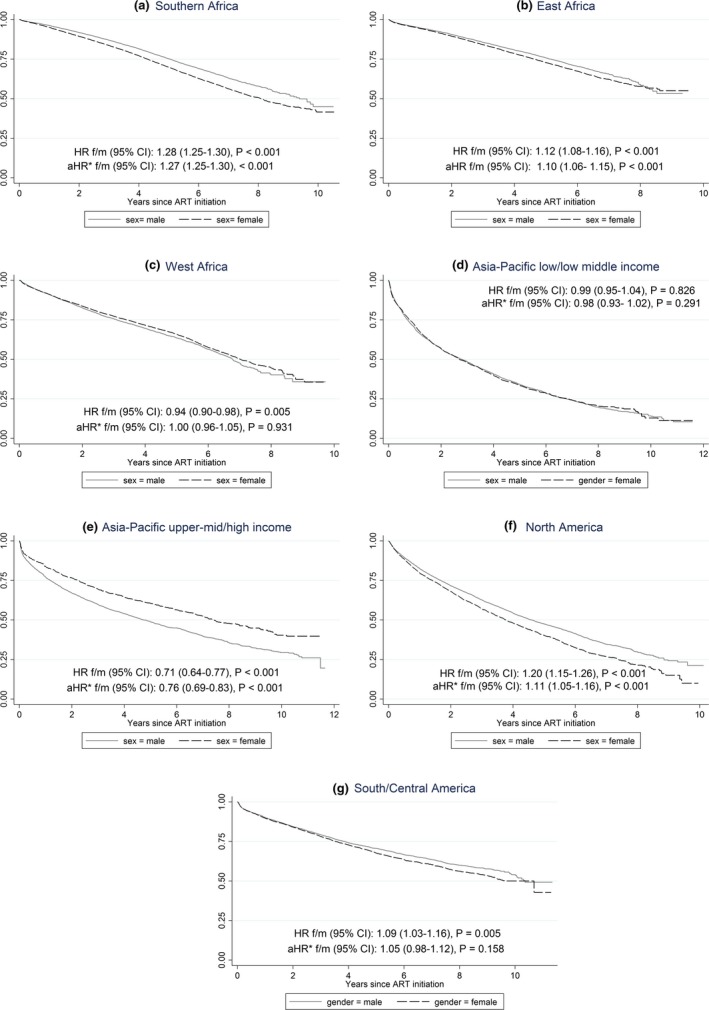
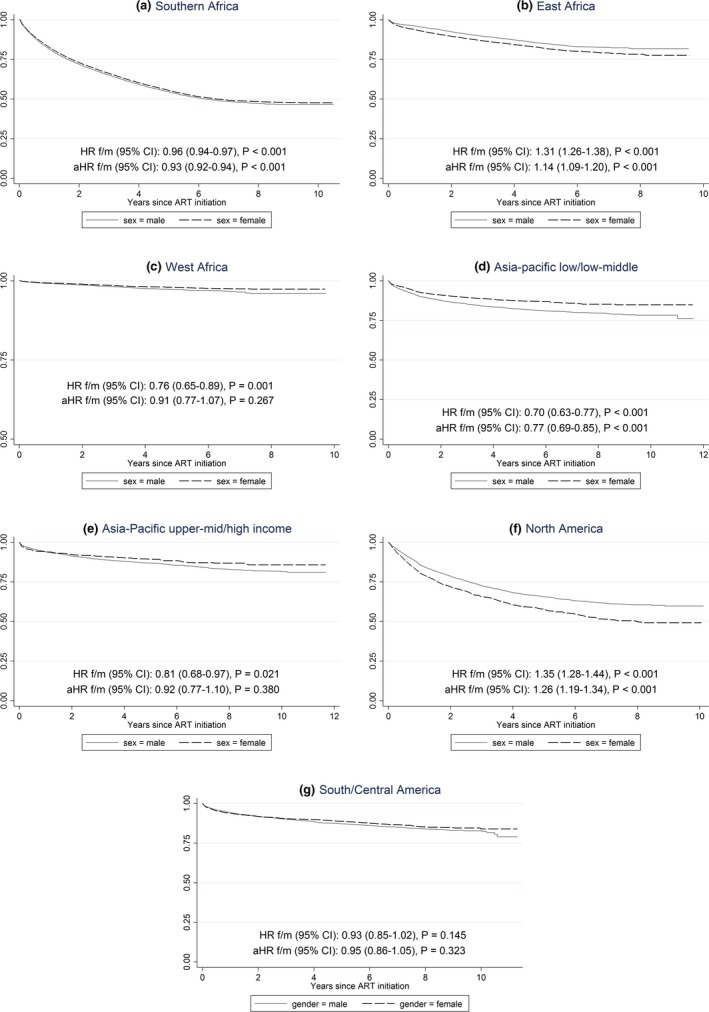
The combined cohort data set comprised of 715,252 participants across seven regions from low- to high-income settings. The median CD4 count at treatment initiation was lower in men compared with women in nearly all regions and time periods. Women from North America and Southern Africa were more likely to switch ART compared to men (p < 0.001) with approximately 90% of women reporting a major change after 10 years in North America. Overall, after 8 years on ART, >50% of HIV- positive men and women from Southern Africa, East Africa, South and Central America remained on their original regimen. Men were more likely to have a treatment interruption compared with women in low- and middle-income countries from the Asia/Pacific region (p < 0.001) as were men from Southern Africa (p < 0.001). Greater than 75% of men and women did not report a treatment interruption after 10 years on ART from all regions except North America and Southern Africa.
There are regional variations in the ART regimen commenced at baseline and rates of major change and treatment interruption according to sex. Some of this is likely to reflect changes in local and international antiretroviral guideline recommendations but other sex-specific factors such as pregnancy may contribute to these differences.
2015 年,世界卫生组织建议所有 HIV 感染者在确诊后尽快考虑开始抗逆转录病毒治疗(ART)。在初始 ART 方案的选择、转换指征、转换时间和二线方案的选择方面,男女之间存在差异,但尚未得到充分描述。本研究的目的是描述按性别、日历年度和地区划分的初始 ART 方案和 CD4 计数,并分析按地区划分的每个地区的男女在一线 ART 改变或中断的时间。
参与的队列包括:南部、东部和西部非洲(IeDEA-Africa)、北美(NA-ACCORD)、加勒比地区、中/南美洲(CCASAnet)和亚太地区(包括澳大利亚)(IeDEA 亚太地区)。每个地区和按性别分析的主要结局是初始 ART 的选择、转换时间和一线方案的停药时间。
综合队列数据集包含来自中低收入到高收入国家的七个地区的 715252 名参与者。几乎所有地区和时间段的男性治疗开始时的 CD4 计数均低于女性。与男性相比,来自北美和南部非洲的女性更有可能转换 ART(p<0.001),大约 90%的女性在北美报告了 10 年后的重大改变。总体而言,在开始 ART 治疗 8 年后,南部非洲、东部非洲、南美洲和中美洲的超过 50%的 HIV 阳性男性和女性仍在使用最初的方案。在中低收入国家的亚洲/太平洋地区,与女性相比,男性更有可能出现治疗中断(p<0.001),南部非洲的男性也是如此(p<0.001)。除了北美和南部非洲,所有地区的男女在接受 ART 治疗 10 年后,超过 75%的人没有报告治疗中断。
根据性别,基线时开始的 ART 方案以及重大改变和治疗中断的发生率存在地区差异。其中一些可能反映了当地和国际抗逆转录病毒指南建议的变化,但其他一些性别特异性因素,如怀孕,也可能导致这些差异。