Centre for Neuroscience and Trauma, Blizard Institute, Barts and the London School of Medicine and Dentistry, Queen Mary University of London, London, UK.
Center of Genomic and post-Genomic, IRCCS Mondino Foundation, Pavia, Italy.
J Neurochem. 2018 Sep;146(5):631-641. doi: 10.1111/jnc.14542.
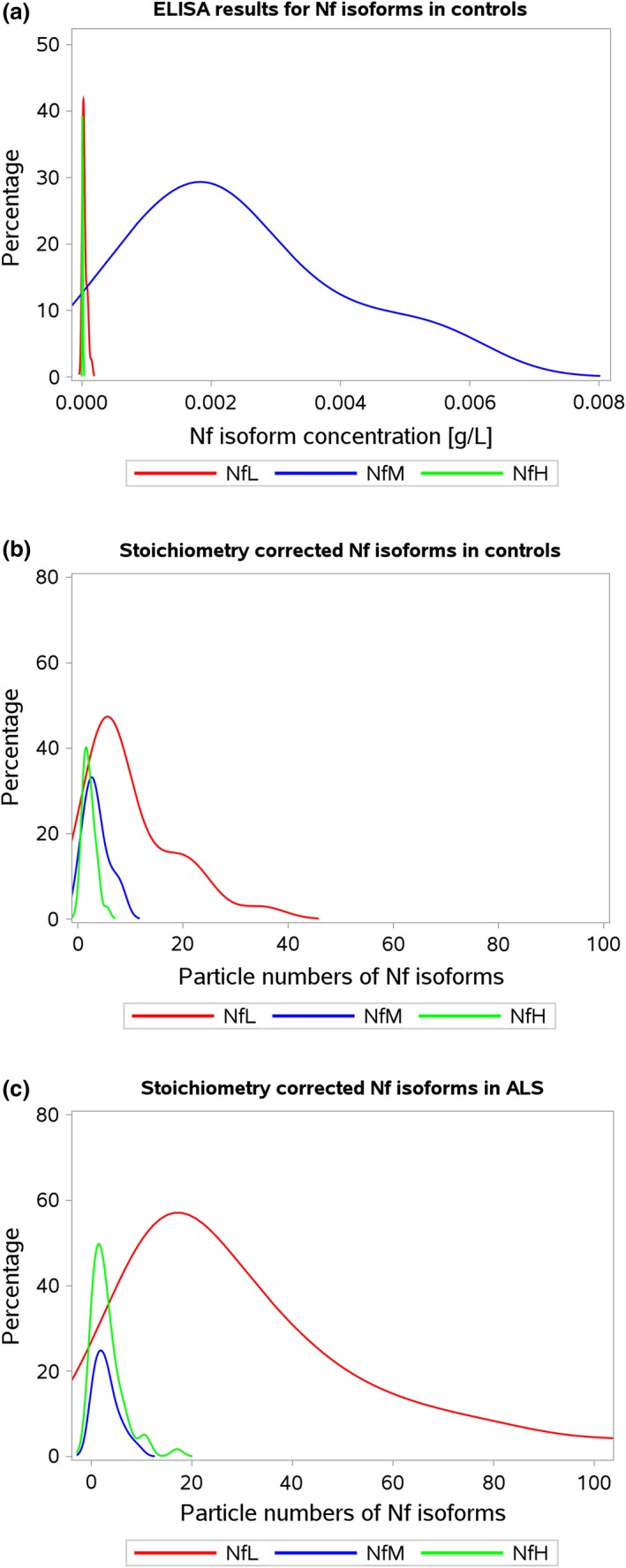
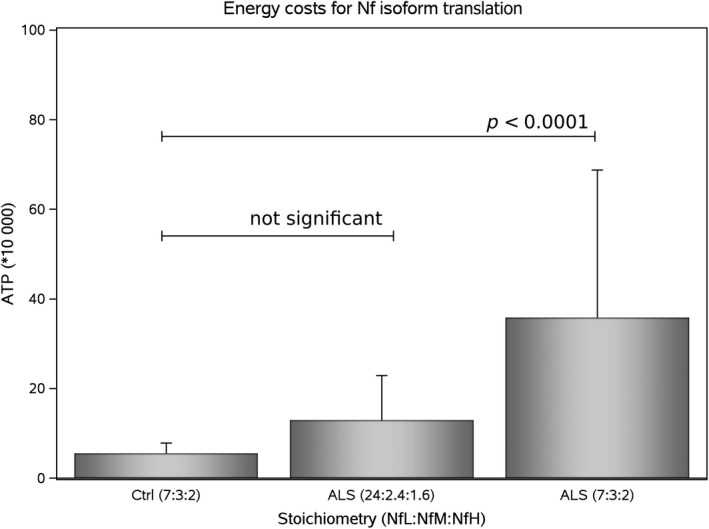
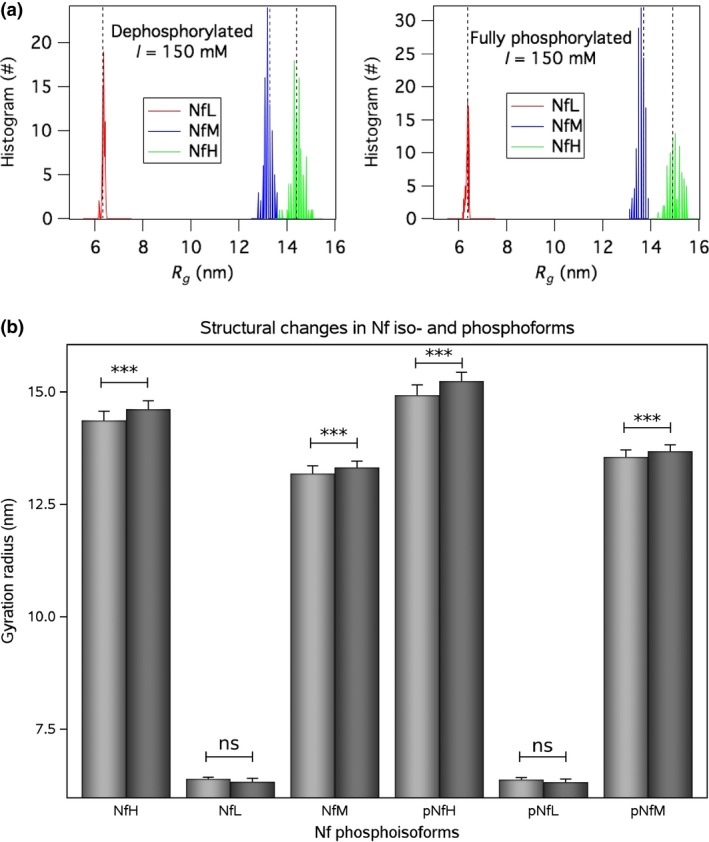
Neurofilament proteins (Nf) are a biomarker of disease progression in amyotrophic lateral sclerosis (ALS). This study investigated whether there are major differences in expression from in vivo measurements of neurofilament isoforms, from the light chain, NfL (68 kDa), compared with larger proteins, the medium chain (NfM, 150 kDa) and the heavy (NfH, 200-210 kDa) chains in ALS patients and healthy controls. New immunological methods were combined with Nf subunit stoichiometry calculations and Monte Carlo simulations of a coarse-grained Nf brush model. Based on a physiological Nf subunit stoichiometry of 7 : 3 : 2 (NfL:NfM:NfH), we found an 'adaptive' Nf subunit stoichiometry of 24 : 2.4 : 1.6 in ALS. Adaptive Nf stoichiometry preserved NfL gyration radius in the Nf brush model. The energy and time requirements for Nf translation were 56 ± 27k ATP (5.6 h) in control subjects compared to 123 ± 102k (12.3 h) in ALS with 'adaptive' (24:2.4:1.6) Nf stoichiometry (not significant) and increased significantly to 355 ± 330k (35.5 h) with 'luxury' (7:3:2) Nf subunit stoichiometry (p < 0.0001 for each comparison). Longitudinal disease progression-related energy consumption was highest with a 'luxury' (7:3:2) Nf stoichiometry. Therefore, an energy and time-saving option for motor neurons is to shift protein expression from larger to smaller (cheaper) subunits, at little or no costs on a protein structural level, to compensate for increased energy demands.
神经丝蛋白(Nf)是肌萎缩侧索硬化症(ALS)疾病进展的生物标志物。本研究旨在探讨 ALS 患者与健康对照组相比,神经丝同工型的活体测量中,轻链 NfL(68 kDa)与较大蛋白(NfM,150 kDa 和 NfH,200-210 kDa)之间的表达是否存在显著差异。研究结合了新的免疫方法和神经丝亚基化学计量计算以及粗粒度神经丝刷模型的蒙特卡罗模拟。基于生理神经丝亚基化学计量比 7:3:2(NfL:NfM:NfH),我们发现 ALS 中的“适应性”神经丝亚基化学计量比为 24:2.4:1.6。适应性神经丝化学计量比在神经丝刷模型中保持了 NfL 的旋转半径。在对照组中,神经丝翻译的能量和时间需求分别为 56±27k ATP(5.6 小时),而 ALS 患者中具有“适应性”(24:2.4:1.6)神经丝化学计量比的能量和时间需求分别为 123±102k(12.3 小时)(无显著差异),而具有“奢侈”(7:3:2)神经丝亚基化学计量比的能量和时间需求则显著增加至 355±330k(35.5 小时)(p 值均<0.0001)。具有“奢侈”(7:3:2)神经丝化学计量比的情况下,与疾病进展相关的能量消耗最高。因此,运动神经元的一种节能和省时的选择是将蛋白表达从较大的亚基转移到较小的(更便宜的)亚基,在蛋白结构水平上几乎没有或没有任何成本,以补偿能量需求的增加。