Cheecharern Sukrom
Department of Orthopedics, Rajavithi Hospital, College of Medicine, Rangsit University, Bangkok, Thailand.
Asia Pac J Sports Med Arthrosc Rehabil Technol. 2018 Mar 14;12:22-29. doi: 10.1016/j.asmart.2018.01.003. eCollection 2018 Apr.
Anterior cruciate ligament (ACL) reconstruction is one of the most common knee ligament reconstruction sustained by sports players. Previous studies have revealed different rates of returning to play sports depending on study sites, subjects, and time to follow-up; however, this subject has not been adequately investigated in Thailand.
This study aimed to assess the percentage of ACL reconstruction patients who successfully returned to sport activities. Factors associated with being able to return to sport were also determined.
A cross-sectional study was conducted to assess the rates of return to sport of patients who underwent ACL reconstruction between 2005 and 2015. All potential patients were initially contacted via letter or mobile phone and asked to report their long-term follow-up outcomes. Collected data from the interview, including return to sport status, performance following ACL, and reasons for not returning to play (if applicable) were then combined with the initial surgical findings and enrollment/follow-up cohort data for analysis. This study was reviewed and approved by the ethics committee of Rajavithi Hospital.
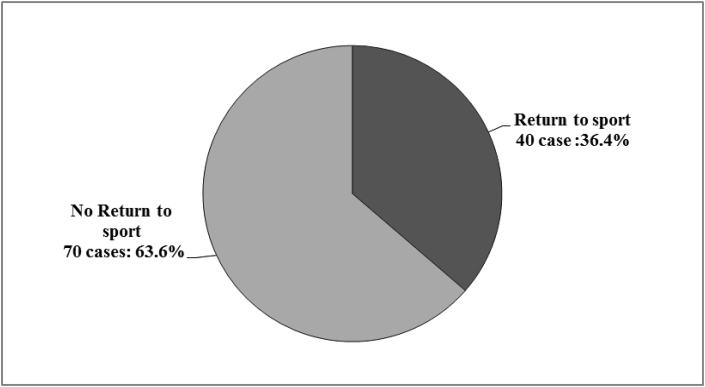
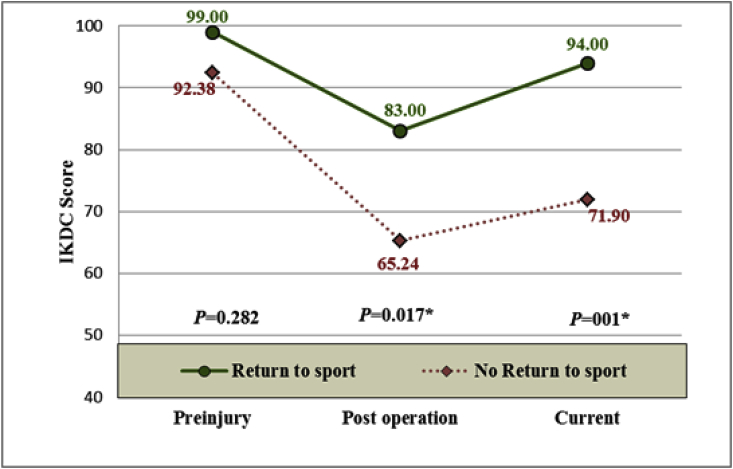
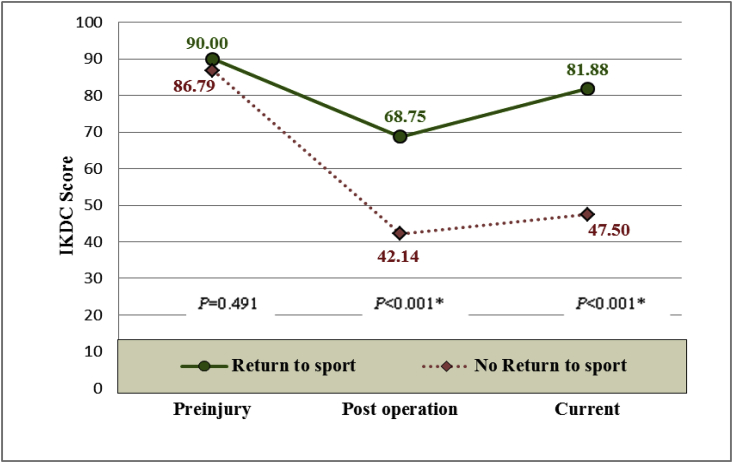
A total of 110 participants were recruited, with a mean age of 35.05 ± 9.16 years. Most of the patients were male, single, with bachelor degree education, engaged in "other" occupations, had income up to 10,000 baht/month, were in the social security scheme (54.5%), and had no underlying diseases (85.5%). The mean ± SD of BMI was 25.58 ± 4.30 kg/m. When classified by whether or not they returned to sports, it was found that sex, education, income and underlying disease of those who returned to sport were significantly different from those of subjects who did not (p < 0.05). At follow-up, 36.4% had returned to sport. The main reasons stated for not returning to sport following ACL were fear of injury, concern about possible long-term effects, and worry about the possibility of re-injury. Overall, total IKDC scores of patients who returned to sport were significantly higher than those of subjects who did not. However, some points such as ability to kneel, ride and bend the knee were not different in the two groups. Bachelor degree education, monthly income lower than 10,000 Thai baht and IKDC score were the factors associated with returning to sport.
The rates of return to sport after ACL reconstruction were low compared to those of other reports in the literature. Education, low income and IKDC score were predictive factors of sport re-participation. Further studies should be carried out to assess the impact on treatment indications and rehabilitation.
前交叉韧带(ACL)重建是运动员最常进行的膝关节韧带重建手术之一。以往研究表明,根据研究地点、研究对象和随访时间的不同,恢复运动的比例也有所不同;然而,泰国尚未对这一主题进行充分研究。
本研究旨在评估成功恢复体育活动的ACL重建患者的比例。同时确定与能够恢复运动相关的因素。
进行一项横断面研究,以评估2005年至2015年间接受ACL重建的患者恢复运动的比例。所有潜在患者最初通过信件或手机进行联系,并要求他们报告长期随访结果。然后将访谈收集的数据,包括恢复运动状态、ACL重建后的表现以及未恢复运动的原因(如适用)与最初的手术结果和入组/随访队列数据相结合进行分析。本研究经拉贾维提医院伦理委员会审查并批准。
共招募了110名参与者,平均年龄为35.05±9.16岁。大多数患者为男性,单身,拥有本科学历,从事“其他”职业,月收入高达10,000泰铢,参加社会保障计划(54.5%),且无基础疾病(85.5%)。BMI的平均值±标准差为25.58±4.30kg/m²。按是否恢复运动进行分类时,发现恢复运动者与未恢复运动者在性别、教育程度、收入和基础疾病方面存在显著差异(p<0.05)。随访时,36.4%的患者恢复了运动。ACL重建后未恢复运动的主要原因是害怕受伤、担心可能的长期影响以及担心再次受伤的可能性。总体而言,恢复运动的患者的IKDC总分显著高于未恢复运动的患者。然而,两组在诸如下跪、骑车和屈膝能力等方面并无差异。本科学历、月收入低于10,000泰铢以及IKDC评分是与恢复运动相关的因素。
与文献中的其他报告相比,ACL重建后恢复运动的比例较低。教育程度、低收入和IKDC评分是恢复运动参与的预测因素。应开展进一步研究以评估对治疗指征和康复的影响。