Department of Psychiatry, The University of Hong Kong, Pokfulam, Hong Kong SAR, China.
Department of Molecular & Cellular Biology, Baylor College of Medicine, Houston, TX, 77030, USA.
Transl Psychiatry. 2018 Jul 2;8(1):125. doi: 10.1038/s41398-018-0167-x.
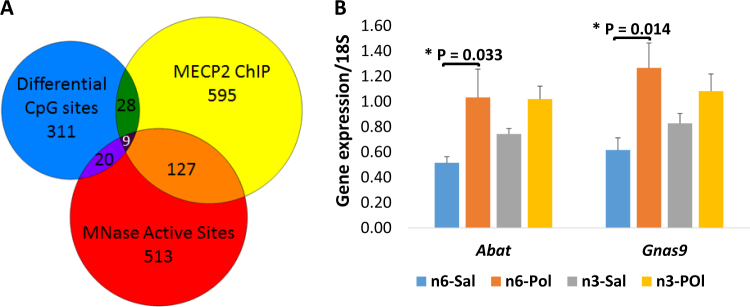
An unstable epigenome is implicated in the pathophysiology of neurodevelopmental disorders such as schizophrenia and autism. This is important because the epigenome is potentially modifiable. We have previously reported that adult offspring exposed to maternal immune activation (MIA) prenatally have significant global DNA hypomethylation in the hypothalamus. However, what genes had altered methylation state, their functional effects on gene expression and whether these changes can be moderated, have not been addressed. In this study, we used next-generation sequencing (NGS) for methylome profiling in a MIA rodent model of neurodevelopmental disorders. We assessed whether differentially methylated regions (DMRs) affected the chromatin state by mapping known DNase I hypersensitivity sites (DHSs), and selected overlapping genes to confirm a functional effect of MIA on gene expression using qPCR. Finally, we tested whether methylation differences elicited by MIA could be limited by post-natal dietary (omega) n-3 polyunsaturated fatty acid (PUFA) supplementation. These experiments were conducted using hypothalamic brain tissue from 12-week-old offspring of mice injected with viral analogue PolyI:C on gestation day 9 of pregnancy or saline on gestation day 9. Half of the animals from each group were fed a diet enriched with n-3 PUFA from weaning (MIA group, n = 12 units, n = 39 mice; Control group, n = 12 units, n = 38 mice). The results confirmed our previous finding that adult offspring exposed to MIA prenatally had significant global DNA hypomethylation. Furthermore, genes linked to synaptic plasticity were over-represented among differentially methylated genes following MIA. More than 80% of MIA-induced hypomethylated sites, including those affecting chromatin state and MECP2 binding, were stabilised by the n-3 PUFA intervention. MIA resulted in increased expression of two of the 'top five' genes identified from an integrated analysis of DMRs, DHSs and MECP2 binding sites, namely Abat (t = 2.46, p < 0.02) and Gnas9 (t = 2.96, p < 0.01), although these changes were not stabilised by dietary intervention. Thus, prenatal MIA exposure impacts upon the epigenomic regulation of gene pathways linked to neurodevelopmental conditions; and many of the changes can be attenuated by a low-cost dietary intervention.
不稳定的表观基因组与神经发育障碍(如精神分裂症和自闭症)的病理生理学有关。这很重要,因为表观基因组是潜在可修饰的。我们之前曾报道过,产前暴露于母体免疫激活(MIA)的成年后代在下丘脑中存在显著的全基因组 DNA 低甲基化。然而,哪些基因的甲基化状态发生了改变,它们对基因表达的功能影响,以及这些变化是否可以得到调节,尚未得到解决。在这项研究中,我们使用下一代测序(NGS)对神经发育障碍的 MIA 啮齿动物模型进行了甲基组谱分析。我们通过绘制已知的 DNA 酶 I 超敏位点(DHS)来评估差异甲基化区域(DMR)是否影响染色质状态,并选择重叠基因,使用 qPCR 来确认 MIA 对基因表达的功能影响。最后,我们测试了 MIA 引起的甲基化差异是否可以通过产后饮食(ω)n-3 多不饱和脂肪酸(PUFA)补充来限制。这些实验是使用怀孕第 9 天注射病毒类似物 PolyI:C 或生理盐水的孕鼠的 12 周龄后代的下丘脑脑组织进行的。每组的一半动物从断奶开始就喂食富含 n-3 PUFA 的饮食(MIA 组,n=12 个单位,n=39 只小鼠;对照组,n=12 个单位,n=38 只小鼠)。结果证实了我们之前的发现,即产前暴露于 MIA 的成年后代有显著的全基因组 DNA 低甲基化。此外,在 MIA 之后,与突触可塑性相关的基因在差异甲基化基因中过度表达。超过 80%的 MIA 诱导的低甲基化位点,包括那些影响染色质状态和 MECP2 结合的位点,都通过 n-3 PUFA 干预得到了稳定。MIA 导致五个“前五位”基因中的两个的表达增加,这是从 DMR、DHS 和 MECP2 结合位点的综合分析中确定的,即 Abat(t=2.46,p<0.02)和 Gnas9(t=2.96,p<0.01),尽管这些变化没有通过饮食干预得到稳定。因此,产前 MIA 暴露会影响与神经发育状况相关的基因途径的表观基因组调控;并且许多变化可以通过低成本的饮食干预来减轻。