Hizuoka Cancer Center, Shizuoka, Japan.
Tokushima University Hospital, Tokushima, Japan.
Cancer Sci. 2018 Sep;109(9):2852-2862. doi: 10.1111/cas.13724. Epub 2018 Aug 9.
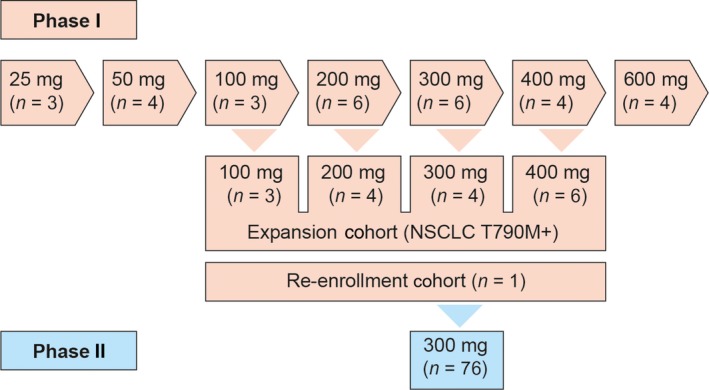
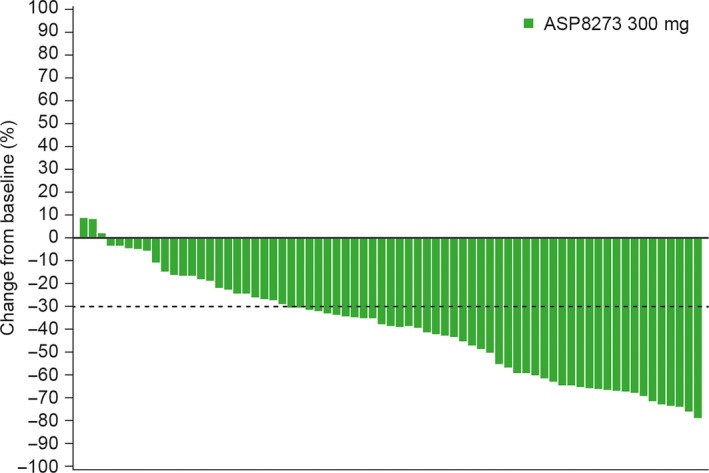
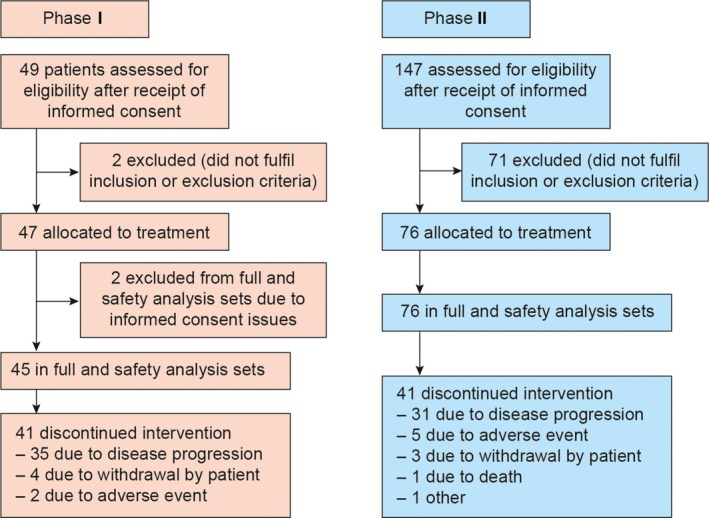
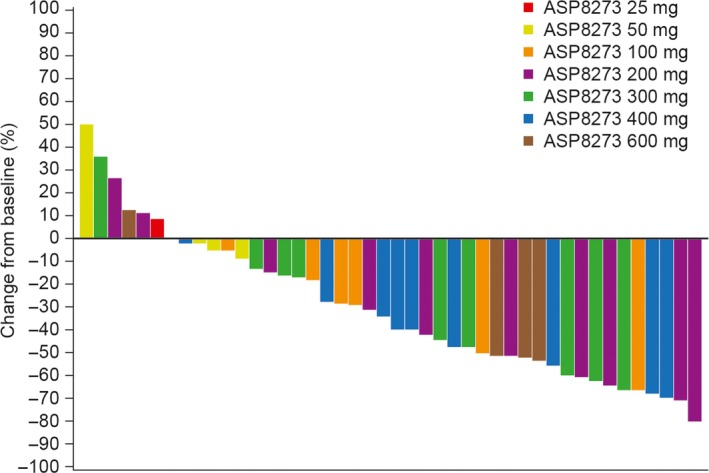
Epidermal growth factor receptor (EGFR)-activating mutations confer sensitivity to tyrosine kinase inhibitor (TKI) treatment for non-small-cell lung cancer (NSCLC). ASP8273 is a highly specific, irreversible, once-daily, oral, EGFR TKI that inhibits both activating and resistance mutations. This ASP8273 dose-escalation/dose-expansion study (NCT02192697) was undertaken in two phases. In phase I, Japanese patients (aged ≥20 years) with NSCLC previously treated with ≥1 EGFR TKI received escalating ASP8273 doses (25-600 mg) to assess safety/tolerability and to determine the maximum tolerated dose (MTD) and/or the recommended phase II dose (RP2D) by the Bayesian Continual Reassessment Method. In phase II, adult patients with T790M-positive NSCLC in Japan, Korea, and Taiwan received ASP8273 at RP2D to further assess safety/tolerability and determine antitumor activity, which was evaluated according to Simon's two-stage design (threshold response = 30%, expected response = 50%, α = 0.05, β = 0.1). Overall, 121 (n = 45 [33W/12M] phase I, n = 76 [48W/28M]) phase 2) patients received ≥1 dose of ASP8273. In phase I, RP2D and MTD were established as 300 and 400 mg, respectively. As 27 of the 63 patients treated with ASP8273 300 mg achieved a clinical response, ASP8273 was determined to have antitumor activity. The overall response rate at week 24 in all patients was 42% (n = 32/76; 95% confidence interval, 30.9-54.0). Median duration of progression-free survival was 8.1 months (95% confidence interval, 5.6, upper bound not reached). The most commonly reported treatment-related adverse event in phase II was diarrhea (57%, n = 43/76). ASP8273 300 mg was generally well tolerated and showed antitumor activity in Asian patients with both EGFR-activating and T790M mutations.
表皮生长因子受体 (EGFR)-激活突变使非小细胞肺癌 (NSCLC) 对酪氨酸激酶抑制剂 (TKI) 治疗敏感。ASP8273 是一种高度特异、不可逆、每日一次、口服的 EGFR TKI,可抑制激活和耐药突变。这项 ASP8273 剂量递增/剂量扩展研究(NCT02192697)分为两个阶段进行。在第 I 阶段,先前接受过≥1 种 EGFR TKI 治疗的≥20 岁日本 NSCLC 患者接受了递增的 ASP8273 剂量(25-600mg),以评估安全性/耐受性,并通过贝叶斯连续评估法确定最大耐受剂量(MTD)和/或推荐的 II 期剂量(RP2D)。在第 II 阶段,日本、韩国和中国台湾的 T790M 阳性 NSCLC 成年患者接受 RP2D 的 ASP8273 治疗,以进一步评估安全性/耐受性,并根据 Simon 的两阶段设计(阈值反应=30%,预期反应=50%,α=0.05,β=0.1)确定抗肿瘤活性。总体而言,121 名(n=45 [33W/12M] 第 I 阶段,n=76 [48W/28M] 第 II 阶段)患者接受了≥1 剂 ASP8273。在第 I 阶段,确定 RP2D 和 MTD 分别为 300 和 400mg。由于接受 ASP8273 300mg 治疗的 63 名患者中有 27 名达到了临床反应,因此确定 ASP8273 具有抗肿瘤活性。所有患者在第 24 周的总体缓解率为 42%(n=32/76;95%置信区间,30.9-54.0)。中位无进展生存期为 8.1 个月(95%置信区间,5.6,上限未达到)。第 II 阶段报告的最常见治疗相关不良事件是腹泻(57%,n=43/76)。ASP8273 300mg 总体耐受性良好,在具有 EGFR 激活和 T790M 突变的亚洲患者中显示出抗肿瘤活性。