Comparative Plant and Fungal Biology, Royal Botanic Gardens Kew, West Sussex, UK.
Earth and Environmental Sciences Department, University of Pavia, Pavia, Italy.
Plant Biol (Stuttg). 2019 May;21(3):487-497. doi: 10.1111/plb.12872. Epub 2018 Aug 8.
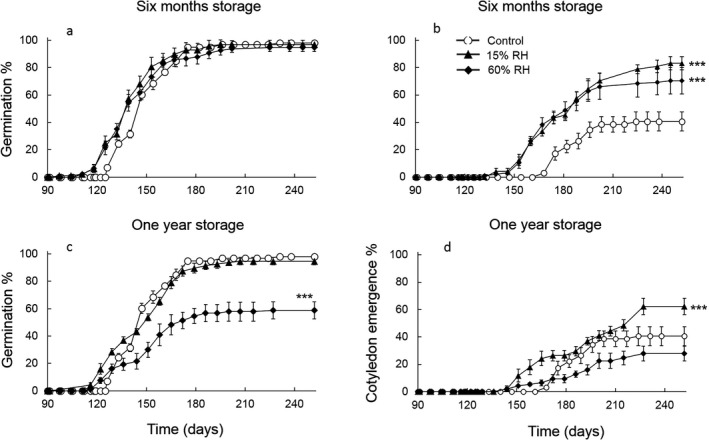
Conopodium majus is a geophyte with pseudomonocotyly, distributed in Atlantic Europe. It is an indicator of two declining European habitats: ancient woodland understories and oligotrophic hay meadows. Attempts to reintroduce it by seed have been hindered by scarce seedling emergence and limited knowledge of its seed biology. Micro-CT scanning was used to assess pseudomonocotyly. Embryo growth and germination were studied in the laboratory and the field, using dissection and image analysis. The effects of temperature, light, nitrate and GA on germination were tested. Seed desiccation tolerance was investigated by storage at different RHs and by drying seeds at different stages of embryo growth. Seeds possess morphological but not physiological dormancy. Embryo growth and germination were promoted by temperatures between 0 and 5 °C, arrested above 10 °C, and indifferent to alternating temperatures, light, nitrate and GA . Pseudomonocotyly appears to result from cotyledon fusion. While seeds tolerated drying to 15% RH and storage for 1 year at 20 °C, viability was lost when storage was at 60% RH. Seeds imbibed at 5 °C for 84 days had significant internal embryo growth but were still able to tolerate drying to 15% RH. Reproduction by seed in C. majus follows a strategy shared by geophytes adapted to deciduous temperate forests. The evolution of fused cotyledons may enable the radicle and the hypocotyl to reach deeper into the soil where a tuber can develop. The embryo is capable of growth within the seed at low temperatures so that germination is timed for early spring.
大南星是一种具有假单轴性的地下茎植物,分布于大西洋欧洲地区。它是两种欧洲衰退生境的指示物种:古老的林地林下层和贫营养的干草草地。通过种子进行再引入的尝试受到了幼苗出苗稀少和对其种子生物学了解有限的阻碍。我们使用微 CT 扫描来评估假单轴性。通过在实验室和野外进行解剖和图像分析,研究了胚胎生长和发芽。测试了温度、光照、硝酸盐和 GA 对发芽的影响。通过在不同 RH 下储存和在胚胎生长的不同阶段干燥种子来研究种子的脱水耐性。种子具有形态休眠但没有生理休眠。胚胎生长和发芽在 0 到 5°C 之间的温度下得到促进,在 10°C 以上的温度下被阻止,并且对交替温度、光照、硝酸盐和 GA 不敏感。假单轴性似乎是由子叶融合引起的。虽然种子可以耐受干燥至 15% RH 并在 20°C 下储存 1 年,但在 60% RH 下储存时,活力丧失。在 5°C 下吸胀 84 天的种子具有显著的内部胚胎生长,但仍能够耐受干燥至 15% RH。大南星通过种子进行繁殖的策略与适应落叶温带森林的地下茎植物共享。融合子叶的进化可能使胚根和下胚轴能够深入到土壤中,在那里可以发育出块茎。胚胎能够在低温下在种子内生长,从而使发芽时间与早春同步。