Departments of Medical Sciences.
Pathology-Genetics-Immunology Department, Institut Curie, Paris.
Am J Surg Pathol. 2018 Sep;42(9):1190-1200. doi: 10.1097/PAS.0000000000001100.
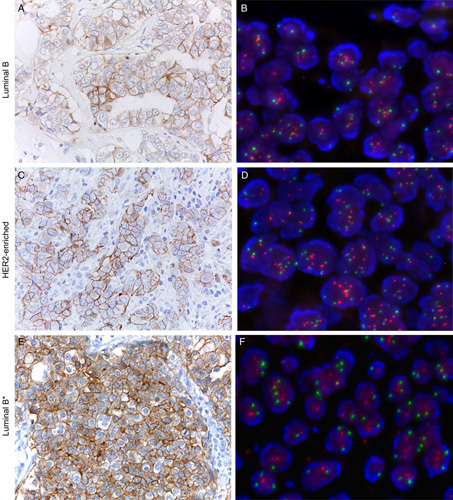
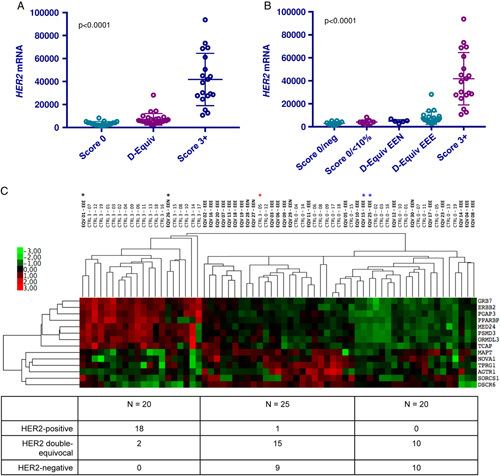
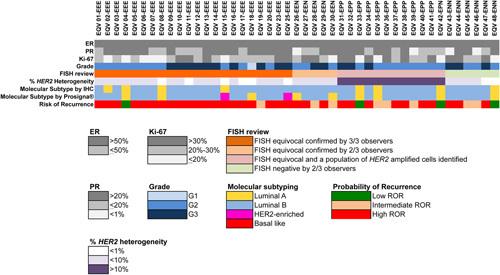
The American Society of Clinical Oncology/College of American Pathologists (ASCO/CAP) 2013 guidelines for HER2 assessment have increased the number of HER2 equivocal breast carcinomas following in situ hybridization reflex testing, that is, HER2 "double equivocal" (equivocal protein expression and equivocal gene copy number). Forty-five double-equivocal carcinomas were subjected to Prosigna analysis. Twenty-seven cases were investigated for the expression of genes found to be differentially expressed between estrogen receptor (ER)-positive/HER2-positive (N=22) and ER-positive/HER2-negative (N=22) control cases. Twenty-nine of the 45 cases were also analyzed by targeted sequencing using a panel of 14 genes. We then explored the pathologic complete response rates in an independent series of double-equivocal carcinoma patients treated with trastuzumab-containing chemotherapy. All cases were ER-positive, with a mean Ki67 of 28%. Double-equivocal carcinomas were predominantly luminal B (76%); 9 cases (20%) were luminal A, and 2 cases (4%) HER2-enriched. The majority (73%) showed a high risk of recurrence by Prosigna, even when the carcinomas were small (<2 cm), node-negative/micrometastatic, and/or grade 2. Double-equivocal carcinomas showed TP53 (6/29, 20%), PIK3CA (3/29, 10%), HER2 (1/29, 3%), and MAP2K4 (1/29, 3%) mutations. Compared with grade-matched ER-positive/HER2-negative breast carcinomas from METABRIC, double-equivocal carcinomas harbored more frequently TP53 mutations and less frequently PIK3CA mutations (P<0.05). No significant differences were observed with grade-matched ER-positive/HER2-positive carcinomas. Lower pathologic complete response rates were observed in double-equivocal compared with HER2-positive patients (10% vs. 60%, P=0.009). Double-equivocal carcinomas are preferentially luminal B and show a high risk of recurrence. A subset of these tumors can be labeled as HER2-enriched by transcriptomic analysis. HER2 mutations can be identified in HER2 double-equivocal cases.
美国临床肿瘤学会/美国病理学家协会(ASCO/CAP)2013 年 HER2 评估指南增加了原位杂交反射试验后 HER2 不确定的乳腺癌数量,即 HER2“双重不确定”(不确定的蛋白表达和不确定的基因拷贝数)。45 例 HER2 不确定的乳腺癌进行了 Prosigna 分析。27 例调查了在雌激素受体(ER)阳性/HER2 阳性(N=22)和 ER 阳性/HER2 阴性(N=22)对照病例中差异表达的基因的表达。45 例中有 29 例还通过靶向测序用 14 个基因的小组进行了分析。然后,我们探索了接受曲妥珠单抗化疗的双重不确定乳腺癌患者的病理完全缓解率。所有病例均为 ER 阳性,平均 Ki67 为 28%。双重不确定的乳腺癌主要为管腔 B 型(76%);9 例(20%)为管腔 A 型,2 例(4%)为 HER2 富集型。即使肿瘤较小(<2cm)、淋巴结阴性/微转移且/或分级 2 级,大多数(73%)仍通过 Prosigna 显示高复发风险。双重不确定的乳腺癌显示 TP53(6/29,20%)、PIK3CA(3/29,10%)、HER2(1/29,3%)和 MAP2K4(1/29,3%)突变。与 METABRIC 中分级匹配的 ER 阳性/HER2 阴性乳腺癌相比,双重不确定的乳腺癌更频繁地出现 TP53 突变,而较少出现 PIK3CA 突变(P<0.05)。与分级匹配的 ER 阳性/HER2 阳性乳腺癌相比,没有观察到显著差异。与 HER2 阳性患者相比,双重不确定患者的病理完全缓解率较低(10%比 60%,P=0.009)。双重不确定的乳腺癌优先为管腔 B 型,并显示出高复发风险。其中一部分肿瘤可以通过转录组分析标记为 HER2 富集型。可以在 HER2 不确定的病例中识别 HER2 突变。