School of Population and Public Health, University of British Columbia, Vancouver, Canada.
BC Centre for Disease Control, University of British Columbia, Vancouver, Canada.
BMC Public Health. 2018 Jul 5;18(1):834. doi: 10.1186/s12889-018-5765-2.
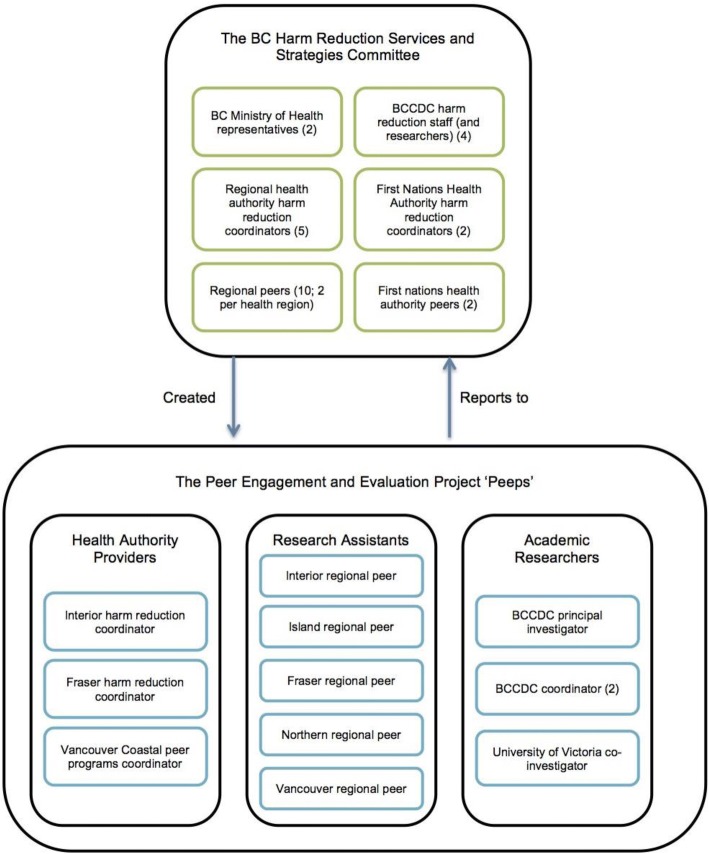
The Peer Engagement and Evaluation Project (PEEP) aimed to engage, inspire, and learn from peer leaders who represented voices of people who use or have used illicit substances, through active membership on the 'Peeps' research team. Given the lack of critical reflection in the literature about the process of engaging people who have used illicit substances in participatory and community-based research processes, we provide a detailed description of how one project, PEEP, engaged peers in a province-wide research project.
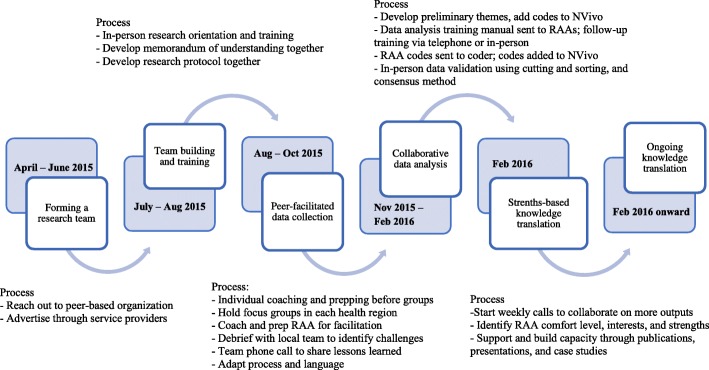
By applying the Peer Engagement Process Evaluation Framework, we critically analyze the intentions, strategies employed, and outcomes of the process utilized in the PEEP project and discuss the implications for capacity building and empowerment among the peer researchers. This process included: the formation of the PEEP team; capacity building; peer-facilitated data collection; collaborative data analysis; and, strengths-based approach to outputs.
Several lessons were learned from applying the Peer Engagement Process Evaluation Framework to the PEEP process. These lessons fall into themes of: recruiting and hiring; fair compensation; role and project expectations; communication; connection and collaboration; mentorship; and peer-facilitated research.
This project offers a unique approach to engaging people who use illicit substances and demonstrates how participation is an important endeavor that improves the relevance, capacity, and quality of research. Lessons learned in this project can be applied to future community-based research with people who use illicit substances or other marginalized groups and/or participatory settings.
同伴参与和评估项目(PEEP)旨在通过积极参与“Peeps”研究团队,让代表使用或曾经使用过非法药物的人的声音的同伴领袖参与进来,激励他们,并从他们那里学习。鉴于文献中缺乏对让使用非法药物的人参与参与式和社区为基础的研究过程的过程进行批判性反思,我们详细描述了一个项目,PEEP,如何让同伴参与全省范围的研究项目。
通过应用同伴参与过程评估框架,我们批判性地分析了 PEEP 项目中使用的过程的意图、所采用的策略和结果,并讨论了对同伴研究人员的能力建设和赋权的影响。这个过程包括:PEEP 团队的组建;能力建设;同伴主导的数据收集;合作数据分析;以及基于优势的产出方法。
从应用同伴参与过程评估框架到 PEEP 过程中,我们吸取了一些经验教训。这些教训分为以下几个主题:招聘和雇佣;公平薪酬;角色和项目期望;沟通;联系和合作;指导;以及同伴主导的研究。
这个项目提供了一种独特的方法来让使用非法药物的人参与进来,并展示了参与是一项重要的努力,它可以提高研究的相关性、能力和质量。在这个项目中吸取的经验教训可以应用于未来与使用非法药物的人或其他边缘化群体和/或参与式环境进行的社区为基础的研究。