Division of Systems Medical Science, Institute for Comprehensive Medical Science, Fujita Health University, 1-98 Dengakugakubo Kutsukake-cho, Toyoake, Aichi, 470-1192, Japan.
Addictive Substance Project, Tokyo Metropolitan Institute of Medical Science, Setagaya-ku, Tokyo, 156-8506, Japan.
Mol Brain. 2018 Jul 6;11(1):38. doi: 10.1186/s13041-018-0378-3.
Maturation abnormalities of the brain cells have been suggested in several neuropsychiatric disorders, including schizophrenia, bipolar disorder, autism spectrum disorders, and epilepsy. In this study, we examined the expression patterns of neuronal maturation markers in the brain of a mouse model of dementia with Lewy body-linked mutant β-synuclein (βS), especially in the hippocampus, to explore whether such brain abnormalities occur in neurodegenerative disorders as well.
Quantitative PCR (qPCR) and immunohistochemical analyses were performed using the hippocampus of 14-month-old P123H βS transgenic (Tg) mice to evaluate the expression of molecular markers for maturation of dentate granule cells.
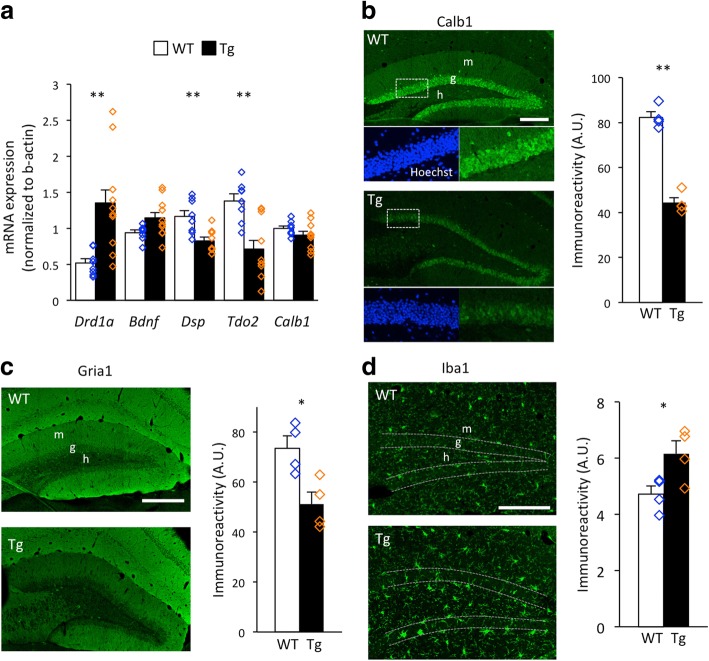
Based on qPCR results, expression of Tdo2 and Dsp (markers of mature granule cells) was decreased and that of Drd1a (a marker of immature granule cells) was increased in the hippocampus of P123H βS Tg mice compared to that in wild-type controls. Immunohistochemical analysis revealed decreased expression of mature granule cell markers Calb1 and Gria1, along with increased expression of the microglial marker Iba1, in the hippocampal dentate gyrus region of P123H βS Tg mice. P123H βS Tg mice exhibited immature-like neuronal molecular expression patterns and microgliosis in the hippocampus. Pseudo-immaturity of dentate granule cells, associated with neuroinflammation, may be a shared endophenotype in the brains of at least a subgroup of patients with neuropsychiatric disorders and neurodegenerative diseases.
在包括精神分裂症、双相情感障碍、自闭症谱系障碍和癫痫在内的几种神经精神疾病中,已经提出了脑细胞成熟异常的问题。在这项研究中,我们检查了与路易体相关的突变β-突触核蛋白(βS)的痴呆小鼠模型的大脑中神经元成熟标志物的表达模式,特别是在海马体中,以探讨这种脑异常是否也发生在神经退行性疾病中。
使用 14 个月大的 P123H βS 转基因(Tg)小鼠的海马体进行定量 PCR(qPCR)和免疫组织化学分析,以评估齿状回颗粒细胞成熟的分子标志物的表达。
根据 qPCR 结果,与野生型对照相比,P123H βS Tg 小鼠的海马体中 Tdo2 和 Dsp(成熟颗粒细胞标志物)的表达降低,而 Drd1a(不成熟颗粒细胞标志物)的表达增加。免疫组织化学分析显示,P123H βS Tg 小鼠的海马齿状回区成熟颗粒细胞标志物 Calb1 和 Gria1 的表达降低,而小胶质细胞标志物 Iba1 的表达增加。P123H βS Tg 小鼠表现出海马中类似未成熟的神经元分子表达模式和小胶质细胞增生。与神经炎症相关的齿状回颗粒细胞假性不成熟可能是至少一部分神经精神疾病和神经退行性疾病患者大脑的共同表型。