Suzuki Katsunori, Hasegawa Kazuki, Watanabe Mio
Division of Endocrinology and Metabolism, Saiseikai Niigata Daini Hospital, Niigata, Japan.
J Clin Med Res. 2018 Aug;10(8):641-647. doi: 10.14740/jocmr3456w. Epub 2018 Jun 27.
We administered once-weekly dipeptidyl peptidase-4 (DPP-4) inhibitor (W) (used omarigliptin as W in this study) to patients with type 2 diabetes taking once-daily DPP-4 inhibitor (D), and investigated efficacy, safety and patient satisfaction before and after switching to W.
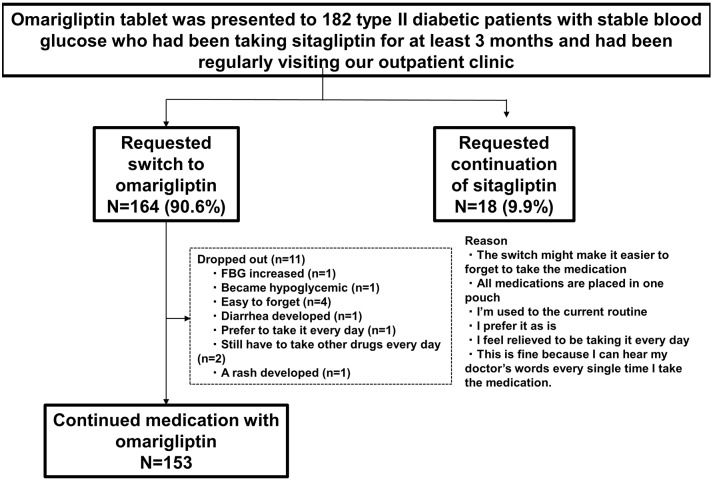
W was administered to 182 patients with type 2 diabetes taking D (used sitagliptin as D in this study), who had been visiting our hospital on an outpatient basis; 164 (90.6%) of these patients requested to switch medications. Of these 164 patients, this study investigated 153 who requested to continue taking W. Hemoglobin A1c (HbA1c) levels, body weight, blood pressure and a questionnaire survey (Diabetes Treatment Satisfaction Questionnaire (DTSQ)) were evaluated in these patients.
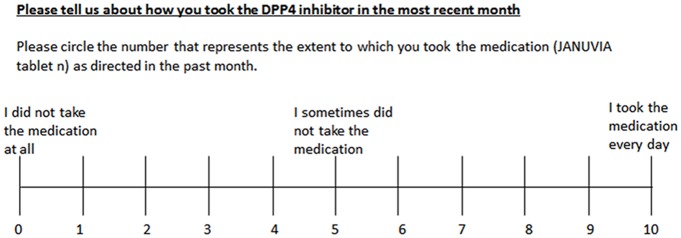
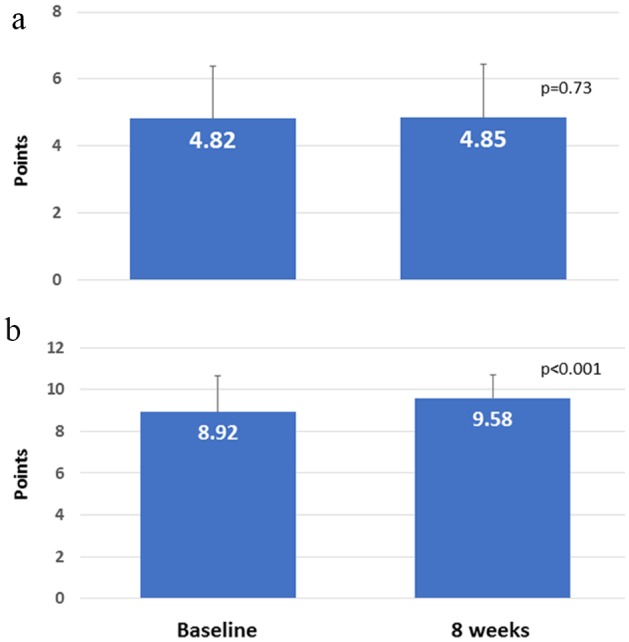
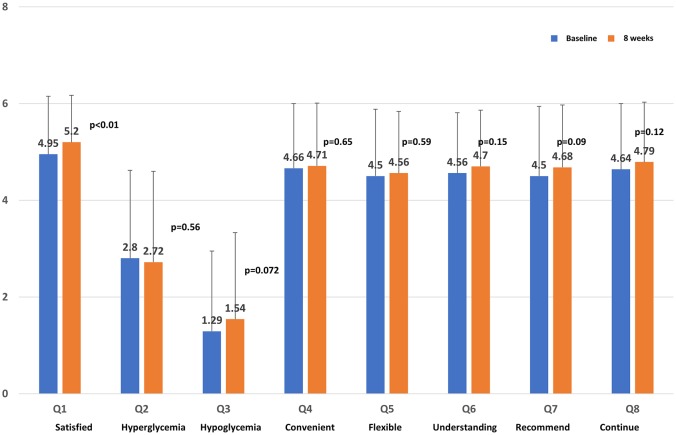
Patient characteristics were as follows: age, 63.9 ± 10.3; male/female ratio, 93:60; duration of diabetes, 14.9 ± 7.7 years; and body mass index (BMI), 25.5 ± 4.2 kg/m. After switching to W, HbA1c levels changed from 7.41 ± 0.7% to 7.36 ± 0.9%, which was not statistically significant. Changes in body weight, BMI, and systolic and diastolic blood pressure were also not significant. On the DTSQ, satisfaction of Q1 significantly increased (P < 0.01). The score for lifestyle assessment did not significantly change, but compliance significantly improved (P < 0.001).
This study revealed that 90% of patients taking D elected to switch to W. Moreover, patient satisfaction and compliance improved after switching to W. Increased satisfaction appeared to be influenced by improved blood glucose control, but was not associated with compliance. Switching from D to W did not affect HbA1c levels but improved patient adherence.
我们对每日服用一次二肽基肽酶-4(DPP-4)抑制剂(D)的2型糖尿病患者,给予每周一次的DPP-4抑制剂(W)(本研究中使用奥格列汀作为W),并在换用W前后调查疗效、安全性及患者满意度。
对182例门诊就诊的正在服用D(本研究中使用西他列汀作为D)的2型糖尿病患者给予W;其中164例(90.6%)患者要求换药。在这164例患者中,本研究调查了153例要求继续服用W的患者。对这些患者评估糖化血红蛋白(HbA1c)水平、体重、血压,并进行问卷调查(糖尿病治疗满意度问卷(DTSQ))。
患者特征如下:年龄63.9±10.3岁;男女比例93:60;糖尿病病程14.9±7.7年;体重指数(BMI)25.5±4.2kg/m。换用W后,HbA1c水平从7.41±0.7%变为7.36±0.9%,差异无统计学意义。体重、BMI、收缩压和舒张压的变化也无显著差异。在DTSQ中,问题1的满意度显著提高(P<0.01)。生活方式评估得分无显著变化,但依从性显著改善(P<0.001)。
本研究显示,90%服用D的患者选择换用W。此外,换用W后患者满意度和依从性得到改善。满意度增加似乎受血糖控制改善的影响,但与依从性无关。从D换用W未影响HbA1c水平,但改善了患者依从性。