Laboratorio de Neurobiología de la Conducta, Departamento de Fisiología, Facultad de Medicina, Universidad Nacional Autónoma de México, Mexico.
Departamento de Neuroquímica, SSA, Instituto Nacional de Neurología y Neurocirugía Manuel Velasco Suárez, Mexico City 14269, Mexico.
Oxid Med Cell Longev. 2018 May 24;2018:5272741. doi: 10.1155/2018/5272741. eCollection 2018.
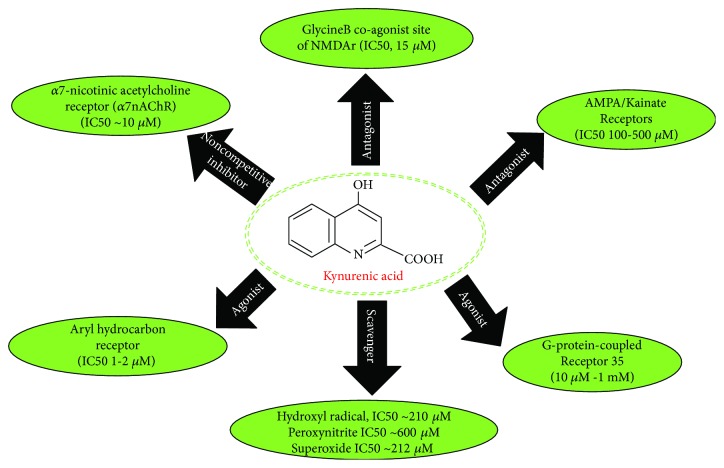
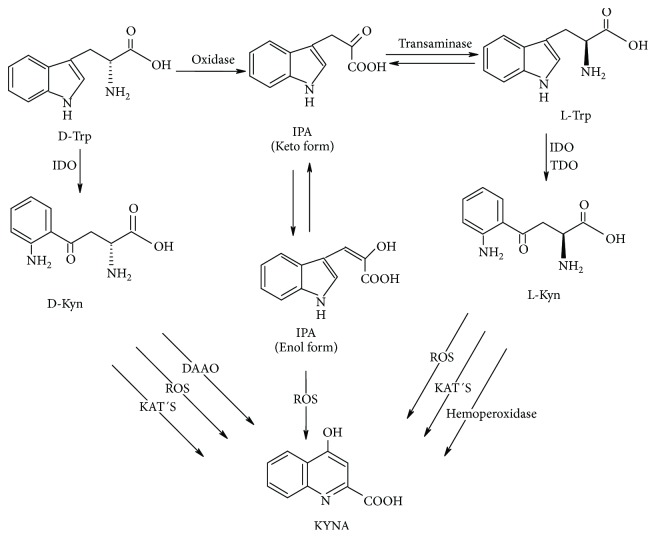
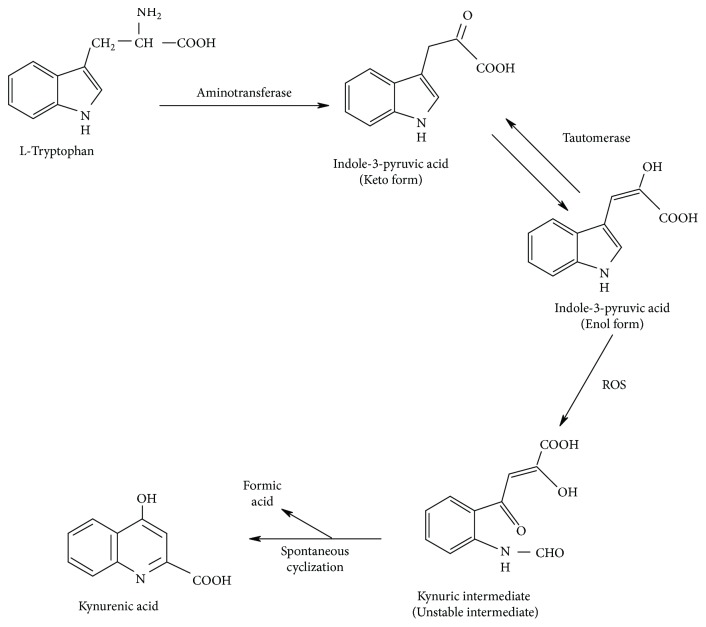
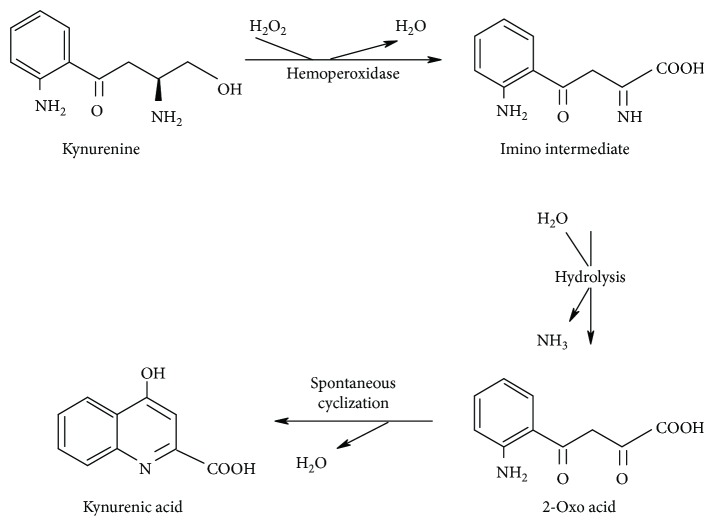
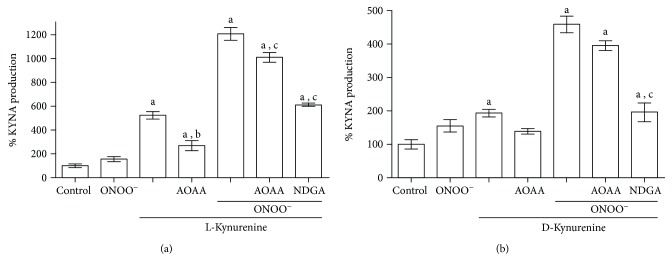
The catabolism of tryptophan has gained great importance in recent years due to the fact that the metabolites produced during this process, with neuroactive and redox properties, are involved in physiological and pathological events. One of these metabolites is kynurenic acid (KYNA), which is considered as a neuromodulator since it can interact with NMDA, nicotinic, and GPR35 receptors among others, modulating the release of neurotransmitters as glutamate, dopamine, and acetylcholine. Kynureninate production is attributed to kynurenine aminotransferases. However, in some physiological and pathological conditions, its high production cannot be explained just with kynurenine aminotransferases. This review focuses on the alternative mechanism whereby KYNA can be produced, either from D-amino acids or by means of other enzymes as D-amino acid oxidase or by the participation of free radicals. It is important to mention that an increase in KYNA levels in processes as brain development, aging, neurodegenerative diseases, and psychiatric disorders, which share common factors as oxidative stress, inflammation, immune response activation, and participation of gut microbiota that can also be related with the alternative routes of KYNA production, has been observed.
色氨酸的分解代谢近年来受到了极大的重视,因为在这个过程中产生的具有神经活性和氧化还原性质的代谢物参与了生理和病理事件。这些代谢物之一是犬尿酸(KYNA),它被认为是一种神经调质,因为它可以与 NMDA、烟碱和 GPR35 受体等相互作用,调节神经递质如谷氨酸、多巴胺和乙酰胆碱的释放。犬尿酸的产生归因于犬尿氨酸氨基转移酶。然而,在一些生理和病理条件下,其高产量不能仅仅用犬尿氨酸氨基转移酶来解释。这篇综述集中讨论了 KYNA 可以通过其他酶如 D-氨基酸氧化酶或通过自由基的参与,从 D-氨基酸或通过其他酶产生的替代机制。值得一提的是,在脑发育、衰老、神经退行性疾病和精神障碍等过程中,KYNA 水平的增加已经被观察到,这些过程有一些共同的因素,如氧化应激、炎症、免疫反应激活和肠道微生物群的参与,这也可能与 KYNA 产生的替代途径有关。