van der Lubbe Joan E M, Huizingh Jeroen, Verspuij Johan W A, Tettero Lisanne, Schmit-Tillemans Sonja P R, Mooij Petra, Mortier Daniella, Koopman Gerrit, Bogers Willy M J M, Dekking Liesbeth, Meijberg Wim, Kwaks Ted, Brandenburg Boerries, Tolboom Jeroen T B M, Schuitemaker Hanneke, Roozendaal Ramon, Kuipers Harmjan, Zahn Roland C
Janssen Vaccines and Prevention, Pharmaceutical Companies of Johnson and Johnson, Archimedesweg 4-6, 2333 CN Leiden, The Netherlands.
2Department of Virology, Biomedical Primate Research Centre, P.O. Box 3306, 2280 GH Rijswijk, The Netherlands.
NPJ Vaccines. 2018 Jul 3;3:25. doi: 10.1038/s41541-018-0063-7. eCollection 2018.
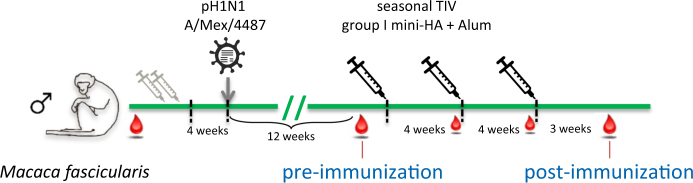
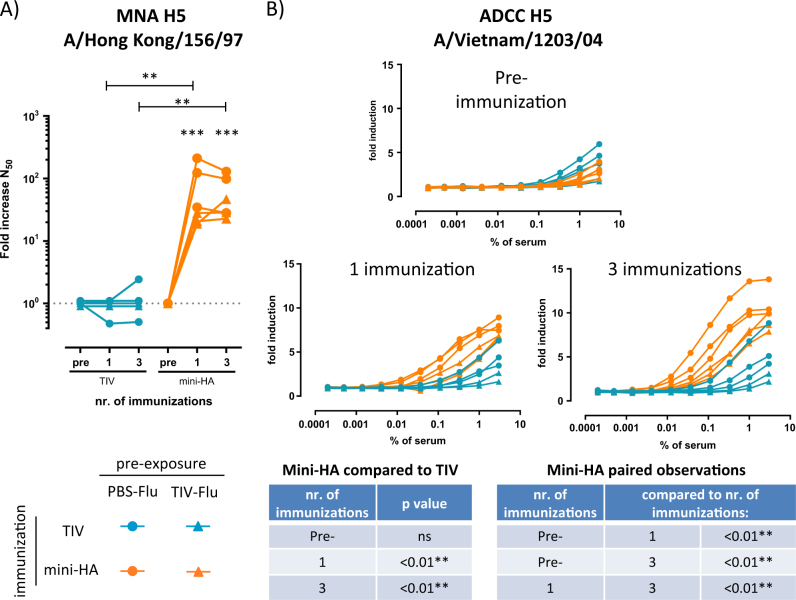
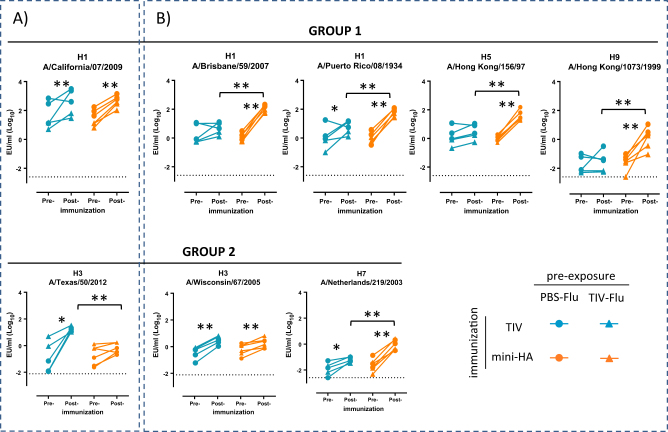
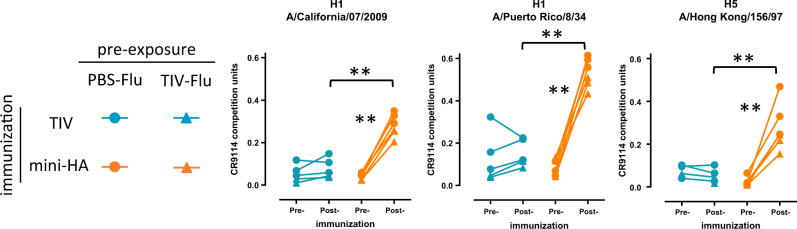
Seasonal vaccines are currently the most effective countermeasure against influenza. However, seasonal vaccines are only effective against strains closely related to the influenza strains contained in the vaccine. Recently a new hemagglutinin (HA) stem-based antigen, the so-called "mini-HA", has been shown to induce a cross-protective immune response in influenza-naive mice and non-human primates (NHP). However, prior exposure to influenza can have a profound effect on the immune response to subsequent influenza infection and the protective efficacy of vaccination. Here we show that mini-HA, compared to a trivalent influenza vaccine (TIV), elicits a broadened influenza-specific humoral immune response in NHP previously exposed to influenza. Serum transfer experiments showed that antibodies induced by both mini-HA and seasonal vaccine protected mice against lethal challenge with a H1N1 influenza strain heterologous to the H1 HA included in the TIV. However, antibodies elicited by mini-HA showed an additional benefit of protecting mice against lethal heterosubtypic H5N1 influenza challenge, associated with H5 HA-specific functional antibodies.
季节性疫苗是目前对抗流感最有效的对策。然而,季节性疫苗仅对与疫苗中所含流感毒株密切相关的毒株有效。最近,一种新的基于血凝素(HA)茎部的抗原,即所谓的“微型HA”,已被证明能在未接触过流感的小鼠和非人类灵长类动物(NHP)中诱导交叉保护性免疫反应。然而,先前接触流感会对后续流感感染的免疫反应和疫苗接种的保护效果产生深远影响。在此我们表明,与三价流感疫苗(TIV)相比,微型HA在先前接触过流感的NHP中引发了更广泛的流感特异性体液免疫反应。血清转移实验表明,微型HA和季节性疫苗诱导的抗体均可保护小鼠免受与TIV中包含的H1 HA异源的H1N1流感毒株的致死性攻击。然而,微型HA诱导的抗体显示出额外的益处,即保护小鼠免受致死性异亚型H5N1流感攻击,这与H5 HA特异性功能性抗体有关。