Kim Seong Woo, Jeon Ha Ra, Shin Ji Cheol, Youk Taemi, Kim Jiyong
Department of Physical Medicine and Rehabilitation, National Health Insurance Service Ilsan Hospital, Goyang, Korea.
Department of Rehabilitation Medicine and Research Institute of Rehabilitation Medicine, Yonsei University College of Medicine, Seoul, Korea.
Yonsei Med J. 2018 Aug;59(6):781-786. doi: 10.3349/ymj.2018.59.6.781.
Cerebral palsy (CP) is a neurodevelopmental disorder that causes serious disability. Prematurity and low birth weight (LBW) are known to be the strongest risk factors of CP. While socioeconomic status (SES) has been found to influence the occurrence of CP, prematurity, and LBW, no studies have investigated this effect in Korea. The aim of this study was to evaluate the incidence of CP, prematurity, and LBW in Korea, as well as the effect of SES thereon.
Data were obtained from the National Health Information Database from 2007 to 2013; persons with a history of CP, prematurity, and LBW were investigated by year. SES was defined in accordance with income quintiles, birth regions, and coverage classification.
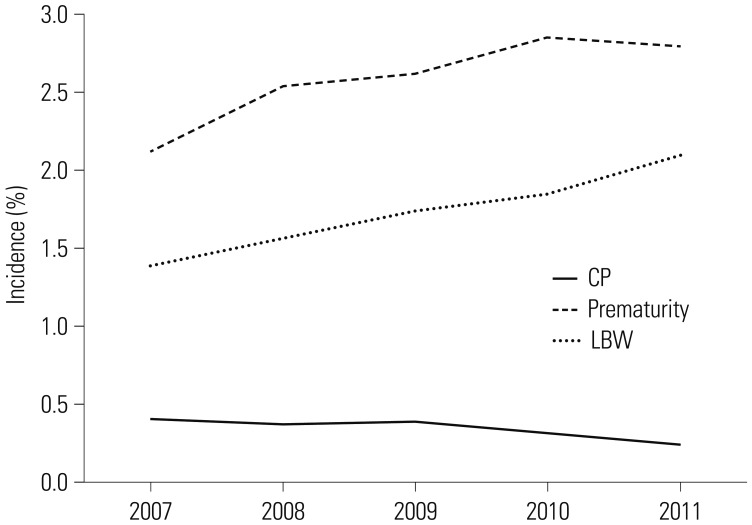
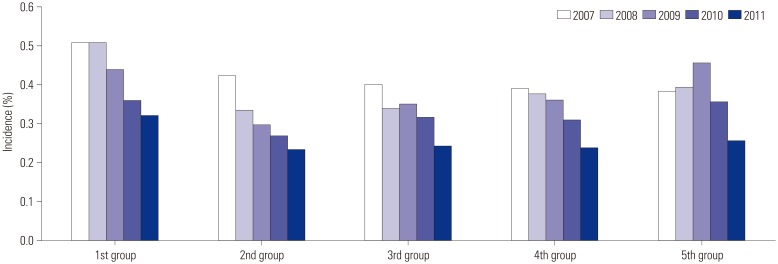
The incidence of CP decreased over the last five years, despite increased rates of prematurity and LBW. CP incidence was significantly lower in affluent groups than in the most deprived group, although this difference disappeared after controlling for confounders. The incidence of CP was significantly higher in medical aid beneficiaries, even after controlling for confounders.
CP incidence in Korea has decreased over the last five years, despite an increase in high-risk deliveries. Income level had no effect in CP incidence. These results may aid CP management and prevention policies.
脑瘫(CP)是一种导致严重残疾的神经发育障碍。早产和低出生体重(LBW)是已知的脑瘫最强风险因素。虽然社会经济地位(SES)已被发现会影响脑瘫、早产和低出生体重的发生,但在韩国尚未有研究调查这种影响。本研究的目的是评估韩国脑瘫、早产和低出生体重的发生率,以及社会经济地位对其的影响。
数据来自2007年至2013年的国家健康信息数据库;按年份对有脑瘫、早产和低出生体重病史的人进行调查。社会经济地位根据收入五分位数、出生地区和医保覆盖分类来定义。
尽管早产和低出生体重率有所上升,但在过去五年中脑瘫的发生率有所下降。富裕群体中的脑瘫发生率显著低于最贫困群体,不过在控制混杂因素后这种差异消失了。即使在控制混杂因素后,医疗救助受益人的脑瘫发生率仍显著较高。
尽管高危分娩有所增加,但韩国在过去五年中脑瘫发生率有所下降。收入水平对脑瘫发生率没有影响。这些结果可能有助于脑瘫管理和预防政策的制定。