Haskell Libby, Tavender Emma J, Wilson Catherine, O'Brien Sharon, Babl Franz E, Borland Meredith L, Cotterell Liz, Schuster Tibor, Orsini Francesca, Sheridan Nicolette, Johnson David, Oakley Ed, Dalziel Stuart R
Children's Emergency Department, Starship Children's Hospital, Private Bag 92024, Auckland, 1142, New Zealand.
University of Auckland, Auckland, New Zealand.
BMC Pediatr. 2018 Jul 6;18(1):218. doi: 10.1186/s12887-018-1187-7.
Bronchiolitis is the most common reason for admission to hospital for infants less than one year of age. Although management is well defined, there is substantial variation in practice, with infants receiving ineffective therapies or management. This study will test the effectiveness of tailored, theory informed knowledge translation (KT) interventions to decrease the use of five clinical therapies or management processes known to be of no benefit, compared to usual dissemination practices in infants with bronchiolitis. The primary objective is to establish whether the KT interventions are effective in increasing compliance to five evidence based recommendations in the first 24 h following presentation to hospital. The five recommendations are that infants do not receive; salbutamol, antibiotics, glucocorticoids, adrenaline, or a chest x-ray.
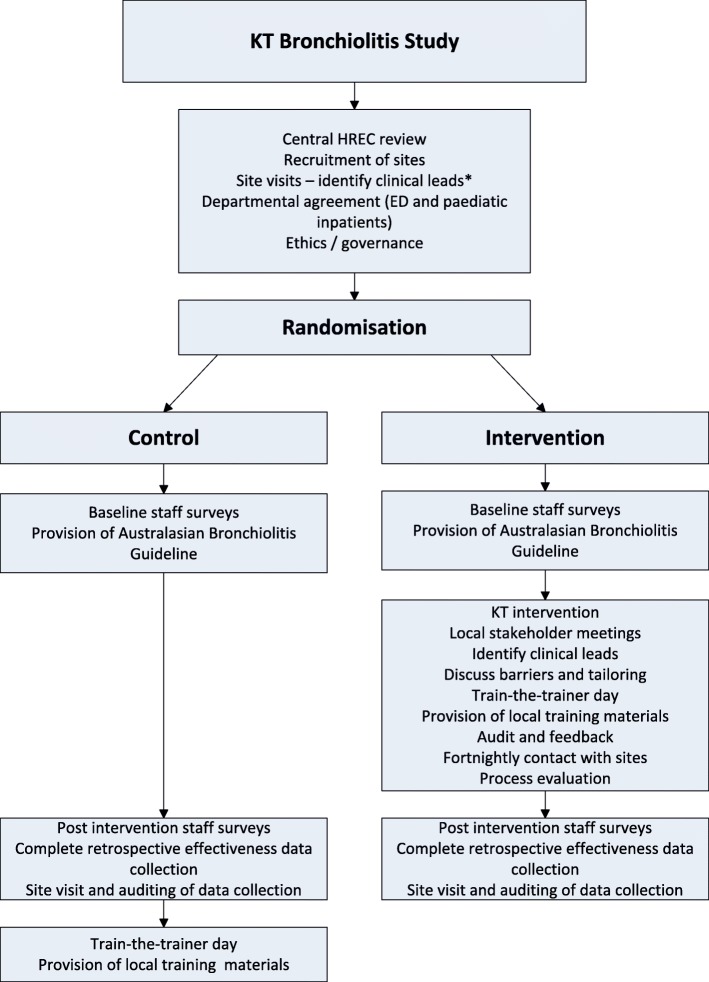
METHODS/DESIGN: This study is designed as a cluster randomised controlled trial. We will recruit 24 hospitals in Australia and New Zealand, stratified by country and provision of tertiary or secondary paediatric care. Hospitals will be randomised to either control or intervention groups. Control hospitals will receive a copy of the recent Australasian Bronchiolitis Guideline. Intervention hospitals will receive KT interventions informed by a qualitative analysis of factors influencing clinician care of infants with bronchiolitis. Key interventions include, local stakeholder meetings, identifying medical and nursing clinical leads in both emergency departments and paediatric inpatient areas who will attend a single education train-the-trainer day to then deliver standardised staff education with the training materials provided and coordinate audit and feedback reports locally over the study period. Data will be extracted retrospectively for three years prior to the study intervention year, and for seven months of the study intervention year bronchiolitis season following intervention delivery to determine compliance with the five evidence-based recommendations. Data will be collected to assess fidelity to the implementation strategies and to facilitate an economic evaluation.
This study will contribute to the body of knowledge to determine the effectiveness of tailored, theory informed interventions in acute care paediatric settings, with the aim of reducing the evidence to practice gaps in the care of infants with bronchiolitis.
Australian New Zealand Clinical Trials Registry ACTRN12616001567415 (retrospectively registered on 14 November 2016).
细支气管炎是1岁以下婴儿住院的最常见原因。尽管管理方法明确,但实际操作存在很大差异,婴儿接受的是无效治疗或管理。本研究将测试量身定制的、基于理论的知识转化(KT)干预措施的有效性,与细支气管炎婴儿的常规传播做法相比,减少使用已知无益的五种临床治疗或管理流程。主要目标是确定KT干预措施是否能有效提高在入院后24小时内对五项循证建议的依从性。这五项建议是婴儿不接受沙丁胺醇、抗生素、糖皮质激素、肾上腺素或胸部X光检查。
方法/设计:本研究设计为整群随机对照试验。我们将在澳大利亚和新西兰招募24家医院,按国家以及是否提供三级或二级儿科护理进行分层。医院将被随机分为对照组或干预组。对照医院将收到一份最新的《澳大利亚细支气管炎指南》。干预医院将接受基于对影响细支气管炎婴儿临床护理因素的定性分析的KT干预措施。关键干预措施包括,当地利益相关者会议,确定急诊科和儿科住院区的医疗和护理临床负责人,他们将参加一次单一的教育培训师培训日活动,然后使用提供的培训材料进行标准化的员工教育,并在研究期间在当地协调审核和反馈报告。在研究干预年之前的三年以及研究干预年干预措施实施后的七个月细支气管炎季节,将进行回顾性数据提取,以确定对五项循证建议的依从性。将收集数据以评估对实施策略的忠诚度,并促进经济评估。
本研究将为确定量身定制的、基于理论的干预措施在急性护理儿科环境中的有效性贡献知识,目的是缩小细支气管炎婴儿护理中证据与实践之间的差距。
澳大利亚新西兰临床试验注册中心ACTRN12616001567415(于2016年11月14日追溯注册)。