Uchiyama Shinichiro, Atarashi Hirotsugu, Inoue Hiroshi, Kitazono Takanari, Yamashita Takeshi, Shimizu Wataru, Ikeda Takanori, Kamouchi Masahiro, Kaikita Koichi, Fukuda Koji, Origasa Hideki, Shimokawa Hiroaki
Center for Brain and Cerebral Vessels, Sanno Hospital and Sanno Medical Center, International University of Health and Welfare, 8-5-35 Akasaka, Minato-ku, Tokyo, 107-0052, Japan.
Minamihachioji Hospital, 3-18-12 Koyasu-cho, Hachioji, Tokyo, 192-0904, Japan.
Heart Vessels. 2019 Jan;34(1):141-150. doi: 10.1007/s00380-018-1219-0. Epub 2018 Jul 6.
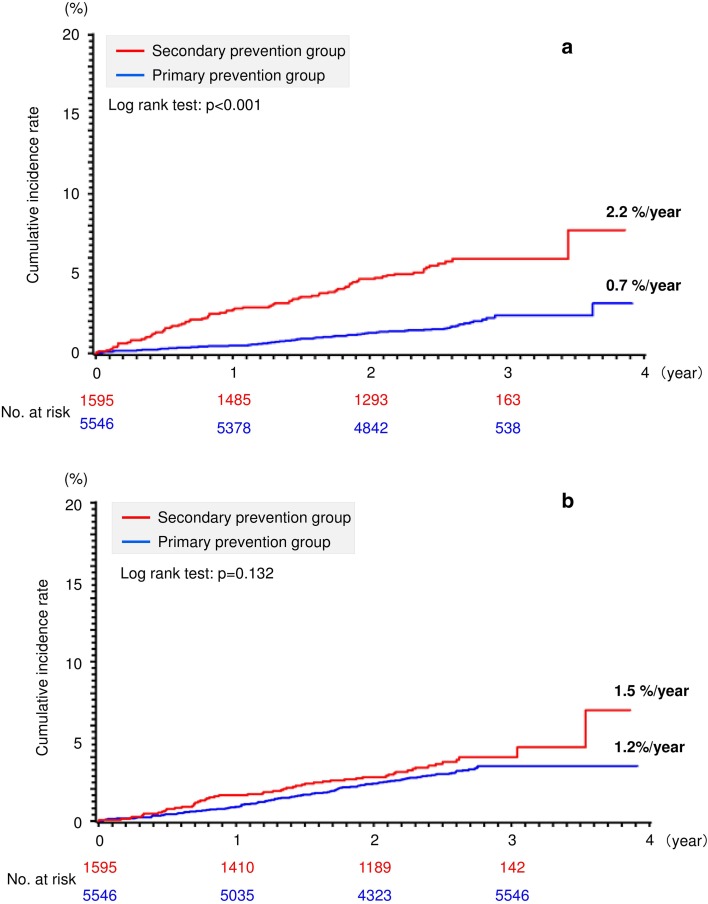
The EXPAND Study examined the real-world efficacy and safety of rivaroxaban for the prevention of stroke and systemic embolism (SE) in Japanese patients with non-valvular atrial fibrillation (NVAF). In this sub-analysis, we compared the differences in efficacy and safety between patients with and those without history of stroke or transient ischemic attack (TIA). This multicenter, prospective, non-interventional, observational, cohort study was conducted at 684 medical centers in Japan. A total of 7141 NVAF patients aged ≥ 20 years [mean age 71.6 ± 9.4 (SD) years] who were being or planned to be treated with rivaroxaban (10 mg/day, 43.5%; 15 mg/day, 56.5%) were followed for a mean period of 897.1 ± 206.8 days with a high follow-up rate (99.7%). The primary prevention group comprised patients without history of ischemic stroke or TIA (n = 5546, 77.7%), and the secondary prevention group comprised those with history of ischemic stroke or TIA (n = 1595, 22.3%). In the primary and secondary prevention groups, the incidence rate of stroke or SE (primary efficacy endpoint) was 0.7 and 2.2%/year, respectively (P < 0.001), and the incidence rate of major bleeding (primary safety endpoint) was 1.2 and 1.5%/year, respectively (P = 0.132). For major bleeding events, the incidence rate of intracranial bleeding was 0.4 and 0.8%/year (P = 0.002) in the primary and secondary prevention groups, respectively. This sub-analysis of the EXPAND Study showed that the Japan-specific dosages of rivaroxaban were effective and safe in Japanese NVAF patients with and those without ischemic stroke or TIA in routine clinical practice.
EXPAND研究调查了利伐沙班在日本非瓣膜性心房颤动(NVAF)患者中预防中风和全身性栓塞(SE)的真实疗效和安全性。在这项亚分析中,我们比较了有中风或短暂性脑缺血发作(TIA)病史的患者与无此类病史的患者在疗效和安全性方面的差异。这项多中心、前瞻性、非干预性、观察性队列研究在日本的684个医疗中心进行。共有7141名年龄≥20岁的NVAF患者[平均年龄71.6±9.4(标准差)岁]正在接受或计划接受利伐沙班治疗(10毫克/天,43.5%;15毫克/天,56.5%),平均随访897.1±206.8天,随访率很高(99.7%)。一级预防组包括无缺血性中风或TIA病史的患者(n = 5546,77.7%),二级预防组包括有缺血性中风或TIA病史的患者(n = 1595,22.3%)。在一级和二级预防组中,中风或SE(主要疗效终点)的发生率分别为0.7%和2.2%/年(P < 0.001),大出血(主要安全终点)的发生率分别为1.2%和1.5%/年(P = 0.132)。对于大出血事件,一级和二级预防组颅内出血的发生率分别为0.4%和0.8%/年(P = 0.002)。EXPAND研究的这项亚分析表明,在常规临床实践中,利伐沙班的日本特定剂量对有或无缺血性中风或TIA的日本NVAF患者有效且安全。