Hernandez-Pacheco Natalia, Guillen-Guio Beatriz, Acosta-Herrera Marialbert, Pino-Yanes Maria, Corrales Almudena, Ambrós Alfonso, Nogales Leonor, Muriel Arturo, González-Higueras Elena, Diaz-Dominguez Francisco J, Zavala Elizabeth, Belda Javier, Ma Shwu-Fan, Villar Jesús, Flores Carlos
Research Unit, Hospital Universitario N.S. de Candelaria, Universidad de La Laguna, Santa Cruz de Tenerife, Spain.
Research Unit, Hospital Universitario Dr. Negrin, Las Palmas de Gran Canaria, Spain.
Intensive Care Med Exp. 2018 Jul 9;6(1):16. doi: 10.1186/s40635-018-0181-6.
The acute respiratory distress syndrome (ARDS) is one of the main causes of mortality in adults admitted to intensive care units. Previous studies have demonstrated the existence of genetic variants involved in the susceptibility and outcomes of this syndrome. We aimed to identify novel genes implicated in sepsis-induced ARDS susceptibility.
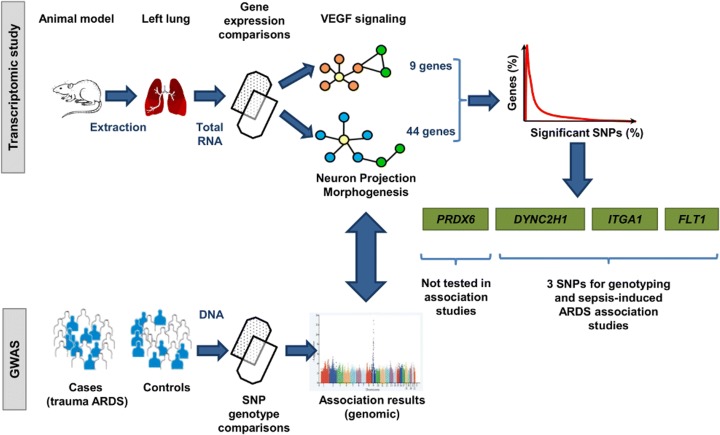
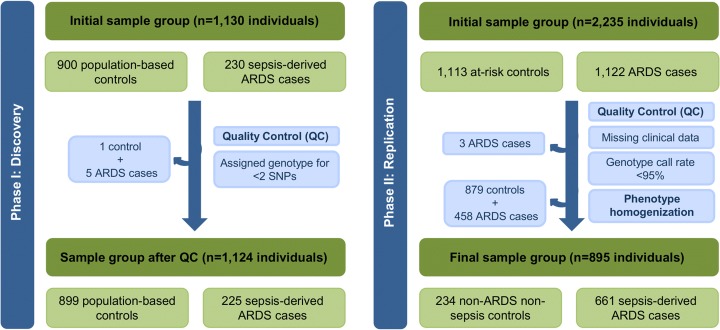
We first performed a prioritization of candidate genes by integrating our own genomic data from a transcriptomic study in an animal model of ARDS and from the only published genome-wide association study of ARDS study in humans. Then, we selected single nucleotide polymorphisms (SNPs) from prioritized genes to conduct a case-control discovery association study in patients with sepsis-induced ARDS (n = 225) and population-based controls (n = 899). Finally, we validated our findings in an independent sample of 661 sepsis-induced ARDS cases and 234 at-risk controls.
Three candidate genes were prioritized: dynein cytoplasmic-2 heavy chain-1, fms-related tyrosine kinase 1 (FLT1), and integrin alpha-1. Of those, a SNP from FLT1 gene (rs9513106) was associated with ARDS in the discovery study, with an odds ratio (OR) for the C allele of 0.76, 95% confidence interval (CI) 0.58-0.98 (p = 0.037). This result was replicated in an independent study (OR = 0.78, 95% CI = 0.62-0.98, p = 0.039), showing consistent direction of effects in a meta-analysis (OR = 0.77, 95% CI = 0.65-0.92, p = 0.003).
We identified FLT1 as a novel ARDS susceptibility gene and demonstrated that integration of genomic data can be a valid procedure to identify novel susceptibility genes. These results contribute to previous firm associations and functional evidences implicating FLT1 gene in other complex traits that are mechanistically linked, through the key role of endothelium, to the pathophysiology of ARDS.
急性呼吸窘迫综合征(ARDS)是入住重症监护病房的成人患者主要死亡原因之一。既往研究已证实存在与该综合征易感性及预后相关的基因变异。我们旨在识别与脓毒症诱导的ARDS易感性相关的新基因。
我们首先通过整合来自ARDS动物模型转录组研究的自身基因组数据以及人类ARDS唯一已发表的全基因组关联研究数据,对候选基因进行优先级排序。然后,我们从优先级基因中选择单核苷酸多态性(SNP),在脓毒症诱导的ARDS患者(n = 225)和基于人群的对照(n = 899)中进行病例对照发现关联研究。最后,我们在661例脓毒症诱导的ARDS病例和234例高危对照的独立样本中验证了我们的发现。
三个候选基因被优先排序:动力蛋白胞质2重链1、fms相关酪氨酸激酶1(FLT1)和整合素α1。其中,发现研究中FLT1基因的一个SNP(rs9513106)与ARDS相关,C等位基因的优势比(OR)为0.76,95%置信区间(CI)为0.58 - 0.98(p = 0.037)。该结果在一项独立研究中得到重复(OR = 0.78,95% CI = 0.62 - 0.98,p = 0.039),在荟萃分析中显示出一致的效应方向(OR = 0.77,95% CI = 0.65 - 0.92,p = 0.003)。
我们将FLT1鉴定为一个新的ARDS易感基因,并证明整合基因组数据是识别新的易感基因的有效方法。这些结果为先前将FLT1基因与其他复杂性状相关联的确凿关联和功能证据做出了贡献,这些复杂性状通过内皮的关键作用在机制上与ARDS的病理生理学相关。